
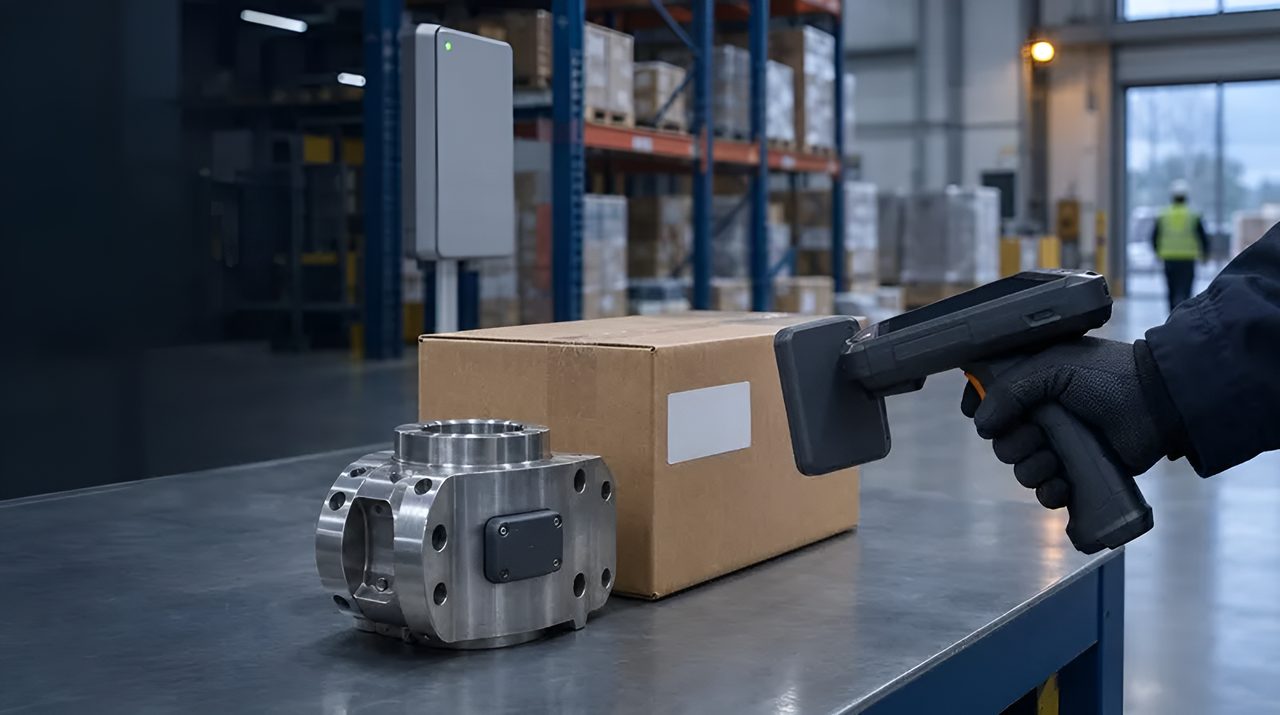
"RFID" is not one technology. It is a family of three quite different things that share a name, a few standards, and almost nothing else commercially. Picking the wrong family is the single most expensive mistake we see in early-stage programmes.
This guide is the short version of the conversation we have at the start of every feasibility engagement.
Passive RFID (a.k.a. Passive RFID, EPC Gen2v2)
Passive tags have no battery. They harvest energy from the reader's RF field and reflect a modulated response. That single design decision (no battery) cascades into everything that makes passive RFID what it is.
Strengths
- Tags cost 3-30 cents in volume. Item-level deployment becomes economically viable.
- Tag form factor is small and flexible: paper labels, fabric inlays, on-metal, in-laundry.
- Effectively unlimited lifespan: no battery to deplete.
- Standardised globally as Passive RFID (GS1 EPC Gen2v2 / ISO/IEC 18000-63).
Weaknesses
- Read range typically 2-10 metres. RF environment matters a lot.
- Liquids and metals attenuate or detune the tag. Specialty inlays solve this but cost more.
- The tag does not initiate anything. You need a reader in range to see it. That drives infrastructure capex.
When to choose
Item-level inventory (retail, DC), dock-door reconciliation, returnable container tracking, work-in-progress at production cells, asset cycle-counting, healthcare consumables, tool-cribs without movement requirements, supply-chain traceability.
Semi-passive RFID (battery-assisted passive)
The tag has a small battery to power onboard logic (memory, a sensor, a clock) but still uses the reader's energy to communicate. A pragmatic middle ground that often gets overlooked.
Strengths
- Adds sensors: temperature, humidity, shock, light, tamper.
- Longer effective read range than passive: the battery powers the IC even when reader signal is weak.
- Lower noise floor than active tags because they don't transmit on their own clock.
Weaknesses
- Battery life 2-7 years depending on duty cycle.
- Hardware prices come from supplier quotes in the survey. Still requires reader infrastructure.
When to choose
Cold-chain monitoring (pharma, food), shock-sensitive transit (electronics, defence), long-dwell asset tags where sensor logs matter, environmental compliance in regulated industries.
Active RFID
The tag has its own radio and battery. It transmits independently, either on a schedule or when triggered by an event. Functionally closer to a small IoT device than to a passive RFID tag.
Strengths
- Read range 30-300+ metres depending on power class and frequency.
- Tag-initiated reporting: you don't need readers everywhere.
- Onboard processor, memory, often sensors. Real edge logic possible.
- Long range means much less reader infrastructure capex over a large site.
Weaknesses
- Hardware prices come from supplier quotes in the survey. Item-level economics break.
- Battery life 3-5 years; replacement is operational overhead.
- Bigger, heavier tags, not appropriate for laundry, consumables, or anything price-sensitive.
- Spectrum and channel coexistence become real engineering problems at scale.
When to choose
Mobile medical equipment, vehicles, large reusable assets, lone-worker safety, mustering, large outdoor yards, defence personnel accountability.
Anywhere the asset value is high enough to absorb the tag cost and the area is large enough that passive-reader density becomes uneconomic.
The 60-second decision
Most decisions reduce to four questions:
- What does the asset cost? Hardware prices come from supplier quotes in the survey.
- How big is the area? A 200 m × 200 m yard with passive RFID needs hundreds of readers. With active, two dozen.
- Do you need a sensor on the tag? Cold chain, shock, tamper → semi-passive or active.
- Do you need the tag to initiate? Lone-worker SOS, geofence exit, periodic location update → active.
The hybrid pattern
The most powerful production deployments don't pick one. They use passive RFID at choke points (dock doors, cell entry, tool crib) for cheap per-event identity, and active or UWB for continuous tracking of high-value assets in zones where it matters.
The cost curve is dramatically better than picking either alone.
That's where independent architecture matters. If you're locked into one supplier's stack you tend to be locked into one tag family. We design for the hybrid case from the start.
Book a free scoping call to talk through your site and your use case. Our technology-selection engagements typically take 4-6 weeks and produce a tag-by-tag, reader-by-reader specification with TCO modelled.
Tag selection for locating and identity programmes
Tag family choice is a locating and physics decision, not a catalogue preference. Passive UHF (RAIN / Gen2) wins on cost and maintenance for gate and inventory identity; battery-assisted passive helps when more forward sensitivity is needed without full active beacons; active tags (including BLE/UWB form factors in modern stacks) enable continuous RTLS. On-metal and liquid-tolerant designs are mandatory when the asset or product would otherwise detune a commodity inlay.
Trial tags on the real SKU mix and mount points before freezing the BOM. At high unit volumes, tag unit cost and application labour dominate TCO, which is why many logistics programmes stay Passive RFID at docks even when a supplier pushes site-wide active RTLS. Document orientation rules; a perfect reader design still fails if labels face the wrong way inside pallet wrap.