
All services: independent RTLS and RFID advice, from supplier selection to programme recovery.
Choose the technology and supplier, prove it in a pilot, and recover programmes that have stalled, led by our advisers at every step. We don't sell hardware, so our advice stays independent.
What each stakeholder gets from an engagement
Drop us in at any stage. Everyone who has to sign off sees a straight answer.
What that covers: RTLS consulting, Auto-ID and RFID selection, independent RFP support, pilot design, implementation assurance and PMO, programme rescue and managed care.
A defensible business case
Outcomes, payback and a gate-governed plan that ships, not another stalled pilot.
Clear scope, clear payback
Independent selection, published fee ranges and deployment certainty.
Architecture & clean integration
The right radio for the physics, scalable architecture and integration into WMS, ERP, EMR or MES.
Workflows people will use
Designed with the people who use them: faster searches, fewer missed steps, helpful safety.
The five engagement stages of an RTLS / RFID programme.
Most programmes move through five stages: Assess, Select, Pilot, Integrate, Roll out. Each ends at a gate, so you only commit to the next step once the previous one has paid off. The service areas further down this page are the work that sits inside these stages.
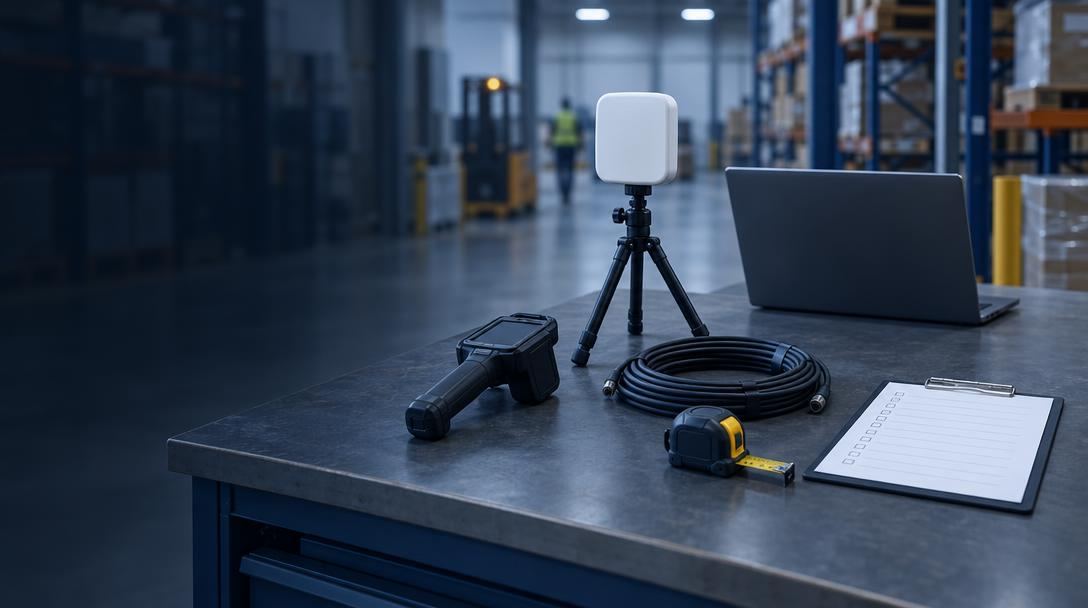
Rental pilot equipment is available for trials, so you commit no capex until you've seen the result.
Assess
Pin down use cases, KPIs, constraints and site conditions, including an RF site survey, before anything is bought.
Scoped and priced per project.
Select
Compare the technologies and suppliers that fit your site, run the RFP and score the answers, on your side of the table.
Scoped and priced per project.
Pilot
Prove it on site against pass/fail criteria agreed in writing first, on rental pilot equipment, ending in a clear go or no-go.
Scoped and priced per project.
Integrate
Connect locating data to your WMS, ERP, MES or EMR with a clean architecture, a security review and acceptance tests.
Scoped and priced per project.
Roll out
Scale across sites and lines with a repeatable playbook, change management, go-live and hypercare support.
Scoped and priced per project.
Rental pilot equipment for trials.
Run your trial or pilot on rented equipment instead of buying the wrong thing. We provide independent rental equipment across UWB, BLE, RAIN and Active RFID, GPS / GNSS and LoRaWAN (anchors, readers, tags and gateways), with no capex and no lock-in. Pilot equipment is TRACIO-owned and rented for evaluation, never sold: when the pilot ends it comes back, and you buy the production system direct from the supplier you choose.
Book a free scoping callEvery engagement is scoped per project and priced in writing before work starts. No packages. TRACIO consultancy fees: UK £3k to £30k per project, £1,200 a day · Europe €3.5k to €35k per project, €1,400 a day · US and Canada $4k to $40k per project, $1,600 a day · Middle East and Australia $4k to $40k per project, $1,600 a day · Rest of the world $3.5k to $35k per project, $1,400 a day. Fees cover our work only; hardware, software licences and other supplier costs are separate. $ = US dollars. Travel extra.
Advisory services, scoped per project.
Focused pieces of work, each scoped to your project and confirmed in writing before it starts.
Supplier Selection & RFP Support
Requirements, shortlist, RFP questions, scoring matrix, TCO model & pilot plan, on your side of the table.
Mobile robotsAMR, AGV and Robot Fleet Management
Independent fleet reviews, specifications, tender and acceptance support, and mixed fleets from different manufacturers under one fleet manager.
RescuePilot Recovery Diagnostic
A paid 1-week diagnostic for a stalled RTLS/RFID programme, ending in a written go/no-go recommendation, followed by 2-3 weeks of recovery planning.
InstallInfrastructure & Installation
Independent anchor-design audit and RTLS installation. We catch over-spec and install accuracy-first.
Business caseROI / Business-Case Board Pack
Savings model, payback, risk register, independent budget and an executive slide pack for sign-off.
ArchitectureIntegration Architecture Review
SAP, Manhattan, Blue Yonder, Epic, ServiceNow, Maximo, OPC UA, MQTT: event schema, security & data flow.
On-siteSite Survey & RF Risk Assessment
Factory, hospital, warehouse or yard RF survey to de-risk read-rate and accuracy before you buy.
DataLocation Data-Quality Audit
Is your RTLS data reliable enough to automate on? We test accuracy, latency, coverage and gaps.
Launch Support
Go-live readiness, cutover planning, user enablement, comms and acceptance testing, so launch day is a non-event.
Go-Live & Hypercare Support
On-site or remote support through go-live and the stabilisation window: rapid issue triage, tuning and adoption until it’s steady-state.
Post-Go-Live Optimisation Audit
Review accuracy, adoption, utilisation and realised ROI after rollout, and close the gaps.
Cold-Chain Compliance Gap Audit
DSCSA, EU FMD, GDP and 21 CFR Part 11, built for regulator-grade auditability.
TrainingIndependent RTLS Training
Buyer training, RFID fundamentals, RTLS PM bootcamp and a supplier-selection masterclass.
Technology Due Diligence
For PE, VC, M&A or corporate buyers: independent assessment of an RTLS/RFID supplier, product or target (tech, roadmap, risk).
Supplier Quote & Contract Review
We challenge the quote: hidden costs, licence traps, support terms, lock-in and SLA gaps, before you sign.
Tag & Sensor Fleet Strategy
Tag economics, battery life, SKU fit, attachment and maintenance model, so the fleet is right-sized and serviceable.
Fractional Location-Intelligence Advisor
An on-call, independent RTLS/RFID advisor on a light monthly retainer, for teams that need expertise without a hire.
What you get from the most-requested advisory engagements.
Deliverables, typical duration and the next step. Indicative fees and durations are on how we work. Exact scope and price are confirmed in writing after a free 30-minute call.
Supplier selection & RFP support
- Requirements, shortlist, RFP questions, scoring matrix, TCO model and pilot plan
- Typically 3 to 6 weeks
- You keep every artefact if you stop at the gate
Pilot design & oversight
- Written pass/fail criteria, baseline and test method, agreed before any equipment goes in
- Independent oversight of the supplier pilot, ending in a go / no-go report
- Typically with timings agreed per site
- If the pilot fails, you exit at the gate with the criteria, measured results and root-cause findings: no rollout spend
Site survey & RF risk assessment
- On-site walkthrough of the RF environment: metal, multipath, interference, mounting and power
- A written risk register and a go / no-go on the technology direction before you buy
- Scoped per site; usually run within a discovery & scoping stage (typically 1 to 5 days on site)
Location data-quality audit
- Accuracy, latency, coverage and gaps measured against ground truth for your use case
- A verdict on whether the data is reliable enough to automate on, plus fixes ranked by impact
- Scoped per site; priced per project or as advisory days
Supplier quote & contract review
- A line-by-line challenge of the quote: hidden costs, licence traps, support terms and SLA gaps
- Lock-in and exit terms checked, including data export and ownership
- Negotiation points in writing; usually a few advisory days
Every programme we deliver is built on the same architecture.
Raw events flow up. Decisions and learning flow down. The independent event stream sits in the middle so the radio layer can change without rewriting the workflow.
- Layer 1: raw events from radios and sensors
- Layer 2 · derived states: dwell, transition, co-location
- Layer 3: business events in the language of the workflow
- Layer 4: decisions, alerts, work orders, interlocks
- Layer 5: analytics, prediction, simulation
Discovery, business case, and roadmap.
Discovery workshops
Structured sessions to surface use cases, stakeholders, workflows, current pain, and the future-state outcomes that justify investment.
Business case & ROI modelling
Quantified ROI models built around your numbers (cost saved, time released, accuracy gained), not a supplier's hypothetical case study.
Multi-year roadmap
Phased adoption plan that sequences use cases, supplier consolidation, integration, and analytics maturity.
Independent evaluation.
The differentiator. We're not a reseller. The recommendation is driven by your environment, accuracy requirement, and total cost of ownership, full stop. Read how we approach industrial RFID strategy and independent RTLS consulting.
Technology stack evaluation
UWB vs BLE vs Passive RFID vs active RFID vs Wi-Fi vs ultrasound vs vision vs SLAM. Comparative analysis against your use case, infrastructure, and budget.
Product & tag benchmarking
Frequency selection (LF, HF, UHF, microwave), inlay tests, reader performance, antenna placement: competitive against your environment, not the supplier's test chamber.
RFP design & supplier management
RFP development with structured evaluation criteria, supplier shortlisting, demo orchestration, and scoring.
Contract & commercial review
Scope, magnitude, technical complexity, resourcing, and commercial fairness validated against current market benchmarks before you sign.
Site, network, and integration design.
RF site survey
On-site or remote-driven surveys, predictive RF modelling, anchor and reader placement, and obstruction analysis.
Network & infrastructure design
Wired and wireless network design, PoE planning, cable-free options where appropriate, and edge compute placement.
Integration design
Middleware architecture and integration mapping to ERP, MES, EMR, CMMS, WMS, ServiceNow, nurse call, paging, BMS, and digital-twin platforms.
Feasibility, PoC, and pilot.
Feasibility studies
Off-the-shelf demonstrations of the critical project requirement, regulator- and standards-compliant from day one. Concise documented feasibility report.
Proof-of-concept
Focused PoCs against a single, measurable hypothesis. Designed for go / no-go decisions, not supplier demos.
In-situ pilots
Small-scale, segregated-network pilots that mirror full deployment conditions, revealing performance issues before scale-up.
Rollout, integration, and commissioning.
Programme management
Multi-site, multi-region rollouts managed against clear gates, governance, and reporting.
Implementation & commissioning
Hardware staging, server build, reader and anchor configuration, tag commissioning, sitefile development, and system networking verification.
UAT & handover
Scripted UAT scenarios, performance verification, as-built documentation, and clean handover into operational support.
Turning location events into operational signal.
Most RTLS programmes stop at a moving dot on a map. The analytics layer is where the ROI actually shows up. Explore our location intelligence practice, and the software & integration team that ships it.
Data engineering
Independent event ingestion, normalisation, and time-alignment with ERP / MES / EMR / WMS systems.
BI & dashboarding
KPI design and dashboarding mapped to the metrics your business already reports, not generic supplier widgets. See location dashboards & analytics.
Digital twin & simulation
Spatial data structured for digital-twin platforms. Simulation, what-if modelling, and predictive analytics on real movement data.
Training, optimisation, and change management.
Operator & admin training
Role-specific training programmes for clinical staff, operators, system admins, and biomed teams.
Performance optimisation
Antenna fine-tuning, reader algorithm adjustments, network optimisation, and zone redefinition based on real operational data.
Change management
Stakeholder engagement, workflow redesign, super-user programmes, and the soft-skills work that drives real adoption.
Audit, advisory, and project recovery.
Post-implementation audit
Quarterly performance audits, drift analysis, and optimisation opportunities. The work that keeps systems delivering value at year two and beyond.
Project recovery
Stalled or failing rollouts triaged in days. Assessment, recovery plan, dedicated project management or guidance to your team, unified communication.
Expert review & dispute resolution
Confidential, independent, unbiased technical review and expert-witness services for RFID and Auto-ID disputes.
Procurement & sourcing review
Validate or optimise sourcing using two decades of RFID marketplace knowledge. Right price, right quality, IP and patent compliance, with a full audit trail.
Go-to-market & channel advisory.
European market entry
EMEA strategy, channel design, distributor selection, and localisation.
Sales channel development
Channel partner identification, enablement, and programme design.
Vertical market expertise
Market knowledge, customer references, and introductions across healthcare, manufacturing, logistics, retail, and aerospace.
Where the work goes deeper.
Six specialised practices alongside the core delivery framework. Engage on any of them as a stand-alone scope, or as part of a larger programme.
Programme rescue & recovery →
Stalled RTLS or RFID rollout? Independent diagnosis and a recovery plan within 3-4 weeks, then supplier renegotiation and re-delivery scoped to your programme.
Digital twin enablement →
Operationally useful twins built on the event stream you already own. AnyLogic, FlexSim, Visual Components.
Cold-chain & pharma serialization →
Temperature, location, and chain-of-custody. DSCSA, EU FMD, GDP, 21 CFR Part 11, proven to regulators.
OT & IoT cybersecurity →
IEC 62443 audits, zone & conduit design, OT-aware monitoring, hardened remote access for suppliers.
Training & certification →
RTLS Architect, RFID fundamentals, VDA 5050, OT cyber. Independent curricula.
Managed services →
Keep a live system at peak: regular health and accuracy reviews, tuning advice, maintenance planning and supplier oversight. Your team runs it. Independent.
What programmes get wrong when they shop “RTLS consulting”.
Search results for locating services mix four different businesses: supplier professional services, reseller pre-sales labelled as consulting, generalist SIs who also sell equipment, and independent advisors. The RFP that treats them as interchangeable produces a biased shortlist and a stalled pilot.
What to demand before you buy: written confirmation of who profits from hardware and licences; a technology-agnostic decision tree (not a single-radio default); RF survey methodology that includes live-shift passes; integration ownership into MES/WMS/EMR with acceptance tests; and a post-go-live accuracy operating model. AGV/AMR work should be advisory and integration only unless you explicitly want a robot supplier in the room.
TRACIO’s hub is organised around that sequence (consulting and selection, installation PMO, platform build, rescue, managed care, training, plus specialised cold-chain, digital-twin, LoRaWAN and OT cyber workstreams) all under the same independence rule. Start at the job, not the radio.
Frequently asked questions.
Does TRACIO sell RTLS or RFID hardware?
No. Our locating services are independent (we have no hardware or platform of our own), so RTLS consulting services and RFID integration recommendations serve your outcome, not a sales target.
What do TRACIO locating services cover end to end?
The full lifecycle: RTLS consulting services and technology selection, RF site survey, architecture, proof of concept, RFID integration and deployment, programme rescue, and managed care after go-live.
Which industries do you work in?
The method applies across manufacturing, logistics, healthcare, pharma, automotive, aerospace, aviation, retail, food and beverage, mining, oil and gas, energy, data centres, construction, defence, sport, and smart buildings and the workplace. See industries for how it applies in each.
How do engagements start?
Usually with a short discovery stage or advisory call to scope the problem, followed by a proposal with clear deliverables and fees.
What does an engagement cost?
It depends on scope. Every engagement is scoped per project and priced in writing before work starts: £3k to £30k per project, or £1,200 a day in the UK. Regional ranges for Europe, North America and other regions are on how we work. Hardware and licences are extra: you buy them direct from the supplier, and we don't resell them.
How long does an engagement take?
Typical durations: a discovery and scoping stage takes typically 1 to 5 days on site, supplier selection and RFP support typically 3 to 6 weeks, and pilot design and oversight with timings agreed per site. Full programme delivery is scoped per project. See how we work.
Do you install?
Yes, where it is the right engagement. Through infrastructure & installation we either run the PMO over your contracted installer, install independently, or review the supplier’s design. You buy the hardware direct from the supplier.
What if the pilot fails?
The pilot is judged against written pass/fail criteria agreed before any equipment goes in. If it fails, the programme stops at the gate: no rollout spend, and you keep the artefacts from that stage (requirements, shortlist, TCO, RFP pack, pilot criteria and the measured results). Sometimes the fix is a different technology or supplier. Sometimes the accurate answer is not to proceed.
Who owns the data, and how do you avoid supplier lock-in?
You do. Your data and IP stay yours, with full export and no lock-in. During supplier selection we write data export, API access and exit terms into the RFP and contract so you can change supplier later.
Related
- AMR & AGV advisory: independent fleet and supplier selection
- Location dashboards & analytics: KPIs in your existing BI tool
- RFID consulting: tag trials, read-point design, RFP and pilot
- UWB RTLS consulting: technology fit, supplier choice, design audit
- VDA 5050 consulting: readiness assessment and conformance testing
- RFID for 3PLs: per-client business cases
Related reading.
Last updated: 5 October 2026