
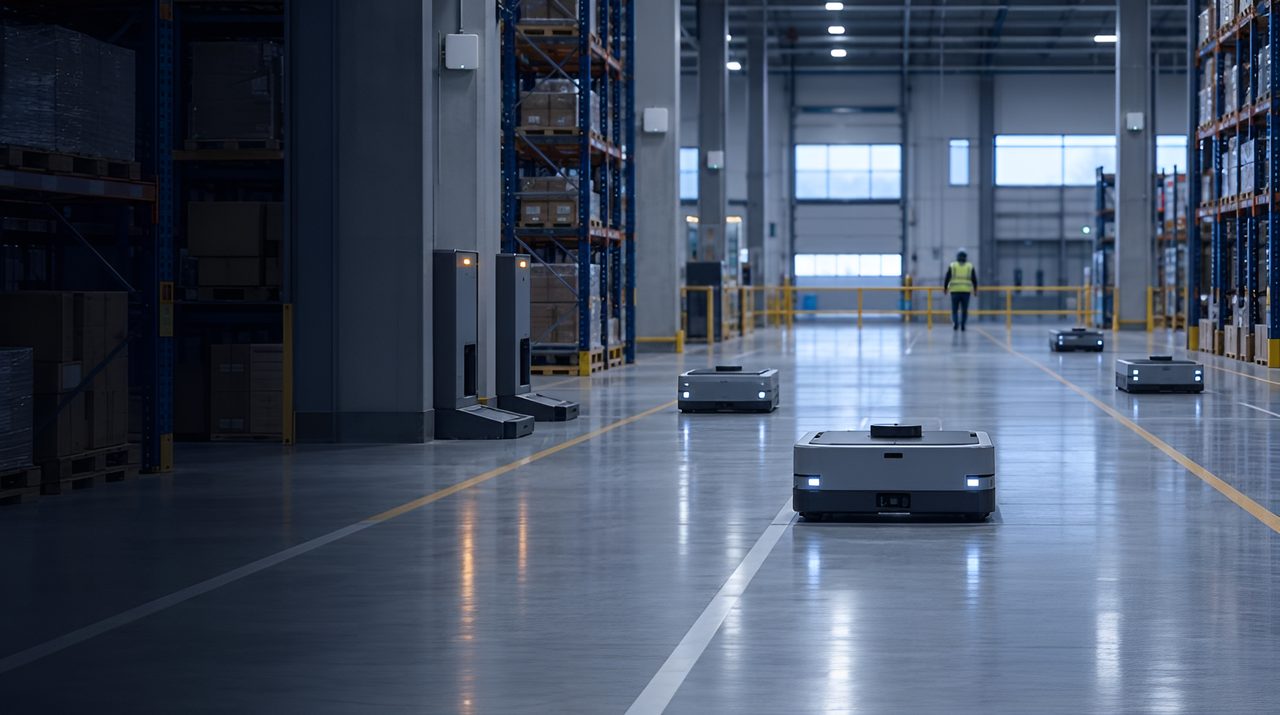
AMR and AGV fleet management, and what VDA 5050 coversRobots from two suppliers blocking each other's aisles?
AMR and AGV selection and fleet management: choose the right robots first, then check which really support VDA 5050. Advisory and integration only. Not a second supplier yard fighting for the same aisle.
Free 30-minute call with an adviser · written proposal with the price after · fixed-scope engagements from £3k.
What is AMR and AGV fleet management? It starts with choosing the right robots for the job, then decides whether one fleet manager can run them, which only works where each robot really supports VDA 5050. Where each AGV or AMR really supports VDA 5050 (we test this), one fleet manager can task it, run traffic management, intersection control and deadlock avoidance on shared paths, and take jobs from your WMS, MES or ERP. TRACIO advises and integrates only.
Fleet orchestration stalls when robots optimise locally and starve the constraint.
VDA 5050 reality
Multi-supplier fleets need a real master controller and shared maps, not slideware interoperability.
Traffic rules
Deadlocks are process failures. Simulate peak density before go-live.
Human overlap
People and AMRs in the same aisle need zoning and speed policies that both sides understand.
Multi-supplier fleet orchestration: how it works, and what it pays back.
One control layer over every robot brand (chosen for your operation), so the floor flows instead of fighting itself.
1 · Standardise
Check each AGV or AMR's real VDA 5050 support before you plan to run them under one fleet manager.
2 · Orchestrate
Central traffic management, intersection control and deadlock avoidance on shared paths, for the robots that pass a VDA 5050 test on your floor.
3 · Integrate
Wire the fleet to your WMS, MES or ERP and surface throughput, utilisation and uptime on one dashboard.
Which approach actually fits.
We don't sell hardware, so our advice stays independent. The architecture serves your throughput and total cost, not a supplier’s roadmap.
VDA 5050
Open interface between robots and a master control, now at version 3.0. Support varies by manufacturer and version.
RTLS-assured
UWB/anchors to verify localisation where SLAM struggles.
Brownfield
Migrate or extend legacy AGVs without ripping out infrastructure.
Industries this solution suits
Two robot brands, one floor, zero deadlocks.
A plant adds AMRs from a second supplier and the two fleets start blocking each other at shared doors. A VDA 5050 master control can put both under one traffic manager, if both really support the version you need. Throughput recovers and the next robot purchase is no longer locked to one brand.
Typically bought by: Operations, automation / controls engineering, logistics, IT/OT.
Relevant case studies
Suppliers we evaluate for this use case
Fleet-manager platforms we assess
Where this solution wins: examples by sector.
Automotive assembly intralogistics (automotive)
Robots from several manufacturers need a VDA 5050 master control, and each one has to be tested against it.
3PL goods-to-person fulfilment (logistics)
Locus, Geek+, MIR fleets at scale.
Aerospace heavy-maintenance hangars (aerospace)
Tugs, GSE, and parts-movement coordinated.
Retail DC AMR-assisted picking (retail)
Pick-and-pass AMRs at peak season.
Manufacturing maintenance and material flow (manufacturing)
AMR replacing tugger trains for kit deliveries.
Related reading.
Who needs this kind of programme.
Manufacturing and DC automation leaders running (or about to run) more than one AGV/AMR brand on shared paths.
IT/OT and controls asked to stop deadlocks at doors without ripping out yesterday’s robots.
Procurement that refuses single-supplier lock-in on the next robot buy.
What buyers compare in this market.
Two layers get mixed up in almost every RFP: the robot manufacturer's own fleet manager, and an independent orchestration layer that sits above several brands.
OEM-native fleet managers. OTTO (Rockwell Automation), MiR (Teradyne), Geek+, Locus, Seegrid, Vecna and peers each run their own robots best. OTTO and MiR are building VDA 5050 support and adapters, so their vehicles can also take orders from a third-party master.
Independent, multi-supplier orchestration. A growing group of platforms coordinate robots from many manufacturers under VDA 5050:
- SYNAOS (Germany): an intralogistics platform that pairs VDA 5050 fleet management with forklift guidance, real-time localisation, warehouse execution and simulation, integrating vehicles from 40+ partner manufacturers.
- idealworks (Idealworks OS): VDA 5050 over MQTT, coordinating AMRs, AGVs, tracked manual vehicles and robot cells from one control layer.
- NAiSE, Meili FMS, Navitec Navithor, BlueBotics ANT server and Kollmorgen NDC: fleet managers and navigation platforms with VDA 5050 support, from lightweight SaaS to AGV-grade control.
The real difference is not the VDA 5050 badge. It is which vehicles have been proven with which master in production, how traffic and charging are handled across brands, whether manual forklifts and people are in scope, and how cleanly jobs arrive from your WMS, MES or SAP EWM.
Why it matters now. VDA 5050 version 3.0 was released in March 2026 (announced April 2026), adding zones and path sharing so free-navigating AMRs can stay under central traffic control. Supplier risk is real too: in December 2025 Zebra announced it was exiting the Fetch AMR business it bought in 2021. A fleet you can move to another master or vehicle brand is cheaper insurance than any single manufacturer's roadmap.
TRACIO advises and integrates only. We help you decide OEM-native control vs VDA 5050 master, assess brownfield bridges, and wire WMS/MES job flow so throughput, not robot brand politics, wins.
Why orchestration programmes stall.
Two fleets, two traffic brains. Shared doors without one master recreate deadlocks the pilot never showed.
Standard theatre. “VDA 5050 support” without certified vehicle+master pairs still means custom glue.
Robots before layout. Orchestration cannot fix a pinched aisle that humans already blocked.
Independent advice. No hardware sales, no vendor commissions.
Our job is architecture, interface selection, RF/safety coexistence and integration, so your next robot purchase is not forced by last year’s proprietary fleet software.
Frequently asked questions
What is VDA 5050 and why does it matter?
VDA 5050 is the open interface standard that lets AGVs and AMRs from different suppliers talk to one master control. It is what makes a mixed-supplier fleet possible without lock-in.
Can robots from different manufacturers run under one fleet manager?
Yes, that is the point. Where vehicles really support VDA 5050, a master controller can coordinate traffic, jobs and charging across brands. We assess each vehicle first and help you work towards it.
How does it fit with our WMS/MES and existing automation?
The fleet controller takes orders from your WMS or MES and coordinates the robots, while RTLS adds shared awareness of people and manual trucks working in the same space.
Do we have to replace our current robots?
No. We assess each vehicle's VDA 5050 support, tell you where gaps need custom work, and help you add capacity step by step.
What outcomes does orchestration deliver?
Higher fleet throughput, fewer deadlocks and traffic jams, smarter charging, and one pane of glass for a fleet that would otherwise run as isolated islands.
Which fleet managers can run a mixed-brand fleet?
Independent VDA 5050 platforms such as SYNAOS, idealworks, NAiSE and Meili FMS coordinate robots from several manufacturers, while OTTO and MiR are building VDA 5050 support so their vehicles can take orders from a third-party master. Which one fits depends on your vehicle mix, whether forklifts and people are in scope, and your WMS or SAP integration.
What changed in VDA 5050 version 3.0?
Released in March 2026 (announced April 2026), version 3.0 adds zones with movement rules and path sharing, so free-navigating AMRs can plan their own routes while the central master still manages traffic. It also adds a standard power-saving action and multilingual error messages. Predefined trajectories and corridors remain for fixed-path AGVs, but some parameter renames are breaking changes, so plan the migration from 2.x.
Last updated: 5 October 2026