
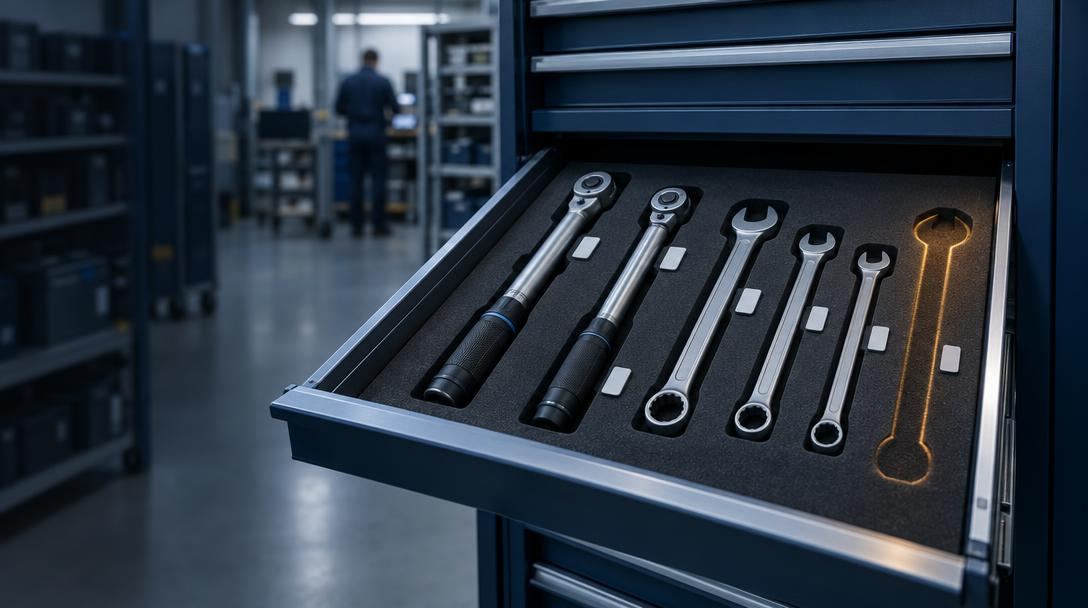
Tool tracking systems, supplied and integrated
We advise, supply the hardware and integrate it with your WMS, ERP or MES. Or we just advise, if that’s all you need.
- Hardware
- Integration
- EMEA · NA · APAC
We reply within one working day with questions or a written price. No obligation. Fixed-scope engagements from £3k. Prefer to talk? Book a free 30-minute call.
Not ready for a call? ··
Tool control RTLS and RFID before the job leaves the crib. FOD and crib accuracy without theatre: identity at point of use.
Prefer to talk? Book a free 30-minute call.
Tool control dies when the crib process is optional on night shift.
Issue/return ritual
Tags without a forced issue/return step become inventory fiction. Design the workflow before the readers.
FOD and calibrated
Calibrated and foreign-object-critical tools need harder controls than general kit. Tier the policy.
Shadow cribs
Unofficial drawers defeat the system. Hunt them with usage analytics, not only gate readers.
Tool & equipment control: how it works, and what it protects.
The right radio for the job, mapped to your use case.
1 · Tag & shadow
Tools are tagged and matched to a shadow board or crib location.
2 · Issue & return
Reads log who took what and when, and confirm every tool returns at shift end.
3 · Prove & prevent
Calibration and torque status travel with the tool. Missing-tool (FOD) alerts fire when a tool is not back in place.
Passive RFID → crib reads · UWB → bay-level FOD
Three questions worth answering, before and after
- How long does it take to find a tool today?
- How many tools are not back at shift end?
- How often is a tool issued past its calibration date?
Talk them through with us on a free 30-minute call.
Which technology fits.
We work for you, not for the technology providers.
UWB
Sub-metre tool location and FOD zones.
Passive RFID
Cheap tracking for consumables.
Integration
Calibration & torque records.
Industries this solution suits
Every tool home before the aircraft moves.
An aerospace MRO shadow-boards and tags its calibrated tools. The crib knows what is out and who has it, a missing torque wrench triggers a FOD alert before sign-off, and calibration status travels with each tool.
Typically bought by: MRO / quality, tool-crib supervisors, EHS, AS9100 auditors.
Relevant case studies
Where this solution wins: examples by sector.
Aerospace FOD prevention (aerospace)
Tools left in airframes cause catastrophic damage. Passive RFID smart cabinets help prevent FOD events.
Defence vehicle and aircraft depots (defence)
Tool control is regulator-required. Passive RFID + smart-cabinets verify every tool's location.
Manufacturing torque-tool and gage management (manufacturing)
Calibration compliance and tool-availability at every station.
Hospital surgical instrument tracking (healthcare)
Every instrument tracked through sterilisation, OR, and re-processing.
Oil & gas turnaround tool tracking (oil-gas)
Contractor tools and calibrated equipment tracked through shutdowns.
Who needs this kind of programme.
Aerospace MRO, defence depots and high-spec manufacturing where missing calibrated tools create FOD and audit risk.
Quality and tool-crib owners needing check-in/out accountability without paper shadow boards that lie.
EHS preventing foreign-object and calibration-expiry incidents.
What buyers compare in this market.
Passive RFID cabinets and portal reads (Impinj/Zebra/Honeywell) dominate volume tool control. UWB (Ubisense and peers) appears for large hangars where continuous find-rate matters. Shadow-board and vision systems compete for smaller cribs. The guidance choice is crib-level accountability versus hangar-wide locating, often a hybrid.
Why tool-control programmes fail.
Tag the tool, skip the ritual. Without enforced check-out, tags become decoration.
Calibration master ignored. Location without expiry linkage fails the audit that motivated the project.
Contractor tools invisible. Transient kits break the FOD story unless identity rules cover them.
Your outcome decides the hardware.
Advice first. We also supply, lease and integrate if you choose. We design the control points, calibration hooks and exception process so FOD and audit risk actually fall.
Frequently asked questions
How does RTLS/RFID prevent lost or left-behind tools?
Each tool is tagged and checked in and out automatically. The system flags missing items before a shift ends, critical for FOD prevention in aerospace and for accountability in regulated work.
Does it support tool cribs and calibration?
Yes, it manages issue and return, links to calibration and maintenance schedules, and shows who has what, replacing paper logs and trust-based sign-out boxes.
What accuracy and technology fit?
RFID cabinets and portals for fast issue and return and presence; UWB where you need to locate a specific tool precisely. We choose by the cost of a missing tool.
How does it integrate with our systems?
Tool status and custody feed your CMMS or ERP and quality records, so accountability and calibration are auditable.
What is the payback?
Less time searching, fewer replacement purchases, and, in aerospace and defence, avoided FOD incidents whose cost dwarfs the system, make this a fast return.
Talk it through in 30 minutes
Free, with no obligation. After the call you get a written price for your project.
Prefer it in writing? Get a written price
Last updated: 5 October 2026