
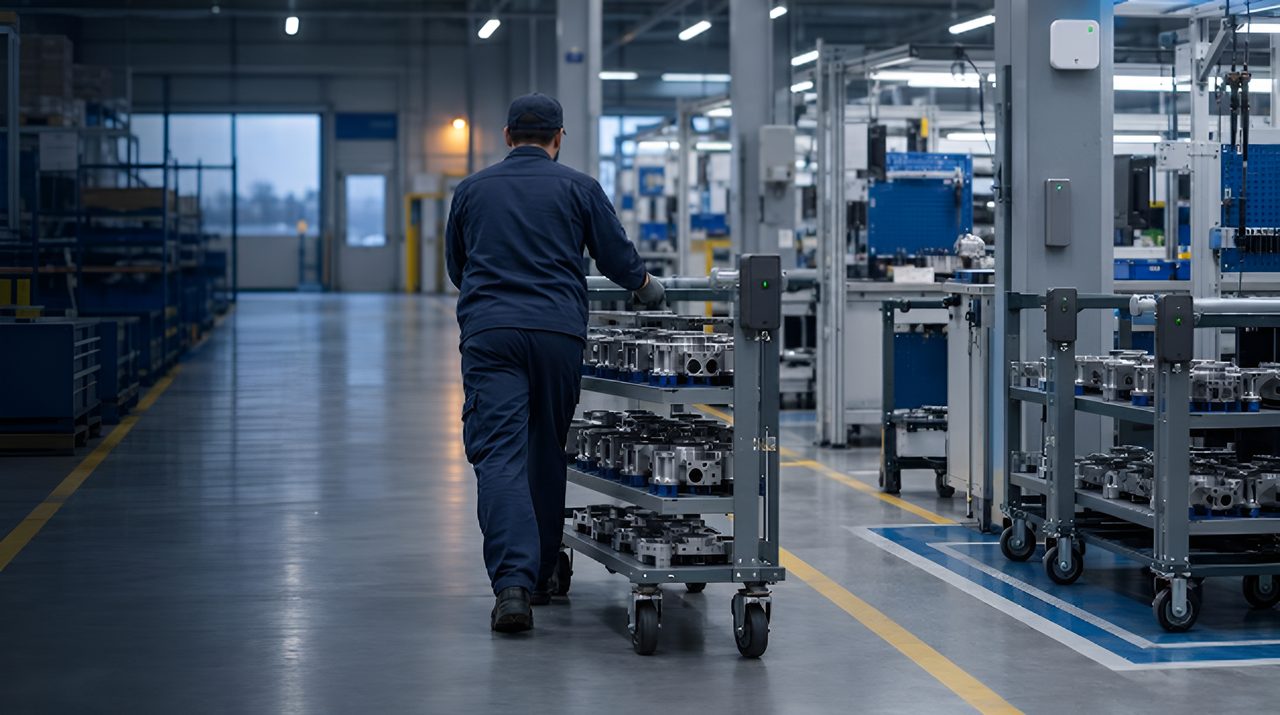
WIP and material flow: see the job between stations.Jobs vanish between stations and lead times slip?
WIP and material flow RTLS for constraint truth. Station dwell the MES already understands, so OEE conversations use the same numbers as the floor.
Free 30-minute call with an adviser · written proposal with the price after · fixed-scope engagements from £3k.
WIP visibility fails when the board shows location and production still plans from tribal knowledge.
Planner UX
If planners do not use the live WIP picture to release work, you bought a map. Put it in the daily tier meeting.
Carrier identity
Track the carrier that moves (tote, AGV, fixture), not only the order, or you lose the physical truth.
Rework loops
Unmodelled rework paths create ghost WIP. Map the ugly paths explicitly.
WIP & material flow: how it works, and what it pays back.
The right radio for the job, mapped to your use case.
1 · Tag & gate
Parts, totes or carriers get a Passive RFID tag. Fixed read gates sit at every station hand-off.
2 · Time each station
Every read timestamps the move, so the system knows real dwell, queue depth and cycle time, not a planning assumption.
3 · Surface the constraint
Bottlenecks, ageing WIP and starved stations are flagged live and pushed to your MES / andon.
Passive RFID → WIP · UWB → cells & tools
Which technology fits.
We work for you, not for the technology providers.
Passive RFID
Item-level WIP at low cost per tag.
UWB
Cell- and tool-level precision.
Analytics
Dwell & bottleneck insight.
Industries this solution suits
See the job, not the guess.
An automotive supplier tags every work-in-progress carrier and reads it at each station. Planners see real dwell and queue per station live, pinpoint the bottleneck, and re-balance the line, lifting throughput without buying new machines.
Typically bought by: Plant managers, production / IE engineers, MES owners, COO.
Relevant case studies
Where this solution wins: examples by sector.
Automotive assembly line (automotive)
UWB or RTLS-grade RFID on every body and engine; MES integration drives bottleneck-busting decisions in real time.
Aerospace engine MRO (aerospace)
Thousands of parts move through teardown-inspect-repair-rebuild. Passive RFID helps find material and shows where work waits.
Pharma drug-product manufacturing (pharma)
Batch-tracking through every process step ensures GMP compliance and audit-ready records.
Electronics SMT and assembly (manufacturing)
PCB tracking through pick-and-place, reflow, AOI and test enables yield management at unit level.
Heavy-machinery final assembly (manufacturing)
Multi-week build cycles benefit hugely from real-time visibility of where every order is.
Who needs this kind of programme.
Discrete manufacturers drowning in WIP age, missing kits and “where is my job” walks.
Plant managers and CI who need station-to-station truth tied to MES orders.
Materials and logistics staging the right kit to the right cell without radio chaos.
What buyers compare in this market.
UWB/RTLS (Ubisense, Sewio, Pozyx) competes with RAIN choke-points (Impinj) and MES scan discipline. Continuous locating shines for roaming WIP. Portals win at cell entry when identity must be definitive. AMR suppliers may pitch material movement as the fix, sometimes right, often premature if WIP identity is still broken.
Why WIP programmes stall.
Location without order ID. Pretty maps that cannot answer which job is late help nobody.
Buffer culture unchanged. Visibility that never reduces tribal safety stock just adds cost.
Pilot on the cleanest line. Rollout to the chaotic cell destroys credibility.
Independent.
We don't sell hardware, so our advice stays independent. We scope the events that expose the real constraint and integrate them so materials and production share one WIP truth.
Frequently asked questions
What does tracking WIP and material flow reveal?
Where work actually sits and waits, queue times, bottlenecks, and WIP levels by stage, so you can cut lead time and lift on-time delivery on evidence, not guesswork.
How is it captured on a busy shop floor?
Tags on parts, totes or carriers report location automatically at each stage, no manual scanning, even in metal-rich plants once the RF design is validated.
What accuracy and technology fit?
Zone or station level is enough for most flow tracking (RFID or BLE); UWB where precise position matters. We design around the plant's RF environment.
How does it integrate with MES or ERP?
WIP status and timing feed your MES or ERP so flow connects to OEE, scheduling and traceability rather than living in isolation.
What is the payback?
Shorter lead times, lower WIP and expediting, better on-time delivery, and faster problem-solving when a job goes missing on the floor.
Last updated: 5 October 2026