
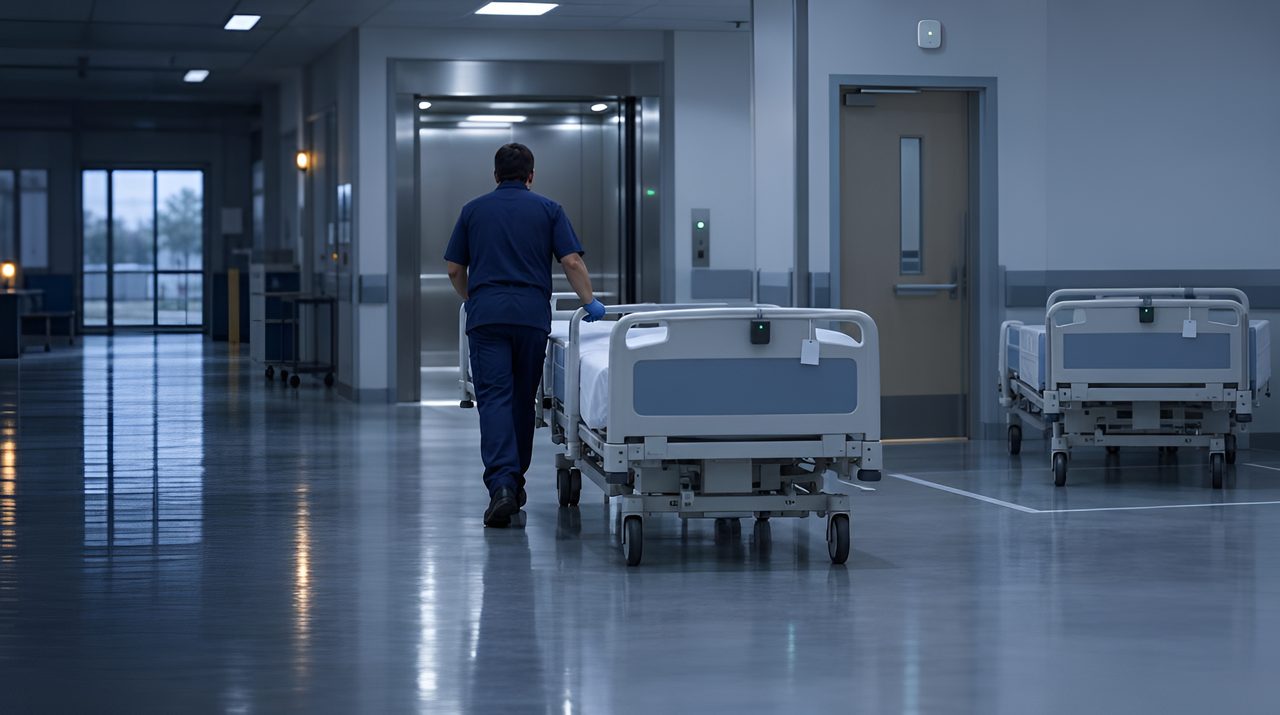
Patient flow: ED minutes and medical equipment search are different designs.Patient flow and equipment search need different designs.
Patient flow RTLS treats ED minutes and medical equipment-search minutes as different problems. Journey states in the PAS or EMR: location as a feed, not a parallel clinical map.
Free 30-minute call with an adviser · written proposal with the price after · fixed-scope engagements from £3k.
What is patient flow RTLS? Patient flow RTLS uses badges on patients, staff and key assets to timestamp each step of the journey, from ED to imaging to ward, without anyone clicking a status. Wait times, dwell and bottlenecks become visible, and bed-cleaning, transport and discharge are triggered the moment a step completes, with milestones feeding your EMR and bed-management systems.
Flow programmes stall when RTLS is treated as a bed board instead of a care pathway.
Bottleneck truth
Location of a patient without ED→ward→discharge timestamps just relocates the argument. Instrument the handoffs.
Clinical ownership
If nursing does not own the exception queue, the map becomes wallpaper. Define who acts when a dwell threshold trips.
Infection and privacy
Pathway data is clinical data. Architecture must satisfy DPIA/HIPAA-equivalent controls before the first tag is issued.
More on choosing a system for a hospital in our hospital RTLS guide. See what hospital RTLS costs over five years, not just at install.
Patient & people flow: how it works, and what it pays back.
The right radio for the job, mapped to your use case.
1 · Track
Patients, staff and key assets carry badges. Zones and beds report their state live.
2 · See the flow
Wait times, dwell and bottlenecks per step (ED → imaging → ward) become visible.
3 · Act
Bed-cleaning, transport and discharge are triggered the moment a step completes.
BLE → zone flow · UWB → precise areas
Which technology fits.
We work for you, not for the technology providers.
BLE
Cost-effective flow tracking.
UWB
Precise zone state.
Integration
EMR / ops dashboards.
Industries this solution suits
Throughput without adding beds.
A hospital tracks bed and zone state live and times each step from ED to ward. The wait building before imaging is exposed, bed-cleaning is triggered on discharge, and throughput rises on the same estate.
Typically bought by: Patient-flow / bed management, ED leadership, operations, EMR owners.
Relevant case studies
Suppliers we evaluate for this use case
Where this solution wins: examples by sector.
ED-to-floor flow (healthcare)
OR-to-discharge flow (healthcare)
Surgical patient flow through phases of care.
Outpatient flow (healthcare)
Clinic-flow analytics reduce no-shows and waiting.
Cardiac-cath and IR flow (healthcare)
Procedural-area patient flow.
Maternity flow (healthcare)
Labour-and-delivery to postpartum flow.
Who needs this kind of programme.
Acute hospitals and health systems chasing ED boarding, bed turns and discharge coordination without adding beds.
Command-centre / capacity teams that already run bed-management software (TeleTracking-class) and need trusted location events, not another dashboard silo.
Clinical engineering and facilities pairing patient flow with asset find-rates so medical equipment and wheelchairs stop blocking pathway KPIs.
What buyers compare in this market.
The competitive set is not one product category. CenTrak and Midmark CareFlow compete on clinical-grade room/bay locating and deep EMR/nurse-call interoperability (including Epic Toolbox-class integrations). AiRISTA Flow leans into workflow orchestration on Wi-Fi/BLE. Transport dispatch, discharge triggers, EVS turn. TeleTracking is often bought as a patient-flow / command-centre platform first, with RTLS as an adjunct rather than the core radio stack. Kontakt.io and Quuppa-class BLE appear when cost and Wi-Fi reuse dominate the RF survey.
We don't sell hardware, so our advice stays independent. We scope the pathway KPIs (ED-to-bed, OR-to-PACU, discharge-to-clean), the accuracy band you actually need (zone vs bed), and which supplier stack (or hybrid) survives EMR ownership, privacy review and multi-campus expansion.
Why most patient-flow RTLS programmes stall.
Treated as a bed board. Location dots without discharge, EVS and transport rituals never move length of stay.
Accuracy overbought. Paying for bay-level everywhere when ED zone flow would pay back first burns capital and battery life.
EMR integration deferred. If milestones never land in ADT/bed-management, nurses keep dual-entering and adoption dies.
Supplier lock framed as “platform”. Buying radio, software and services from one supplier can be right, but only after an independent RF survey and outcome model say so.
Independent. Open where it fits.
Recommendations serve throughput and clinical governance, not a SKU we need to move. Where an existing TeleTracking- or Midmark-class stack already owns the workflow, we often advise fixing the location feed and operating model instead of rip-and-replace.
From dots on a map to hours of length of stay.
Patient flow tracking pays back when a location event changes a decision: a bed cleaned sooner, a transport dispatched on time, a patient moved before the emergency department starts boarding.
- Automatic milestones. Arrival in an ED bay, departure to imaging, entry to theatre, arrival in recovery and discharge from the unit are timestamped without anyone clicking a status.
- Bed turnaround. A discharge triggers environmental services, and the clean status updates the bed board as soon as the room is ready.
- ED boarding and waits. Door-to-provider time, time in the waiting room and ED length of stay, measured instead of estimated.
- Perioperative flow. Pre-op, theatre and recovery status, on-time first case starts and family status boards.
- Clinic throughput. Rooming, time waiting for the clinician and exam room utilisation in outpatient clinics.
- Capacity command centres. Location data feeds capacity platforms such as Epic, TeleTracking and GE HealthCare command centre tools, and the predictive AI models that forecast demand for beds and staff.
Accuracy follows the workflow: room-level certainty for rooming and bays, BLE Angle of Arrival where bays share a room, and zone-level Wi-Fi for waiting areas. The wider locating choices are on our hospital RTLS page.
Frequently asked questions
What does patient-flow tracking improve?
Visibility of where patients are in their journey, wait times, bottlenecks, bed turnaround, so departments such as ED, theatres and imaging run smoother and throughput rises.
Is it tracking patients or just the process?
The goal is flow and timing, not surveillance. Tags, often on a wristband for the visit, capture milestones and zones; reporting focuses on process performance.
What accuracy is needed?
Usually room or zone level (BLE or Wi-Fi) for flow; bed level (UWB) where precise workflow analytics are required. We avoid paying for accuracy the use case does not need.
Does it integrate with our EMR and bed-management?
Yes, milestones and location feed your EMR, ADT and bed-management systems so staff see status where they already work.
What is the business case?
Shorter waits and length of stay, higher utilisation of beds and rooms, and data to justify and measure operational change, directly tied to capacity.
How does RTLS improve emergency department throughput?
RTLS records when patients arrive, are seen, go to imaging and leave, without manual status updates. That exposes where time is lost, triggers bed cleaning and transport automatically, and gives the capacity team a live view of boarding, so decisions are made on what is happening now.
Does patient flow RTLS integrate with Epic?
Most clinical RTLS platforms offer Epic integrations that pass location milestones and bed or room status into the EMR. We define which events are sent, how tags are linked to patients at registration, and who owns the interface, before any hardware is chosen.
What is a capacity command centre?
A capacity command centre is a central team and platform that manages beds, transfers, staffing and patient flow across a hospital or health system. RTLS gives it live status instead of data entered by hand, which is what makes forecasting and escalation reliable.
Last updated: 5 October 2026