
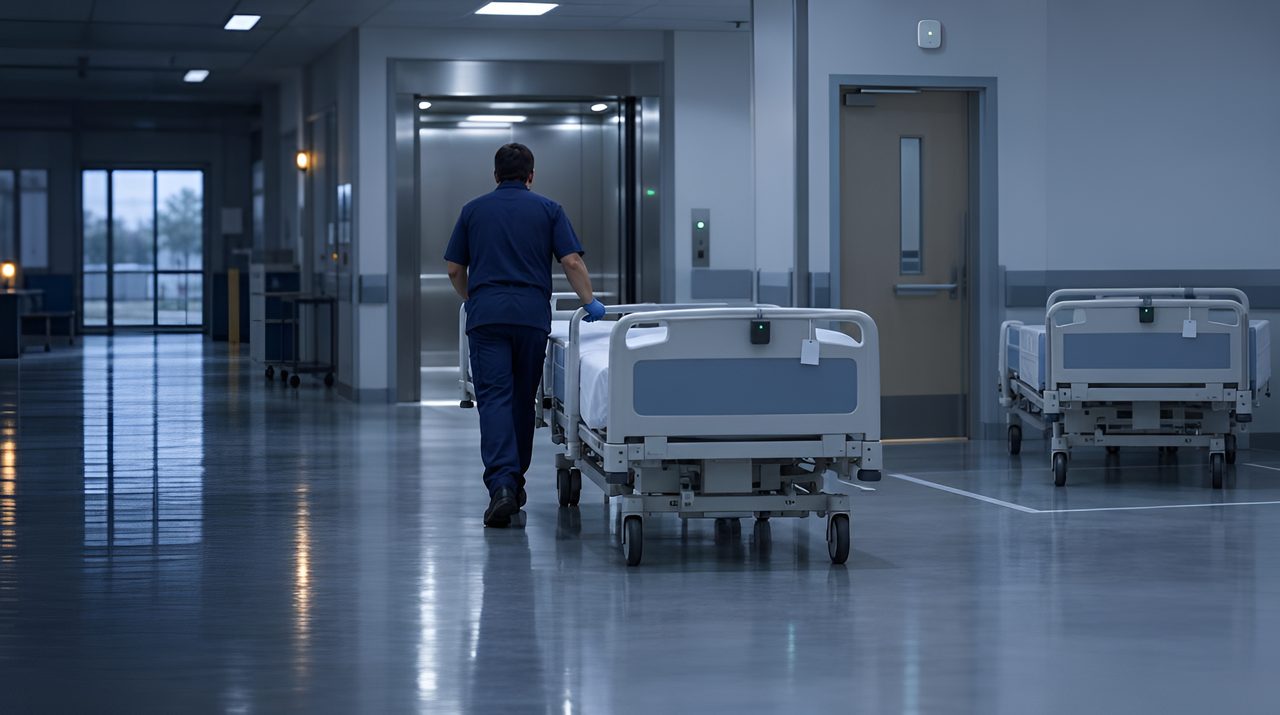
Move patients faster and stop hunting for medical equipment.
A hospital can’t see real-time patient flow through the ED, and clinical staff lose time every shift searching for mobile equipment. Utilisation is low, so the hospital over-buys and over-rents.
The programme and figures on this page come from an earlier work by our advisers. The client name is withheld under NDA. Figures are as reported at the time. Named references are available under NDA when you engage.
Results in this engagement
Staff time per shift recoverable from searching.
Mobile-equipment utilisation after RTLS.
Asset loss avoidable: fewer rentals & re-buys.
Earlier work by our advisers. Client name withheld under NDA. Client name withheld under NDA; figures as reported at the time. Named references available under NDA. We model your own numbers when you engage.
The challenge
Clinical staff spend 30-60 minutes per shift searching for equipment; 10-20% of mobile assets go missing over their life; bottlenecks in patient flow are invisible until they bite.
Our approach
- BLE 5.x AoA / RTLS for equipment and, where appropriate, patient-flow milestones.
- Utilisation analytics to right-size the fleet and cut rentals.
- Bed-turn and ED milestone visibility for flow.
- Hand-hygiene / safety use cases as phase two.
- Integrate with EMR and biomed CMMS.
Technology & integration
Stack deployed: BLE 5.x AoA, UWB for high-accuracy zones, Passive RFID for supply rooms.
Integration: Epic / Cerner (Oracle Health) / Meditech, biomed CMMS, capacity systems.
Related: RTLS for hospitals · Healthcare RTLS · Hospital equipment RTLS
Baseline, method, period and what we excluded.
This page describes an engagement our advisers led in earlier roles. The client name is withheld under NDA. Figures are as reported at the time, with published industry sources where noted.
- Baseline: Bed boards and verbal ED→ward handoffs; dwell causes debated after the shift.
- Method: RTLS on patients/staff where consented; pathway timestamps at handoffs; exception queue owned by flow coordinators.
- Period: ED and one inpatient pathway through a winter peak sample.
- Excluded: Occupancy heatmaps without a care-pathway decision owner.
Programme context
Patient-flow RTLS ties location to pathway timers (ED, theatres, beds). It engages PHI. BAA, minimum necessary, and clear clinical owners are mandatory. Often sequenced after equipment RTLS succeeds.
Integrate with EMR/ADT and capacity boards; do not build a parallel census.
Outcomes in this engagement and how they were earned
Outcomes centre on shorter waits for specific bottlenecks, better bed turn visibility, and fewer manual status calls, when pathways have owners.
Lessons from this engagement
Lessons: pathway ownership beats pretty maps; staff tracking for flow needs separate governance; start with one pathway.
Deeper problem framing
ED and theatre flow suffer from status lag. Manual boards lie. Patient RTLS without pathway owners becomes a map clinicians ignore, while still creating PHI risk.
Approach
One pathway; EMR/ADT join; minimum necessary roles; equipment RTLS first where possible; DPIA and clinical safety documentation before scale.
Outcomes and measurement
Pathway-specific wait components, not vanity 'flow scores'. Owner behaviour is the leading indicator.
Governance, risk and what we refuse to claim
Figures from this engagement only. Your payback depends on adoption, integration quality and exception labour, not tag unit cost. Named references under NDA on engagement.
We challenge any supplier who asks you to accept demo-day averages as production truth.
Implementation sequence and change management
Pick one pathway with an executive owner. Complete privacy assessment. Integrate ADT/EMR status. Train unit clerks and charge nurses on the board that matters. Retire the shadow whiteboard deliberately.
Measure pathway segment times against baseline. If owners do not attend weekly reviews, pause expansion. Staff location for flow needs separate labour consultation where applicable.
Challenge platforms that bury PHI joins in default cloud analytics.
Buyer checklist, supplier challenges and engagement shape
For patient flow, require a named pathway owner and PHI-minimised architecture before any wristband discussion.
Buyer checklist before you sign: (1) written system of record for events; (2) acceptance tests with 95th-percentile performance under real interference; (3) integration owner named in IT/OT; (4) privacy or labour consultation path if people are tagged; (5) cybersecurity zoning sketch; (6) five-year TCO including batteries, spares, recalibration and SLA escalations; (7) exit/export terms so you are not hostage to a cloud tenant; (8) a pilot that can fail without political punishment.
Supplier claims to challenge in this pattern: brochure accuracy without production load; 'compliance included' without artefacts; ROI that assumes perfect adoption in 30 days; references that cannot be called under NDA; install partners who have never worked your vertical's overlays; shared support accounts; and any design that dumps locating onto a flat plant or clinical VLAN.
How TRACIO typically engages: stage-1 architecture and measurement design; independent shortlist and RFP language; pilot acceptance criteria; then optional implementation oversight or programme rescue if a prior pilot stalled. We don't sell hardware, so our advice stays independent. Pages like this one exist so you can prepare the workshop. Your numbers replace every planning band when we model payback.
Risk register themes that recur: mute fatigue on alerts; shadow spreadsheets reappearing beside the platform; battery logistics understaffed; master data too weak to support identity; works-council or IG review starting too late; and success declared on demo day before night-shift reality.
Document baseline windows explicitly: what you measured, for how long, which shifts, and what you excluded. Investment committees and auditors both punish fuzzy before/after stories. If your baseline is weak, spend two to four weeks fixing measurement before ordering anchors or portals. That discipline is cheaper than a stranded deployment and is the difference between a locating programme and a technology souvenir.
Last updated:
Clinical operations, not gadget demos
Independent advisory means the radio is chosen last. After the job, the constraints and the system of record are clear.
Flow and equipment jobs
Patient flow, medical equipment and beds are different jobs. We separate them before shortlisting.
Independent across RTLS suppliers
Hospital RF and EMR/RTLS integration constraints pick the stack, not a preferred badge.
Operate inside clinical IT
Events into the systems nursing and biomedical already open every shift.
Measurement
Baseline: nurse search-time samples, biomed “unable to locate” tickets, and bed/theatre turn where relevant. Pilot: one ward or theatre suite with RTLS + asset ID. Steady-state: mean time-to-find, pool utilisation, and rental avoidance, clinical outcomes only with trust sign-off. Figures are as reported in this engagement.