
Manufacturing: WIP tracking you can trust, traceability the auditor can read.WIP tracking nobody trusts, traceability gaps at audit?
TRACIO delivers manufacturing RTLS and Passive RFID programmes that close the gap between the ERP record and shop-floor reality: WIP tracking, IATF 16949 traceability and tool control, ISA-95-aligned and integrated with the MES you already run.
Free 30-minute call with an adviser · written proposal with the price after · fixed-scope engagements from £3k.
How it works in Manufacturing.
The right radio for each job, mapped to your use case.
1 · Identify
Every part and tote is Passive RFID-tagged, so identity travels down the line.
2 · Locate
UWB tracks WIP, tools and torque events to the exact station, live.
3 · Act
Real OEE flows to your MES and andon triggers location-correct escalations.
Passive RFID → WIP · UWB → tools & torque · BLE → floor safety
Common problems in Manufacturing.
WIP accuracy nobody trusts
ERP says one thing, the line says another. Stock-outs at cells happen because the system doesn't believe what's in front of it.
Tool & torque untraceable
FOD events, missing critical-fasten records, audit failures. The torque tool was on the line, but no one logged which part.
OEE built on guesses
Availability and performance measured monthly, hand-aggregated. By the time the dip is visible, the quarter is over.
Use cases with a clear payback.
WIP visibility
Passive RFID at cells, dock doors, tool cribs. Item-level traceability with read accuracy verified to your environment.
Torque & tool control
UWB-tagged torque tools logging which part on which line. IATF 16949 audit-grade build genealogy.
OEE telemetry
Location events feeding into MES (SAP MII, Rockwell FactoryTalk, Siemens Opcenter) for real-time availability, performance, and quality.
Andon integration
RTLS-driven andon. Cell stops trigger location-correlated escalations to the right team in seconds.
Just-In-Sequence
JIS readiness with verified-sequence telemetry. Auto-alerts on sequence breaks before the line stops.
ISA-95 / Purdue alignment
Network architecture designed to the Purdue Model with proper OT/IT segmentation aligned to IEC 62443.
Hardware & software ecosystem
Passive RFID: Impinj · Zebra · Honeywell · Alien · NXP · Smartrac · Avery Dennison · UWB: Ubisense · Sewio · Pozyx · Eliko
Where we plug in
SAP MII / S/4HANA · Rockwell FactoryTalk · Siemens Opcenter · GE Proficy · AVEVA · Aveva PI · ServiceNow
What we design and document to
IATF 16949 · ISA-95 · Purdue Model · IEC 62443 · ISO 9001 · OPC UA · GS1 EPC Gen2v2
Where it pays back in Manufacturing.
Work-in-progress traceability
Passive RFID at cells plus UWB tool control track WIP from station to station, with full ISO/IATF genealogy.
Tool & torque-tool control
UWB-tagged tools and torque verification prevent build errors and foreign-object debris. First-pass yield rises measurably.
Bottleneck & andon analytics
Zone-dwell analytics expose the real constraint on the line. Rebalancing is measured against your own OEE baseline.
Further reading: UWB vs BLE · RTLS cost guide
Five use cases we see most in manufacturing.
1 · WIP stalled between stations
Pain: Batches wait between stations, and late ones are found by walking the line.
What good looks like: Each batch or carrier shows where it last passed and how long it has waited.
Usually fits: passive RFID read at stations, with BLE or UWB only where position matters, confirmed in the survey. WIP & material flow
2 · Part and batch history
Pain: After a defect, the history is rebuilt from paper, so containment is wider than it needs to be.
What good looks like: Each serial or batch carries its stations, times and material lots, so containment is scoped from records.
Usually fits: 2D code or passive RFID read at key stations, kept in your MES or quality system, confirmed in the survey. Quality traceability
3 · Tools, gauges and fixtures in calibration
Pain: Fixtures are found by memory, and calibration dates sit in a spreadsheet.
What good looks like: Items read at issue and at the station, with a wrong or overdue item flagged before use.
Usually fits: passive RFID on tools and fixtures, with readers at the store and key stations, confirmed in the survey. Tool control
4 · Automatic bookings and MES checks
Pain: Steps are booked by hand, so missed bookings go unseen and finished goods wait unbooked.
What good looks like: Reads book each step, and the MES holds the next step until the last is booked and approved. A process check, not machine safety.
Usually fits: RFID or barcode events into your MES via OPC UA or another supported route, agreed with OT under your change control, confirmed in the survey. MES integration
5 · Returnable containers back in the loop
Pain: Nobody knows which containers are at suppliers or customers.
What good looks like: Containers read at the gate in and out, with late returns flagged by partner.
Usually fits: UHF RFID or GRAI barcode labels read at gates, confirmed in the survey. Returnable assets
Also covered
- Bottlenecks: where jobs wait, from real move data.
- Just in sequence: the right rack at the right station, in the right order.
- Equipment maintenance: serviced on condition and use as well as the calendar.
- AMRs and AGVs: choosing the right AMR or AGV first, then a VDA 5050 fleet manager only where every robot supports it.
- Collision avoidance: forklift and pedestrian proximity alerts that support existing safety measures and don't replace them.
- Forklift tracking: where trucks are, and how much they are used.
Solutions for this industry
Relevant case studies
More use cases, in detail.
WIP visibility on the production line
Problem: Manufacturing throughput depends on visibility of every WIP item at every station. Manual tracking creates variance.
Tech mix: UWB or RTLS-grade RFID on every WIP, MES integration, real-time line-balancing dashboard.
What to measure: line throughput · WIP variance · time to identify bottlenecks (baseline each before the pilot).
Operator and shift-attendance attribution
Problem: Quality-escape investigations need attribution to operator, shift and workstation. Manual records create gaps.
Tech mix: BLE-AoA on operator badges, MES capture of every step, full audit trail.
What to measure: quality-escape investigation time · IATF 16949 / AS9100 compliance (baseline each before the pilot).
Tool and gage management
Problem: Manufacturing tools, gages, and fixtures must be tracked for calibration, location and availability.
Tech mix: Passive RFID on every item, smart-shadow boards and cabinets, integration with calibration-management.
What to measure: tool-search time · calibration compliance · capital tied up in tools (baseline each before the pilot).
Returnable container/dunnage tracking in supplier loops
Problem: Returnable transport items (RTI) circulate between supplier-OEM-customer loops and are lost along the way.
Tech mix: Passive RFID on every RTI, fixed readers at chokepoints, integration with logistics-platform.
What to measure: RTI loss · working capital tied up in RTI · supplier-OEM reconciliation effort (baseline each before the pilot).
Forklift-pedestrian safety
Problem: Forklift-pedestrian collisions are the highest-frequency serious-injury risk in manufacturing.
Tech mix: UWB on forklifts and pedestrian badges, proximity-alerts with automatic slowdown.
What to measure: near-miss events (baseline each before the pilot).
Quality-traceability for serialised products
Problem: Serialised products (automotive, aerospace, electronics) must be traceable to every operation, operator and material lot.
Tech mix: Passive RFID + DataMatrix on every unit, MES integration, full part-genealogy.
Outcome: Recall response time reduced from days to hours, regulator-audit compliance, customer trust improved.
Predictive maintenance on critical equipment
Problem: Critical production equipment (presses, robots, conveyors) is single-point-of-failure; unplanned downtime costs thousands per minute.
Tech mix: Vibration and temperature sensors, LoRaWAN backhaul, integration with CMMS and PdM platform.
What to measure: unplanned downtime · OEE · share of reactive vs planned maintenance (baseline each before the pilot).
AMR and AGV selection and fleet management
Problem: choosing the right AGVs and AMRs for intralogistics, and then knowing which really support VDA 5050 before relying on one fleet manager.
Tech mix: VDA 5050 master, fleet-management software, MES/WMS integration.
What to measure: fleet utilisation · traffic conflicts · mixed-fleet efficiency (baseline each before the pilot).
Energy and utility monitoring for sustainability reporting
Problem: Manufacturers face CSRD and emissions-reporting requirements; sub-meter-level energy data is now required.
Tech mix: Sub-meter sensors on machines, LoRaWAN backhaul, integration with energy-management and sustainability reporting.
What to measure: energy waste · CSRD reporting effort · evidence behind sustainability claims (baseline each before the pilot).
Workforce safety / lone-worker monitoring
Problem: Maintenance and security personnel work alone in plant; fall, gas exposure or incapacitation requires auto-detection.
Tech mix: UWB or BLE duress badges with motion sensor, control-room dashboard, integration with security/EMS.
What to measure: lone-worker incident response time · regulator compliance evidence · insurance premiums (baseline each before the pilot).
Related reading.
What you gain
WIP visibility on every line
Orders, batches and sub-assemblies carry a live location, so planners and supervisors see queues as they build. Measured as WIP location accuracy and time spent searching for jobs.
Less time searching for tools and gauges
Tools and gauges are checked out and located, with calibration status alongside. Measured as search time per job and tools out of calibration found in use.
Bottlenecks you can measure
Dwell and flow data show where material waits, not where it is assumed to wait. Measured as queue time per work centre and OEE on the constrained line.
Safer shop-floor traffic
Forklift-pedestrian alerts and zone data show where near-misses happen and when. Measured as logged near-misses and alerts per zone, per shift.
Traceability for serialised product
Station, operator and time events attach to each serial, so a recall or complaint is scoped from records rather than guesswork. Measured as time to trace a unit and the size of each containment.
Returnables kept in the loop
Containers and dunnage are counted through supplier loops. Measured as loop losses, supplier dwell and replacement spend.
Who else sells into manufacturing locating and what programmes get wrong.
Plant teams meet UWB RTLS suppliers, Passive RFID SIs, MES analytics overlays, and AGV/AMR fleets that pitch visibility as a side-effect of robots. Big-4 digital manufacturing programmes often own the PowerPoint. Specialist SIs own the cable. Each can be useful after the job is defined (WIP dwell, tool custody, dock accuracy, forklift safety) and harmful when the radio is chosen first.
What programmes get wrong: campus-wide UWB when portals and selective zones would pay back; buying robots to fix inventory truth; and accepting supplier density without a live-shift RF survey. TRACIO stays independent across the stack and advisory-only on AMR/AGV.
Discrete manufacturing plants that buy locating.
Discrete manufacturers and large industrial groups use WIP tracking, tool control and material flow tracking. Siemens Opcenter and similar MES brands may appear as integration products. OEM names here are market context, not TRACIO clients.
AMRs and AGVs on the factory floor
Material that arrives late at the line stops production, whoever moved it. We help you choose the right AMR or AGV for each flow, then check what it takes to run them alongside people, forklifts and other fleets.
- Line-side delivery and kitting to assembly stations.
- Moving work in progress between cells, test and stores.
- Empty-container returns and finished-goods moves to the warehouse.
- Replacing an ageing AGV system during live production.
- Robot fleet management: one fleet manager for robots from different manufacturers, shared doors and chargers, and traffic and priority at crossings. We check what it takes and help you make it work.
- Integration with MES and WMS, so material calls and confirmations happen without manual steps.
See AMR and AGV consulting, including AMR/AGV fleet management, or book a free scoping call to talk it through. Free briefs: AMR and AGV fleets, and AMR/AGV fleet management.
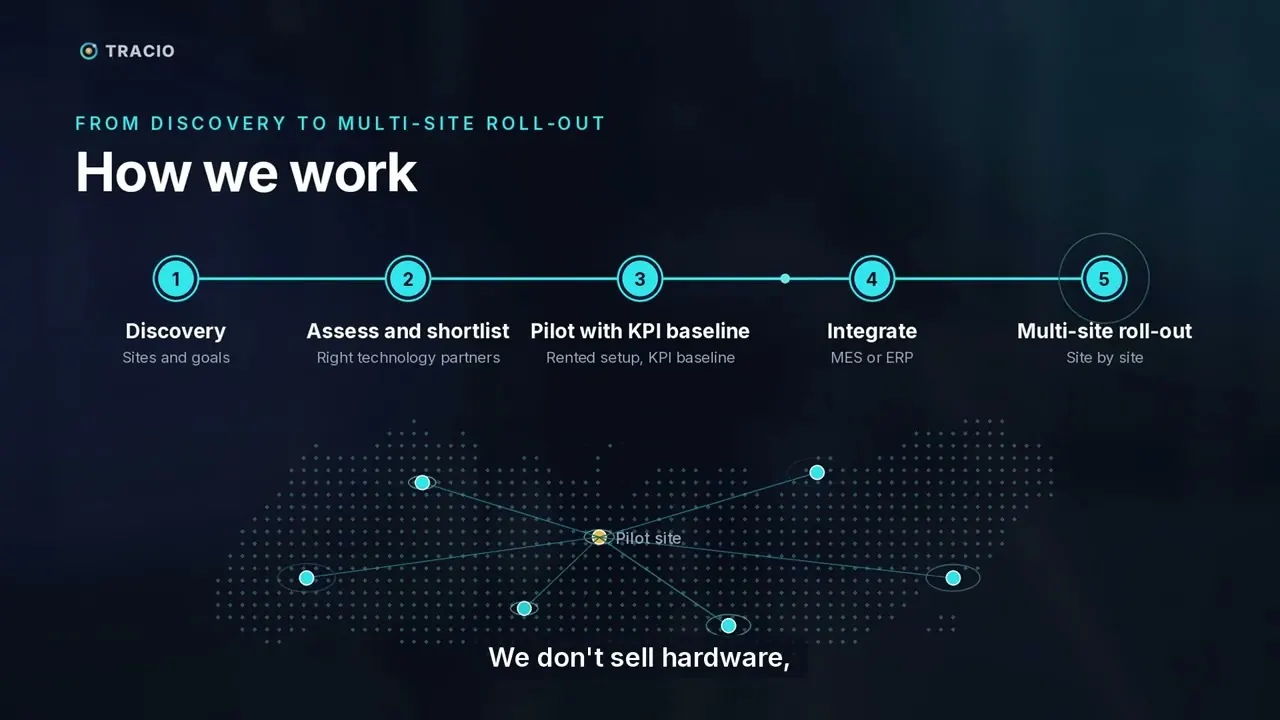
How an engagement works in manufacturing.
Stages, with a gate after each
- Scoping call: 30 minutes with our advisers; a written proposal with the price if there is a fit.
- Discovery & business case: use cases, KPIs and technology direction (typically 1 to 5 days on site).
- Supplier selection: requirements, shortlist, RFP and TCO (typically 3 to 6 weeks).
- Pilot: judged against pass/fail criteria written before any equipment goes in (with timings agreed per site).
- Rollout & handover: scoped per project, phased by site or wave.
What we need from you
- A named sponsor who can sign off each gate
- An operations lead and an IT/OT contact for a few hours a week
- Site drawings, floor plans and process maps
- Access to your MES, ERP and maintenance (CMMS) systems
- Plant access and a line walk during a live shift
Factory tracking: see where every batch, fixture and container is
Play the video (1:17). It loads from YouTube when you click.
Frequently asked questions
What does manufacturing RTLS cover beyond WIP tracking?
Manufacturing RTLS typically pairs WIP tracking with tool control, line-side sequencing and IATF 16949 traceability so genealogy, torque events and quarantine holds are location-backed. The mix of UWB, BLE-AoA and RAIN RFID follows the accuracy each station needs, not a one-stack pitch.
How does RTLS lift WIP accuracy and OEE?
By tracking parts, WIP and assets automatically, it exposes queues, bottlenecks and losses, and it feeds OEE with the data leadership already watches.
Does it work in metal-rich plants?
Yes, with an RF site survey and the right tag and reader choices, RTLS and RFID are reliable even in challenging metal and interference environments.
What can we track?
WIP and material flow, tools and equipment, AGV/AMR fleets, condition for predictive maintenance, and full quality genealogy, on one platform.
How does it integrate with MES or ERP?
Location, flow and condition data feed your MES and ERP via API so improvements connect to OEE, scheduling and traceability. See our MES, SCADA & OPC UA and CMMS integration notes.
What is the payback?
Shorter lead times, higher OEE and on-time delivery, less WIP and expediting, and faster problem-solving, a measurable ROI on the metrics the CFO reads.
What does a manufacturing engagement cost?
It depends on scope and the number of sites. Every engagement is scoped per project and priced in writing before work starts: £3k to £30k per project, or £1,200 a day in the UK. Regional ranges for Europe, North America and other regions are on how we work. Extra sites, on-site RF survey and integration into more than one system of record add to the scope. Hardware and licences are extra: you buy them direct from the supplier, and we don't resell them.
How long does a manufacturing engagement take?
Discovery usually takes 1 to 5 days on site, supplier selection typically 3 to 6 weeks and a pilot with timings agreed per site, with a gate after each. Rollout is scoped per project.
What if the pilot fails?
It stops at the gate. The pilot is judged against written pass/fail criteria agreed before any equipment goes in, so a fail is a clear result, not an argument. You pay no rollout costs and keep the artefacts from each stage: requirements, scored shortlist, TCO, RFP pack, pilot criteria and the measured results. Pilot equipment can be rented, so there is no capex to write off.
Do we need to consult the works council or employees before tracking people?
Usually, yes. Locating people is processing personal data, so under UK and EU GDPR you need a lawful basis, normally a data protection impact assessment, and clear limits on purpose: safety and mustering, not performance monitoring. Where you have a works council or recognised employee representatives, involve them before the pilot. In Germany the works council has a co-determination right over systems that can monitor staff. We design for this from the start: zone-level presence rather than continuous tracks where that is enough, pseudonymised IDs, short retention and role-based access. See GDPR and RTLS.
Who owns the data, and can we avoid supplier lock-in?
You own it. Your data and IP stay yours, with full export. We don't sell hardware, so our advice stays independent. During supplier selection we put data export, open APIs and exit terms into the RFP and contract, so you can change supplier later without starting again.