
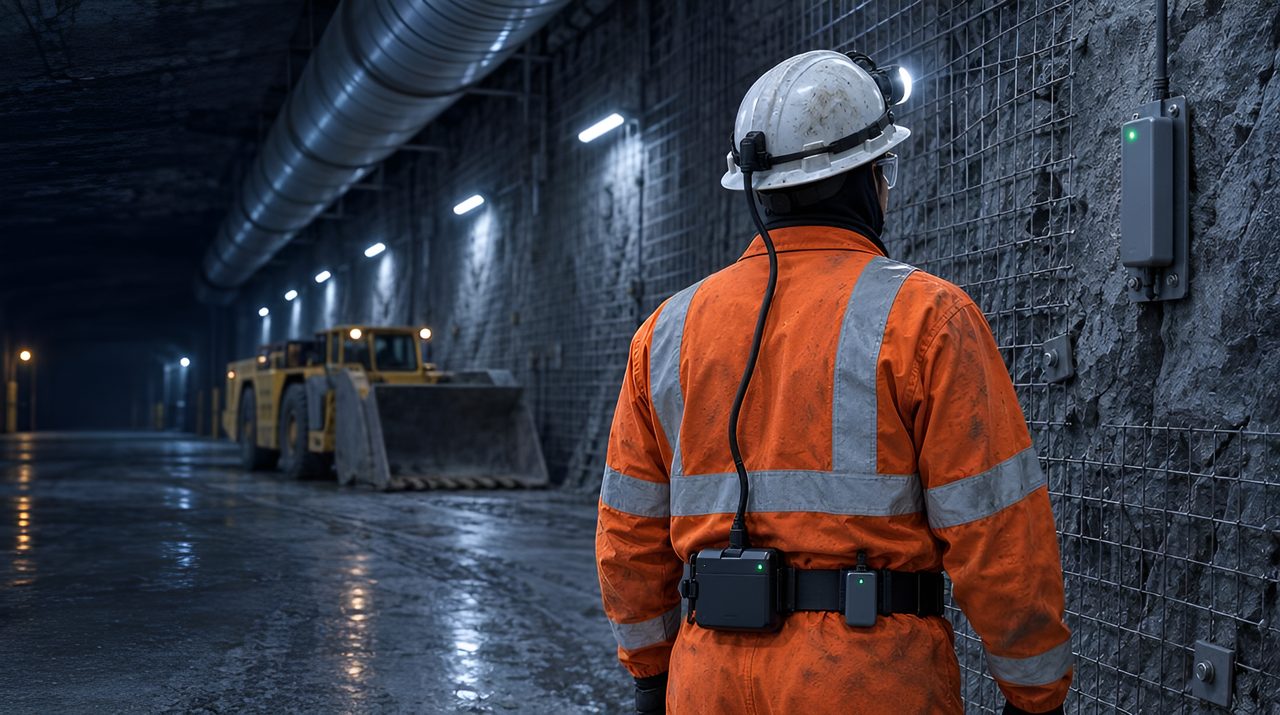
Mining: miner tracking, collision avoidance and mustering that holds.Every miner accounted for? Many systems fail on the real shift.
For underground and open-pit mining. We design miner tracking RTLS, collision avoidance mining programmes, underground mustering, refuge-chamber accountability, blast-zone exclusion and equipment utilisation: ATEX/IECEx-aware and independent.
Compliant with ICMM proximity-detection guidance, MSHA expectations, and ATEX/IECEx where applicable. Hardware-agnostic across UWB, LoRa, RFID, and active RFID under regulated conditions.
Free 30-minute call with an adviser · written proposal with the price after · fixed-scope engagements from £3k.
How it works in Mining.
The right radio for each job, mapped to your use case.
1 · Tag
People and vehicles are tagged for collision avoidance.
2 · Locate
Real-time position underground and across the surface site.
3 · Protect
Proximity and mustering alerts keep crews safe.
Active RFID → proximity · UWB → precision · LoRa → wide-area
Common problems in mining operations.
Muster headcount is paper-based
When the siren goes, the supervisor walks the muster point with a clipboard. Minutes pass before anyone knows whether the headcount matches the shift roster. The regulator wants seconds, not minutes.
Haul-truck utilisation is invisible
Dispatch radios estimate position, idle time, and payload. Actual fleet utilisation only surfaces in the monthly report, long after the productivity ran out the gate.
Blast clearance relies on the radio
Clearance to fire depends on a verbal “all clear” chain. One missed acknowledgement and the zone is hot with someone still in it. The system needs to interlock, not trust.
Use cases with a clear payback.
Who is underground, at shift change and in an emergency
Cap lamp or badge tags read at the portal and shaft show who is underground, alongside the tag board. Usually active RFID or BLE, confirmed in the survey.
Vehicles and people kept apart
Proximity alerts for operators and people on foot, with every event logged. They support your vehicle interaction controls and don't replace them.
Mobile plant serviced by use
Engine hours and fault codes feed the maintenance plan, alongside the manufacturer's schedule. Usually machine telematics, confirmed in the survey.
Critical spares on the shelf
Spares read in and out of stores against the work order, so the record matches the shelf when a machine is down.
Workshop tools back at shift end
Tools checked out and in against a person and a work order, so a tool left in a machine is found before it goes back to work.
More mining use cases.
- Mustering: a headcount at refuge chambers and muster points to support your roll call, which stays.
- Lone workers: an alarm someone can act on for miners working alone, alongside your lone working procedure.
- Blast clearance: a check that tagged people have left the blast zone, alongside your clearance procedure.
- Mobile plant: where haul trucks, loaders and drills are and how much they are used.
- Portable equipment: portable pumps, gas detectors and tools found underground and on the surface.
- Surface fleet: where forklifts and small loaders at the stores and laydown are, and how much they are used.
Hardware & software ecosystem
Mobilaris · Newtrax · Strata · Mine Site Technologies · Inpixon · Ubisense · Impinj · LoRa Alliance member fleets
Where we plug in
Modular Mining DISPATCH · Wenco · Hexagon MineOperate · SAP S/4HANA · Pi historians · ventilation-on-demand controllers · blast-management systems
What good looks like at site level.
What we design and document to
ICMM proximity-detection guidance · MSHA Part 75 expectations · ATEX 2014/34/EU · IECEx · ISO 19296 (mobile machines) · ISO 17757 (autonomous and semi-autonomous earth-moving) · intrinsic-safety (IS) certified hardware where mandated
Where it pays back in Mining.
Underground mustering & SOS
Every miner accounted for at the muster point within seconds and audit-trailed for the regulator, with SOS and refuge-chamber occupancy.
Vehicle collision avoidance
Proximity detection between people and haul trucks reduces near-misses and lost-time injuries in active zones.
Equipment utilisation & dispatch
Haul-fleet utilisation and dispatch analytics cut idle time and lift tonnes-per-shift.
Relevant case studies
More use cases, in detail.
Underground miner safety and proximity detection
Problem: Underground mining is high-risk; miner-equipment proximity (LHDs, haul trucks) is the leading injury cause.
Tech mix: UWB on miners and equipment, proximity-detection with equipment slowdown, integration with mine SCADA.
What to measure: proximity-injury events · mining-regulator compliance · high-potential incidents (baseline each before the pilot).
Mustering and emergency response
Problem: Mining sites must verify all personnel are accounted for in emergencies. Manual roll-call is slow and error-prone underground.
Tech mix: UWB tags on every miner, RFID at refuge stations, integration with mine emergency-response systems.
What to measure: mustering time · refuge-station capacity · emergency-response time (baseline each before the pilot).
Heavy-equipment fleet management
Problem: Mine haul trucks, loaders and dozers represent hundreds of millions in capex; utilisation and PM compliance are critical.
Tech mix: GNSS + telematics on every machine, integration with fleet-management and CMMS, real-time dashboard.
What to measure: fleet utilisation · unplanned downtime · cost per tonne moved (baseline each before the pilot).
Blast-zone clearance verification
Problem: Before blasting, all personnel and equipment must be confirmed clear of blast zone. Manual verification is slow and risky.
Tech mix: UWB on personnel and equipment, blast-zone geofence, automated clearance confirmation.
What to measure: blast-clearance time · blast incidents · production efficiency (baseline each before the pilot).
Tailings dam and pond monitoring
Problem: Tailings facilities have catastrophic failure modes; continuous monitoring is now regulator-mandated post-Brumadinho.
Tech mix: Geotechnical sensors (piezometers, inclinometers, displacement), LoRaWAN backhaul, integration with mine-safety.
Outcome: Real-time tailings-stability monitoring, regulator (GISTM) compliance, catastrophic failure prevention.
Drill-and-blast pattern verification
Problem: Blast patterns must be drilled precisely to spec. Variance causes oversize, fines or worse blast outcomes.
Tech mix: GNSS-RTK on drills, real-time pattern compliance, integration with blast-planning.
Outcome: Drill-pattern compliance verified, blast outcomes improved, downstream processing efficiency improved.
Concentrator-plant uptime monitoring
Problem: Mill and concentrator plants are single points of failure; unplanned downtime costs millions per day.
Tech mix: Vibration, temperature, acoustic sensors on critical equipment, LoRaWAN, integration with CMMS.
What to measure: unplanned downtime · throughput · asset life (baseline each before the pilot).
Conveyor belt and stockpile management
Problem: Mine conveyors move thousands of tonnes per hour; belt failures and stockpile management require real-time visibility.
Tech mix: Belt-condition monitoring (impact, alignment, temperature), stockpile-level radar, integration with mine SCADA.
Outcome: Belt-failure events reduced, conveyor uptime improved, stockpile blending optimised.
Asset tracking for portable equipment and tools
Problem: Mine sites move thousands of portable items between sites and shifts; tool loss is significant.
Tech mix: Passive RFID on every tool, gate-portal readers at mine-entry/exit, integration with asset-management.
What to measure: tool loss · capital tied up in tools · audit compliance for licensed tools (baseline each before the pilot).
Environmental and dust monitoring
Problem: Mining operations must monitor dust, noise, vibration and water quality for regulator compliance.
Tech mix: Environmental sensors via LoRaWAN, integration with environmental-management and regulator reporting.
Outcome: Real-time environmental compliance, regulator-reporting automated, community-relations improved.
What you gain
Faster mustering with a live headcount
Every person underground or on the pit has a last known position, so the muster board shows who is missing and where. Measured as time from alarm to verified headcount in drills.
Fewer vehicle-person conflicts
Proximity alerts warn operators and pedestrians in blind spots, and every event is logged. Measured as proximity events per shift and the locations where they cluster.
Blast zones confirmed clear
Clearance is verified from positions before firing, not only by a sweep. Measured as clearance verification time and delayed or aborted firings.
Fleet utilisation you can see
Haul trucks, loaders and support vehicles report where they are and how long they wait. Measured as queue time at shovels and crushers and utilisation per machine.
Portable equipment that stays found
Tools, gas detectors and portable kit are located across levels and sites. Measured as search time and replacement spend.
Who else sells into mining locating and what programmes get wrong.
Underground and pit programmes meet proximity-detection OEMs, leaky-feeder and mesh RTLS, fleet management systems and fatigue suppliers. Cap lamps and vehicle kits are crowded. Integration to mustering and collision workflows is where programmes stall.
What programmes get wrong: treating proximity alerts as a complete safety case; ignoring underground RF survey reality; and dual fleets of incompatible people and vehicle tags. Independent design aligns safety KPIs, ratings and the control-room picture.
Mustering and fleet locating in mining.
Major miners (including Rio Tinto, BHP and Anglo American) operate underground and surface mustering, proximity and fleet-utilisation locating under strict safety regimes. Cited as well-known market operators, not TRACIO clients.
How an engagement works in mining.
Stages, with a gate after each
- Scoping call: 30 minutes with our advisers; a written proposal with the price if there is a fit.
- Discovery & business case: use cases, KPIs and technology direction (typically 1 to 5 days on site).
- Supplier selection: requirements, shortlist, RFP and TCO (typically 3 to 6 weeks).
- Pilot: judged against pass/fail criteria written before any equipment goes in (with timings agreed per site).
- Rollout & handover: scoped per project, phased by site or wave.
What we need from you
- A named sponsor who can sign off each gate
- An operations lead and an IT/OT contact for a few hours a week
- Site drawings, floor plans and process maps
- Access to your fleet management, collision-avoidance, access and mustering systems
- Site and underground inductions, with escort where required
Frequently asked questions
How does miner tracking RTLS support underground mustering and collision avoidance?
Miner tracking RTLS provides continuous accountability for people underground or on the pit, so underground mustering is evidence-based after an alarm. The same locating layer can feed collision avoidance mining alerts for vehicles and pedestrians, with tags and readers chosen for hazardous-area ratings, not a single OEM stack.
How does RTLS keep miners accounted for?
Real-time location and mustering, including underground where GPS fails, mean every person is accounted for, and a worker in trouble is located fast.
Does it work underground and in harsh conditions?
Yes, rugged UWB, mesh or leaky-feeder-based systems track people and vehicles in tunnels and pits where GNSS does not reach.
Can it improve machine utilisation too?
Yes, the same platform tracks mobile plant and vehicles for utilisation, collision avoidance and maintenance, tying safety and productivity together.
Does it support collision avoidance for heavy vehicles?
Yes, proximity detection between people and heavy machinery is a core mining use case, with escalating alerts and incident logging.
How does it integrate with our systems?
Safety, location and utilisation data feed your control-room, fleet-management and EAM systems for one operational picture.
What does a mining engagement cost?
It depends on scope and the number of sites. Every engagement is scoped per project and priced in writing before work starts: £3k to £30k per project, or £1,200 a day in the UK. Regional ranges for Europe, North America and other regions are on how we work. Extra sites, on-site RF survey and integration into more than one system of record add to the scope. Hardware and licences are extra: you buy them direct from the supplier, and we don't resell them.
How long does a mining engagement take?
Discovery usually takes 1 to 5 days on site, supplier selection typically 3 to 6 weeks and a pilot with timings agreed per site, with a gate after each. Rollout is scoped per project.
What if the pilot fails?
It stops at the gate. The pilot is judged against written pass/fail criteria agreed before any equipment goes in, so a fail is a clear result, not an argument. You pay no rollout costs and keep the artefacts from each stage: requirements, scored shortlist, TCO, RFP pack, pilot criteria and the measured results. Pilot equipment can be rented, so there is no capex to write off.
Do we need to consult the works council or employees before tracking people?
Usually, yes. Locating people is processing personal data, so under UK and EU GDPR you need a lawful basis, normally a data protection impact assessment, and clear limits on purpose: safety and mustering, not performance monitoring. Where you have a works council or recognised employee representatives, involve them before the pilot. In Germany the works council has a co-determination right over systems that can monitor staff. We design for this from the start: zone-level presence rather than continuous tracks where that is enough, pseudonymised IDs, short retention and role-based access. See GDPR and RTLS.
Who owns the data, and can we avoid supplier lock-in?
You own it. Your data and IP stay yours, with full export. We don't sell hardware, so our advice stays independent. During supplier selection we put data export, open APIs and exit terms into the RFP and contract, so you can change supplier later without starting again.