
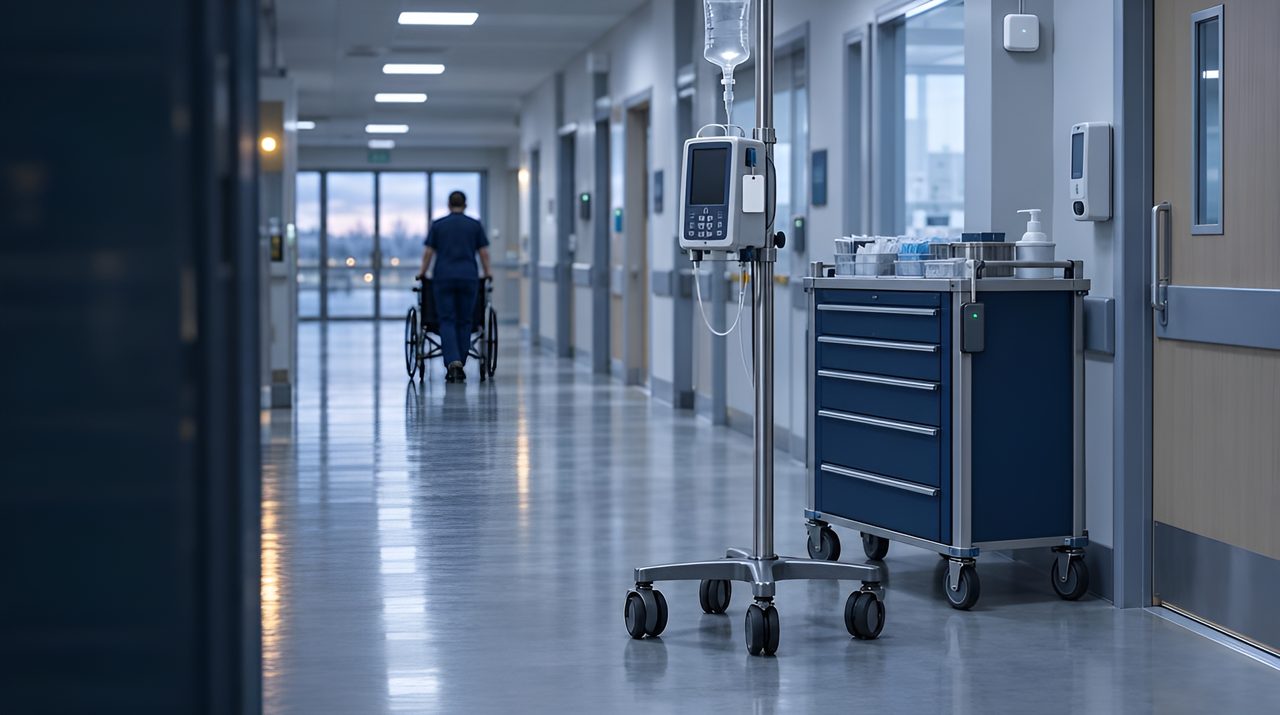
Healthcare: medical equipment found, patient flow visible, utilisation proved.Nurses searching for equipment instead of caring?
TRACIO designs hospital locating programmes around patient flow RTLS, hospital asset tracking and staff duress (BLE 5.x AoA, UWB and Passive RFID where each fits) feeding EHR utilisation and medical-equipment CMMS so operations, nursing and clinical informatics leads can measure their KPIs instead of estimating them.
Free 30-minute call with an adviser · written proposal with the price after · fixed-scope engagements from £3k.
How hospital tracking works.
The right radio for each job, mapped to your use case.
1 · Tag
Mobile equipment, beds and staff carry BLE or UWB tags.
2 · Locate
Find any piece of medical equipment, cart or asset in under 30 seconds.
3 · Integrate
Location flows to your EHR, CMMS and nurse-call system.
BLE 5.x AoA → assets · UWB → precision · RFID → supplies
Where hospitals lose time today.
Equipment hunting
Clinical staff lose time every shift hunting for medical equipment, telemetry, wheelchairs. So the hospital rents or buys more to cover for kit it already owns.
Patient flow bottlenecks
Emergency department throughput, bed turnaround and discharge readiness run on what people remember, not on recorded data, and length of stay goes up.
Compliance pressure
Accreditation visits, regulator inspections, hand-hygiene audits, infant security: every audit turns into a scramble for evidence.
Where tracking pays back in a hospital.
Mobile medical equipment locating
BLE 5.x AoA across acute wards. Find a monitor, pump or IV stand to within 1 to 3 metres in under 30 seconds. Direct integration with medical-equipment CMMS for work-order automation.
Patient flow analytics
Real-time bed-state, dwell, and transition events feeding your EHR. Handover from the emergency department to the ward measured in minutes, not estimated.
Staff safety & duress
Wearable duress badges with sub-room location precision. Emergency response times measured and improved.
Infant security
UWB or BLE infant-protection programmes with audit-grade chain-of-custody.
Hand-hygiene attestation
Tag-and-dispenser proximity events captured automatically. Compliance dashboards integrated with infection-prevention reporting.
Clinical workflow integration
HL7 v2 / FHIR R4 interfaces into your EHR, whichever supplier you run. Location signal triggers nurse-call escalations, theatre scheduling changes, discharge readiness flags.
Hardware & software ecosystem
CenTrak · Securitas Healthcare (formerly Stanley Healthcare / AeroScout) · Sonitor · AiRISTA Flow · Kontakt.io Care · Midmark · Versus / Midmark RTLS
Where we plug in
EHR and patient administration systems (for example Epic, Oracle Health, Meditech, Dedalus, InterSystems TrakCare, Cambio) · ServiceNow · medical-equipment CMMS (for example Maximo, Nuvolo)
What we design and document to
Your health-data law (GDPR in the UK and EU, HIPAA in the US, and the equivalent elsewhere) · HL7 v2 / FHIR R4 · IHE profiles · IEC 80001-1 for networks carrying medical devices · ISO/IEC 27001 · your accreditation body's standards
What changes on the ward.
Medical equipment & mobile equipment tracking
Clinical staff stop hunting for medical equipment, telemetry and wheelchairs. BLE 5.x AoA and UWB locating cut search time per shift and rental spend.
Patient flow & bed management
Bed-state and patient-flow events speed emergency department throughput and bed turn, integrated with the EHR, so patients move on without avoidable waits.
Hand-hygiene & staff safety
Automated hand-hygiene compliance, infant security, and staff-duress badges raise audit scores and protect lone clinicians.
Further reading: RTLS for hospitals (equipment, patient flow & safety) · UWB vs BLE · RTLS cost guide
Five use cases we see most in hospitals.
1 · Medical equipment found
Pain: Staff walk wards to find free medical equipment, and the library can't say what is out.
What good looks like: Staff see where free, clean items were last reported, and loans are recorded at the library.
Usually fits: barcode or RFID at the library, BLE or Wi-Fi where room level is worth it, confirmed in the survey. Asset tracking
2 · Instrument sets traced
Pain: Sets lose their record between theatre, decontamination and storage.
What good looks like: Each set is identified at every step and linked to its cycle and patient. Sterile services still release every set.
Usually fits: GS1 barcodes, 2D codes or sterilisation-grade RFID, read at each step, confirmed in the survey. Tool and instrument control
3 · Cleaning status before reuse
Pain: Used and clean items sit side by side.
What good looks like: Items show "needs cleaning" or "clean" from a recorded step. Location never decides an item is safe to reuse.
Usually fits: a scan at the cleaning point, plus location events where tags are fitted, confirmed in the survey.
4 · Staff duress with a location
Pain: Staff who need help can't always say where they are.
What good looks like: A duress call reaches responders with its room or zone. It supports your violence prevention and lone working procedures, and never replaces them.
Usually fits: staff badges on BLE, infrared or Wi-Fi where your risk assessment needs them, confirmed in the survey. Lone worker safety
5 · New builds planned in early
Pain: Readers, power and network points are added after handover, at extra cost.
What good looks like: Reader positions, power and network are agreed before walls are fixed, and coverage is tested before handover.
Usually fits: a coverage plan in the building design, confirmed in the survey. Survey and installation support
Also covered
- Patient flow: arrival to ward milestones recorded and shared with your EHR.
- Hand hygiene: dispenser data that supports the audits you already run.
- Specimens and implants: custody records at each handover.
- Cold storage: medicine and vaccine fridge records.
- Equipment servicing: recorded use alongside the manufacturer's schedule.
- Beds and rooms: how bed spaces are really used.
Location can be shared with your EHR, whichever supplier you use, through an interface your EHR team approves, under your change control. Get the healthcare brief
Solutions for this industry
Relevant case studies
More hospital use cases, in detail.
Hand-hygiene compliance with point-of-care attribution
Problem: Health regulators and WHO guidance expect hand-hygiene compliance to be monitored, but self-reported figures overstate real behaviour.
Tech mix: BLE-AoA or UWB on staff badges, BLE/IR sensors on dispensers and bed locations, attribution of every hand-hygiene event to a specific patient encounter.
What to measure: verified hand-hygiene compliance · evidence for your regulator or accreditation body (baseline each before the pilot).
Infant protection at bed level
Problem: Infant abduction is a low-frequency catastrophic event. Bed-level certainty of infant location is mandatory for maternity units.
Tech mix: BLE-AoA or ultrasound tags on infants, exit-door access control, real-time bed-level position monitoring.
Outcome: mother-infant matching verified, with an audit trail for your accreditation body.
Surgical instrument and tray tracking (CSSD)
Problem: Surgical sets can contain hundreds of instruments, and each set goes through the same loop: theatre, decontamination, inspection, packing, sterilisation and storage. Recording every step prevents loss, shows where each set is and confirms each set is complete before it goes back to theatre.
Tech mix: Instruments are identified, not located: a 2D DataMatrix or UDI mark (laser-etched or on a label) or an RFID tag built to survive repeated sterilisation, on each instrument or tray, read at every process step (decontamination, inspection, pack, sterilise, theatre) with scanners, RFID readers or smart cabinets. Integration with the sterile-services tracking system you already run. RTLS such as UWB or BLE suits trays, case carts and equipment, not individual instruments.
What to measure: instrument loss · surgical set readiness · retained-instrument incidents (baseline each before the pilot).
Capital asset utilisation (medical equipment, ventilators)
Problem: Hospital capital equipment is over-bought because finding free units is slow. Actual utilisation is often low while clinicians can't locate equipment.
Tech mix: BLE-AoA or Wi-Fi RTLS on every device, room-level zone visibility, integration with biomedical engineering CMMS.
What to measure: capital purchases · clinician search time · biomedical PM compliance (baseline each before the pilot).
Patient flow & length-of-stay reduction
Problem: Patient throughput in the emergency department, operating theatres and wards depends on visibility of patient location and process status. Opaque flow creates bottlenecks.
Tech mix: BLE-AoA on patient bands, EHR integration for process events, dashboards showing flow from the emergency department to the ward, and from theatre to discharge.
What to measure: emergency department length of stay · theatre turnover · inpatient throughput (baseline each before the pilot).
Wander prevention & unplanned exits
Problem: Confused, dementia, or post-anaesthesia patients can wander; the risk of leaving unnoticed is highest in geriatric and mental health units.
Tech mix: BLE wander-management tags on patients, exit-door interlocks, nursing-station alerts on zone-breach.
What to measure: unplanned exits · staff response time · family confidence (baseline each before the pilot).
Staff safety / lone-worker duress
Problem: Healthcare staff face workplace violence (clinical units, mental health and emergency departments especially). Staff must be able to summon help with location.
Tech mix: BLE-AoA or UWB duress badges, bed-level alarm raising, integration with security and unit-staff alert.
What to measure: staff duress response time · perceived safety · regulator/insurer compliance evidence (baseline each before the pilot).
Specimen and lab-sample tracking
Problem: Lab specimens (blood, tissue, biopsy) must be tracked from draw to result. Lost specimens cause re-draws, delays and patient anxiety.
Tech mix: Passive RFID on every specimen, fixed readers at draw, transport, lab and result, EHR integration for chain-of-custody.
What to measure: specimen loss · turnaround time · re-draw rate (baseline each before the pilot).
Consignment stock & implant tracking
Problem: Consignment implants (orthopaedic, cardiac) are high-value and have expiry dates. Managing them manually creates waste and theatre readiness issues.
Tech mix: Passive RFID on every implant, smart cabinet at theatre consumable storage, integration with materials management and procedure trolley preparation.
What to measure: consignment write-offs · surgical set readiness · implant chain-of-custody in the patient record (baseline each before the pilot).
Hospital bed and stretcher fleet management
Problem: Hospitals hold hundreds of beds and stretchers; finding a clean discharge-ready bed takes 5-20 min during peak turnover.
Tech mix: BLE-AoA on beds and stretchers, status (clean/dirty/in-use) from bedside terminals, integration with bed-management software.
What to measure: bed turnover time · wait from the emergency department to a ward bed · discharge throughput (baseline each before the pilot).
Related reading.
What you gain
Less time hunting for equipment
Nurses and porters find medical equipment, beds and wheelchairs from a screen instead of walking wards. Measured as time-to-find and “unable to locate” tickets for the tagged asset classes.
In earlier work by our advisers: from 22 minutes of hunting to under 30 seconds to find any medical equipment, see the case study.
Utilisation you can see before you rent or buy
Location and dwell data show how much of the fleet is in use, idle or hoarded. Measured as utilisation of the tagged pool and rental or re-purchase spend.
Patient flow with real timestamps
Arrival, treatment and discharge milestones are captured by location rather than keyed in late. Measured as waits between milestones and bed-turn time.
Faster help for staff under threat
A duress alert arrives with a location, so responders go to the right room. Measured as alert-to-response time in drills and live events.
Infant and wander protection that holds
Tag, zone and exit events trigger a lockdown or alert before a patient leaves the unit. Measured as alerts, false alarms and drill response times.
Custody for instruments, specimens and implants
Sets, samples and consignment stock carry a time-stamped trail from store to theatre or lab. Measured as missing items, mislabelled or lost samples and consignment reconciliation time.
Who else sells into healthcare RTLS and what programmes get wrong.
CenTrak, Securitas Healthcare, Midmark, Sonitor, AiRISTA and peers are widely used in clinical RTLS; dedicated bed-management systems own bed flow; EHR suppliers gate integration. Buying the radio without EHR, bed-management and clinical engineering ownership produces expensive maps nurses ignore.
What programmes get wrong: hospital-wide infrastructure before proving equipment search-time or emergency department flow; too many locators; and a weak link to the CMMS. Phasing the rollout and challenging the locator count keeps the spend under control.
Hospital RTLS programmes in major health systems.
Large health systems in Europe, North America, the Middle East and Asia-Pacific run equipment tracking, staff duress and patient-flow programmes. Cited as market examples of scale and governance, not as TRACIO clients.
Room-level, bay-level or sub-metre: match the accuracy to the workflow.
Most hospital RTLS disappointments start with the wrong accuracy for the job. Clinical-grade locating is not one technology. It is the right certainty in the right place.
- Room-level certainty (IR / Gen2IR hybrid, BLE). The standard for nurse call automation, staff duress with room-level alerts, hand hygiene compliance and patient-to-room association. Infrared cannot pass through walls, so it confirms which room, not just roughly where.
- Bay- and bed-level (BLE Angle of Arrival). Sub-metre X, Y positioning for emergency department bays, pre-op and recovery, bed management, wheelchair tracking and patient flow, without a UWB anchor in every room.
- Enterprise Wi-Fi RTLS. Rides your Cisco, HPE Aruba or Juniper network for asset tracking and equipment utilisation where zone-level answers are enough and rapid deployment matters.
- UWB and ultrasound. For the few workflows that need precision: infant protection at bed level, operating theatre and procedural analytics, clinical workflow studies.
- Passive RFID and smart cabinets. For supplies, implants, specimens and sterile processing, where choke-point reads beat live location.
Enterprise location services work best when one infrastructure carries several use cases: asset management, staff safety, infection control, environmental monitoring and wayfinding, rather than a new system per department.
From location data to capacity, safety and compliance.
Capacity and patient journey. Real-time location feeds patient flow analytics, bed management and discharge readiness, the inputs to capacity command centres and predictive, AI-driven staffing and bed planning. Location intelligence is what lets those models act on what is happening now, not what was charted an hour ago.
Staff safety and workplace violence prevention. Wearable duress badges and panic buttons with room-level alerts, routed to security and nearby staff, give clinicians fast help and give the hospital evidence for its workplace violence prevention programme.
Infection control. Automated hand hygiene compliance monitoring, contact tracing between staff, patients and equipment, and clean/dirty status for equipment turnaround and the cleaning teams.
Environmental monitoring. Continuous temperature monitoring for vaccine, pharmacy, lab and blood fridges, plus humidity and room pressure for operating theatres and isolation rooms, with alerts and audit trails for inspections and accreditation surveys.
Patient and resident safety. Wander management and prevention of unplanned exits for dementia, mental health and senior living, and infant protection and abduction prevention in maternity units.
Integration first. Location events only pay back when they land in the EHR, nurse call, medical-equipment CMMS and bed-management tools. We design the interfaces before the infrastructure.
Care homes, senior living & wander management.
Care homes and assisted-living operators face the same locating questions as hospitals, at a different scale: knowing that a resident at risk has left a safe area, reaching a fall or a call with a location, and protecting staff who work alone at night.
- Wander management: door and perimeter alerts for residents at risk, without locking every door for everyone
- Resident call and fall alerts that arrive with a location
- Staff duress on the same infrastructure: see lone-worker safety
- Dignity by design: alerts on exits and zones rather than continuous tracking, with consent and capacity decisions recorded (in line with the capacity and liberty-protection rules that apply where you operate)
Many homes already have a nurse-call or door-access system. The first question is usually whether to extend it or replace it, and we answer that before anyone buys tags.
Hospital goods transport (AGVs and AMRs)
Moving meals, linen, waste, pharmacy and sterile supplies around a hospital takes a lot of staff time, often through public corridors and lifts. We help you choose the right AGV or AMR for each flow first, then check what it takes to run them safely around patients, staff and visitors.
- An independent review of an existing AGV system: how routes, lifts, doors and charging perform, where it fails, what it costs to keep running, and whether to fix or replace it.
- Meals, linen and waste moved on set routes, with clean and dirty loads kept apart.
- Pharmacy and sterile supplies delivered to wards and theatres when they are needed.
- Replacing an ageing hospital AGV system without stopping the service.
- Lift, door and fire-door interfaces agreed with your estates, fire safety and infection prevention teams.
- Charging and uptime, and routing around patients and staff at peak times.
- Robot fleet management: one fleet manager for vehicles from different manufacturers, shared lifts, doors and chargers, and links to hospital and estates systems.
We don't sell vehicles or fleet software. Sign-off for safety, fire and infection control stays with your own specialists. See AGV vs AMR and AMR and AGV consulting, including AMR/AGV fleet management, or book a free scoping call to talk it through. Free briefs: AMR and AGV fleets, and AMR/AGV fleet management.
How an engagement works in healthcare.
Stages, with a gate after each
- Scoping call: 30 minutes with our advisers; a written proposal with the price if there is a fit.
- Discovery & business case: use cases, KPIs and technology direction (typically 1 to 5 days on site).
- Supplier selection: requirements, shortlist, RFP and TCO (typically 3 to 6 weeks).
- Pilot: judged against pass/fail criteria written before any equipment goes in (with timings agreed per site).
- Rollout & handover: scoped per project, phased by site or wave.
What we need from you
- A named sponsor who can sign off each gate
- An operations lead and an IT/OT contact for a few hours a week
- Site drawings, floor plans and process maps
- Access to your EHR, biomedical CMMS and nurse-call systems
- Ward and department access, infection-control rules and time with a clinical lead
Hospital tracking: find medical equipment and speed up porter jobs
Play the video (1:25). It loads from YouTube when you click.
Frequently asked questions
What is patient flow RTLS in a hospital?
Patient flow RTLS locates patients, beds and key equipment in real time so patients waiting in the emergency department for a bed, bed turnover and theatre throughput are visible without manual status boards. Paired with hospital medical equipment tracking and EHR utilisation feeds, it shortens search time and supports staff duress workflows on the same BLE-AoA or UWB layer.
What can RTLS track in a hospital?
Mobile equipment such as infusion pumps, wheelchairs and beds, staff duress and safety, patient and people flow, temperature for vaccines and blood, hand-hygiene compliance, and overall asset utilisation, often on one platform.
How accurate does healthcare RTLS need to be?
It varies by use case. Room or bay level (BLE or Wi-Fi) is enough for equipment and patient flow; bed or centimetre level (UWB) suits workflow analytics and infant protection; choke-point reads (RFID) handle sterile-instrument tracking.
Is RTLS safe and compliant in clinical settings?
Yes. The low-power radio used by BLE, UWB and RFID is non-interfering with medical devices, and we design to your IT security, data-privacy (GDPR, HIPAA or your local equivalent) and clinical-engineering requirements from day one. TRACIO never processes patient data, and has no access to your systems unless you grant it for a project.
Will it integrate with our EHR, CMMS and nurse-call systems?
Yes. Location and event data feeds your EHR, biomedical CMMS, RTLS-aware nurse-call and building systems through standard interfaces, so the information lands where clinicians and engineers already work. See our CMMS integration notes.
Do we need new Wi-Fi or cabling?
Not always. Some solutions ride your existing Wi-Fi or BLE. Others need dedicated anchors. We survey first and reuse infrastructure wherever it meets the accuracy you need.
What is clinical-grade RTLS?
It means location certainty good enough to automate a clinical workflow, not just show a dot on a map. In practice that is usually room-level certainty from infrared or a hybrid IR and BLE system for nurse call automation, staff duress and hand hygiene, plus BLE Angle of Arrival where bay- or bed-level position is needed.
Can RTLS support workplace violence prevention?
Yes. Wearable duress badges and panic buttons send a staff member's room-level location to security and nearby colleagues in seconds, and the event record supports your workplace violence prevention programme and incident review.
Which hospital RTLS suppliers do you evaluate?
We assess clinical RTLS platforms including CenTrak, Securitas Healthcare, AiRISTA, Kontakt.io, Sonitor and Midmark, alongside Wi-Fi and BLE options on your existing network. We don't sell hardware, so our advice stays independent. The recommendation follows your workflows, infrastructure and budget.
What does a healthcare engagement cost?
It depends on scope and the number of sites. Every engagement is scoped per project and priced in writing before work starts: £3k to £30k per project, or £1,200 a day in the UK. Regional ranges for Europe, North America and other regions are on how we work. Extra sites, on-site RF survey and integration into more than one system of record add to the scope. Hardware and licences are extra: you buy them direct from the supplier, and we don't resell them.
How long does a healthcare engagement take?
Discovery usually takes 1 to 5 days on site, supplier selection typically 3 to 6 weeks and a pilot with timings agreed per site, with a gate after each. Rollout is scoped per project.
What if the pilot fails?
It stops at the gate. The pilot is judged against written pass/fail criteria agreed before any equipment goes in, so a fail is a clear result, not an argument. You pay no rollout costs and keep the artefacts from each stage: requirements, scored shortlist, TCO, RFP pack, pilot criteria and the measured results. Pilot equipment can be rented, so there is no capex to write off.
Who owns the data, and can we avoid supplier lock-in?
You own it. Your data and IP stay yours, with full export. During supplier selection we put data export, open APIs and exit terms into the RFP and contract, so you can change supplier later without starting again.