
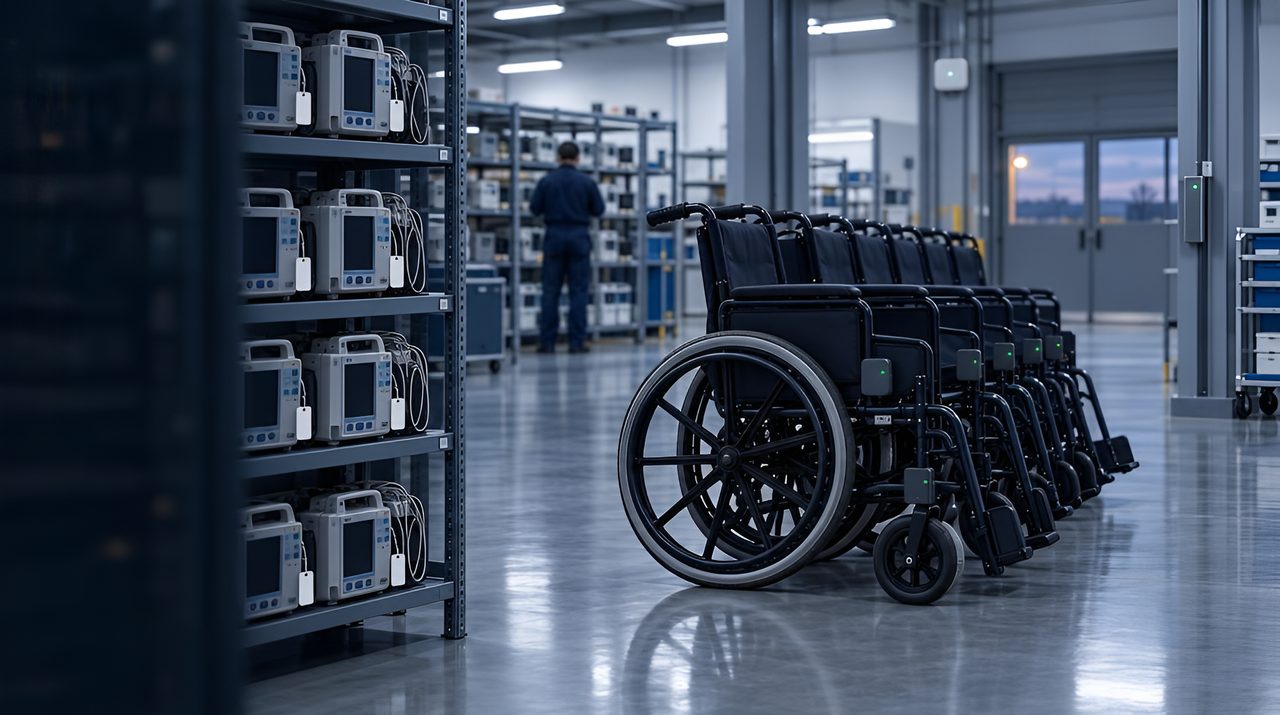
Hospital asset tracking: independent medical equipment locating.Staff spending shifts searching for medical equipment?
Hospital asset tracking starts with a simple problem: nurses and biomed teams lose time hunting for mobile medical equipment, and the hospital buys or rents more to cover the gap.
The RTLS that fixes this lives in BLE-AoA most often, UWB occasionally, RAIN RFID at supply points. The deciding question is rarely which radio. It is the integration to Epic, Cerner or Meditech.
Free 30-minute call with an adviser · written proposal with the price after · fixed-scope engagements from £3k.
The clinical workflow this serves.
Biomedical engineering teams locate, prep and stage equipment (medical equipment, vents, monitors, mobile imaging) against ward demand. Without live location, the team escalates to over-purchasing or rental, which compounds budget pressure year over year.
Live equipment location lifts medical equipment utilisation, gives nurses back search time on every shift, and lets biomed shift from reactive triage to PM-scheduled service.
The clinical credibility of the system depends on the workflow integration as much as the location accuracy. Medical equipment that appears in Epic but require a separate dashboard get ignored.
Technology selection: which radio for which clinical zone.
BLE-AoA (Quuppa, Aruba, Cisco Spaces, Juniper Mist) for most equipment locating: sub-metre accuracy, battery life in years, clinical workflow fit.
UWB is usually the most precise of these options. The accuracy you get depends on your site, and we confirm it in the survey.
Passive RFID at supply points (clean utility, dirty utility, soiled holds) for cycle-count workflow rather than continuous location.
Active RFID in legacy CenTrak / Stanley Healthcare AeroScout installations: we frequently advise on rip-and-replace vs incremental migration of these systems.
Integration is the deciding commercial point.
Epic (Beacon, Rover, Hyperspace) integration is the standard for US hospitals; the event-stream wiring is well-trodden but the workflow design varies wildly by site.
Cerner / Oracle Health integration via OPC-UA, HL7 or proprietary APIs depending on the version.
Meditech, AllScripts, in-house EMRs: integration scoping is the deciding cost line, not the radio.
Biomed CMMS integration (TMS, Nuvolo, Maximo) often as important as EMR. Biomed-led adoption usually drives the success metric.
What the install economics actually look like.
Hardware prices come from supplier quotes in the survey. Density typically 1 per 60-100 m² for clinical workflow accuracy.
Hardware prices come from supplier quotes in the survey. An independent design audit often cuts the Locator count while still meeting the accuracy KPI.
Hardware prices come from supplier quotes in the survey.
See our infrastructure service for the design-audit engagement model and the BLE-AoA density guide for technical detail.
Who sells medical equipment locating and what hospitals get wrong.
The same healthcare RTLS field as patient flow (CenTrak, Securitas Healthcare, Midmark, Sonitor, AiRISTA, HID/GuardRFID-class infant and asset suites, plus BLE-AoA platforms via Aruba/Quuppa-style integrators) also sells equipment locating. Difference: the buyer is often clinical engineering and finance chasing rental avoidance and search-time, while nursing still has to trust the map. Supplier packages bundle tags, Locators and a console. SI quotes follow the supplier density model.
What programmes get wrong: tagging everything before proving medical equipment and one high-rent category; Locator over-density that an independent audit can often cut; weak CMMS/EMR integration so location never opens a work order; and ignoring PAR-level process so RTLS becomes an expensive lost-and-found.
TRACIO challenges density, selects radio per clinical zone, and designs CMMS/workflow integration without a cut on tags or locators. Coordinate with patient flow when the same infrastructure must serve both jobs.
What clinical engineering needs before the map is trusted.
Equipment locating pays back on search-time, rental avoidance and PAR discipline, not on tagging the entire biomedical inventory on day one. Pick one or two high-rent, high-search categories (medical equipment are the classic), set a baseline search-time study with clinical engineering and nursing, then design radio and density to hit that job. Expanding categories is easy after trust exists. Boiling the ocean is how budgets die.
CMMS integration should turn location into maintenance and distribution action (open work orders, update asset status, trigger PAR replenishment), not leave a separate console nurses check “when they remember.” Charger and battery programmes, tag loss, and equipment that leaves campus for repair need explicit process. Privacy and staff-feeling issues arise when badges blur equipment and people tracking. Keep the use case crisp.
Independent Locator density audits can often cut hardware against supplier drawings while meeting ward-zone accuracy. Shared infrastructure with patient flow is fine if identity, zones and clinical ownership are designed once. Supplier PS will install their count. They will not challenge it.
Acceptance: measured search-time reduction on the pilot category, rental spend movement where that was the business case, PAR compliance improvement, and a runbook clinical engineering can execute without the supplier on speed-dial.
Medical equipment locating at health-system scale.
Equipment tracking is common in large hospital groups. The patterns below reflect how those market programmes are typically procured and integrated, not named TRACIO work.
Frequently asked questions
Why BLE-AoA rather than UWB for hospital equipment?
Battery life. Hospital equipment tags need to last 3-5 years on a single battery. UWB tags need replacement every few months at typical update rates. BLE-AoA gives sub-metre accuracy with years of battery life, which fits clinical asset workflow.
Do we have to rip out our existing CenTrak / Stanley Healthcare system?
Not necessarily. We frequently advise incremental migration: new ward deployments on BLE-AoA / UWB, legacy active-RFID system kept running until refresh cycle. The integration layer hides the underlying radio so the EMR-side workflow is consistent.
How does this integrate with Epic / Cerner / Meditech?
Via the EMR's location-service API. Epic Beacon and Hyperspace, Cerner via HL7 / FHIR, Meditech via proprietary or middleware. The event stream feeds both the EMR location field and biomed CMMS work orders.
What ROI is typical?
Lower medical equipment rental spend, nurse search time recovered on every shift and higher equipment utilisation. Your own payback case comes from a baseline measured before the pilot.
Last updated: