
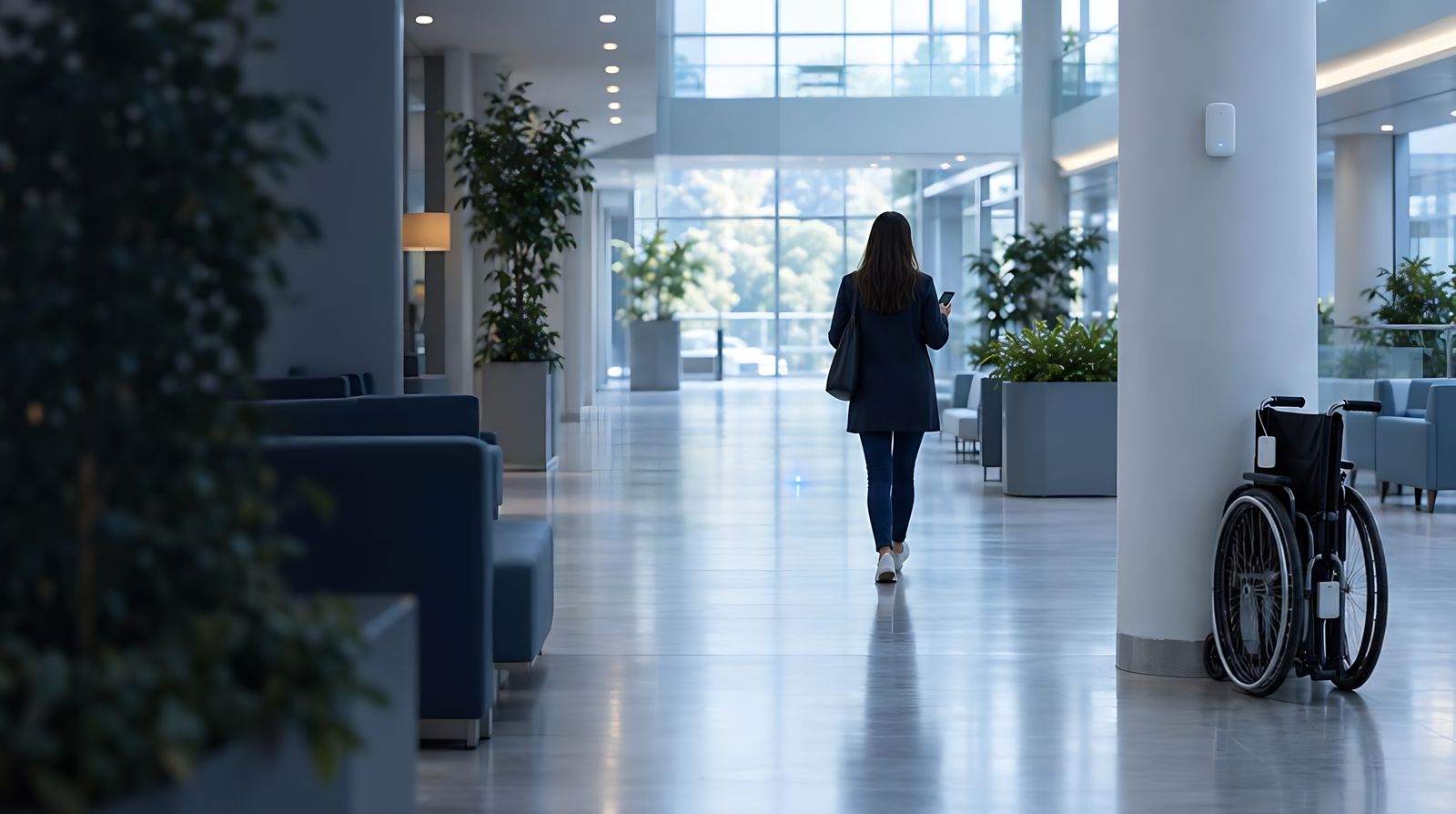
Indoor wayfinding: late arrivals are the metric.Late arrivals because people can't find their way?
Indoor wayfinding RTLS where late arrivals are the metric. A blue dot is a feature, wayfinding that belongs in the app and building systems you already operate.
Free 30-minute call with an adviser · written proposal with the price after · fixed-scope engagements from £3k.
Blue-dot wayfinding fails when the map and the building disagree.
Map hygiene
CAD that is six renovations behind the walls will route people into closed corridors. Budget for survey and change-control, not only SDKs.
Cold start
First fix in a multi-floor atrium is the hard problem. BLE/UWB hybrids and vertical transitions need explicit design, “it works in the demo hallway” is not enough.
Visitor vs staff
Visitors need phone-first journeys. Staff need badge and workflow integration. One app rarely serves both without friction.
Indoor wayfinding: how it works, and what it pays back.
The right positioning technology for your building (chosen for your building) behind a blue-dot experience people already understand.
1 · Map
We digitise your floor plans and points of interest (rooms, clinics, desks, exits and accessible routes) into a routable map.
2 · Position
BLE beacons, UWB or Wi-Fi place a blue dot on the visitor’s phone, browser-based where possible so there is no app to install.
3 · Guide
Turn-by-turn routing to any destination, plus footfall and dwell analytics to improve layout and signage.
Which technology fits.
We don't sell hardware, so our advice stays independent.
BLE beacons
Broad coverage at low cost: the workhorse of blue-dot navigation.
UWB
Sub-metre guidance where precision matters.
Wi-Fi / VPS
Re-use existing Wi-Fi or visual positioning to limit new hardware.
Industries this solution suits
From “where do I go?” to door-to-door directions.
A large hospital rolls out browser-based wayfinding linked from appointment texts. Patients route themselves from the car park to the right clinic, missed and late appointments fall, and reception stops escorting lost visitors.
Typically bought by: Facilities, patient experience / operations, estates, digital / IT.
Suppliers we evaluate for this use case
Where this solution wins: examples by sector.
Hospital visitor wayfinding (healthcare)
Visitor navigation in complex hospital campuses.
Airport passenger wayfinding (transport)
Terminal navigation for passengers.
Conference and venue wayfinding (workplace)
Event-venue navigation and session-finding.
Retail store wayfinding (retail)
In-store product-location and aisle navigation.
Industrial-site visitor wayfinding (industrials)
Industrial-site safety and induction.
Who needs this kind of programme.
Hospitals, campuses and airports where missed appointments and staff escort time dominate the cost of getting lost.
Retail and venue operators combining indoor navigation with occupancy and blue-dot experiences.
IT/network teams asked to turn on wayfinding on existing Aruba or Cisco Wi-Fi/BLE without a second locating estate.
What buyers compare in this market.
Buyers usually shortlist Cisco Spaces and Aruba when wayfinding is an extension of the enterprise WLAN, versus dedicated BLE beacon platforms (Kontakt.io, Estimote-class) when map UX and SDK control matter more than network ownership. Clinical campuses sometimes fold wayfinding into the same RTLS estate used for patient flow, CenTrak/Midmark/AiRISTA-class, which only works if the accuracy and privacy model match both jobs.
TRACIO scopes map maintenance, blue-dot accuracy expectations, offline behaviour and who owns floor-plan updates. The failure modes that kill wayfinding after the pilot demo.
Why wayfinding stalls after go-live.
Maps rot. Renovations without a map ops process make the app worse than paper signs.
Accuracy sold, not measured. Marketing turn-by-turn without RF survey evidence creates helpdesk tickets, not fewer late arrivals.
Orphan apps. Wayfinding that never connects to appointments, kiosks or digital signage stays a novelty.
Independent.
We advise whether network-native locating is enough, when a dedicated BLE layer pays back, and how to keep map governance affordable.
Frequently asked questions
How does indoor navigation work without GPS?
Indoor positioning (BLE, UWB or Wi-Fi) locates the user on a venue map and gives turn-by-turn directions. The indoor equivalent of GPS, which does not work reliably inside buildings.
Do visitors need an app?
Often, but not always, blue-dot navigation usually runs in a mobile or web app. Some venues add kiosks and digital signage for people who do not install anything.
How accurate does wayfinding need to be?
A few metres is enough to guide someone down the right corridor. Denser BLE or UWB improves accuracy in complex venues such as hospitals and airports.
What else can the same infrastructure do?
The positioning layer that powers wayfinding can also drive asset tracking, occupancy and analytics, so navigation often funds a broader RTLS platform.
What is the benefit?
Less time and stress finding rooms, fewer missed appointments and 'where is it' calls, and footfall analytics for large, complex buildings.
Last updated: 5 October 2026