
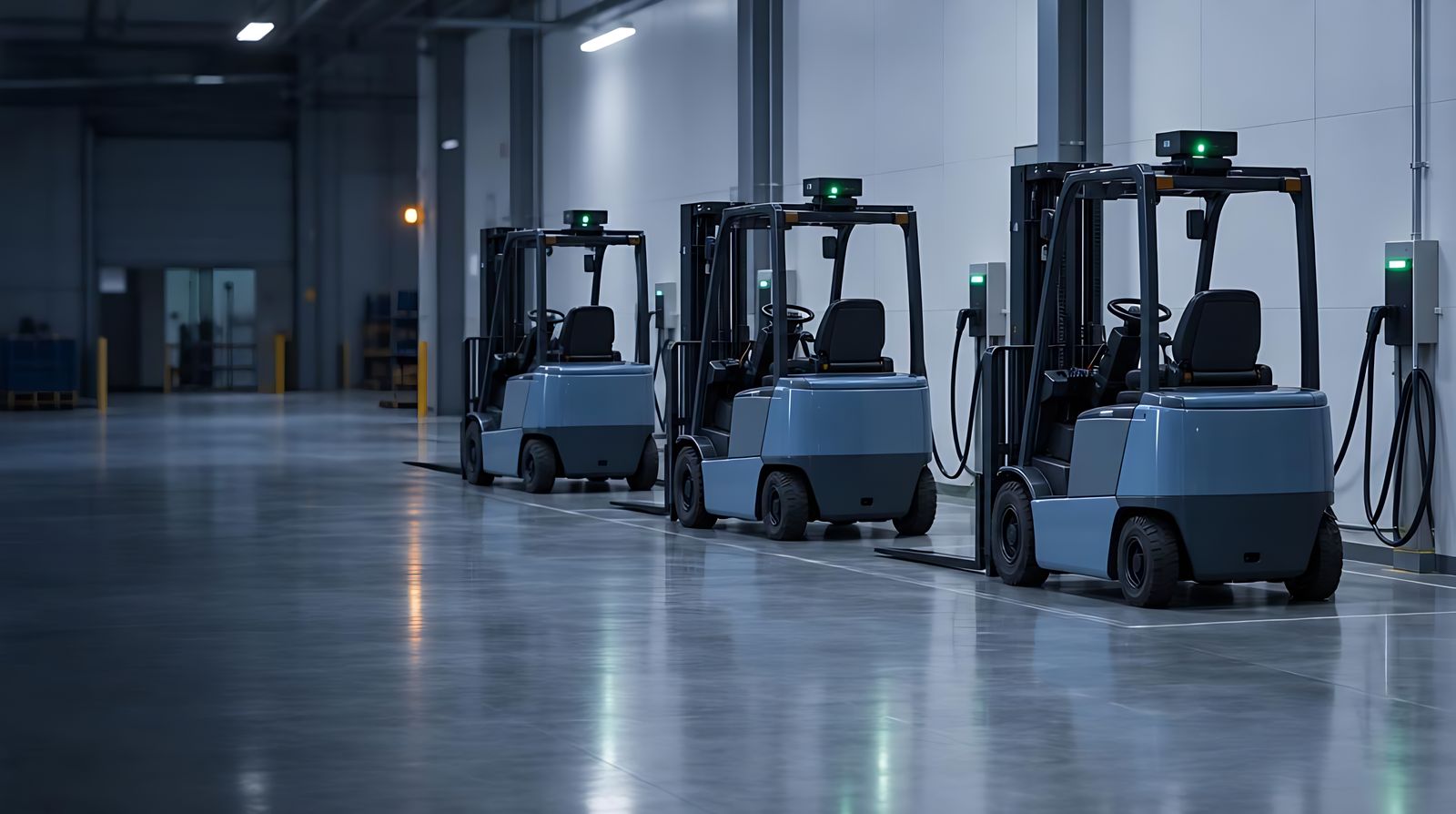
Forklift and vehicle tracking: right-size the fleet and record the near-miss.Too many forklifts, or too few? Most sites can't tell.
Forklift tracking RTLS that right-sizes the fleet and records the near-miss. Material-move visibility safety and throughput KPIs can share.
Free 30-minute call with an adviser · written proposal with the price after · fixed-scope engagements from £3k.
Indoor material-handling utilisation and impacts. For yard/GPS fleets see vehicle telematics. For multi-site construction/mining plant see heavy equipment.
Forklift programmes stall when impacts are logged but behaviour never changes.
Impact without coaching
G-force events without a review ritual train drivers to ignore the beeper. Pair hardware with a weekly exception huddle.
Indoor RF
Racks and metal kill naive BLE. Validate aisle-level accuracy on the live floor before you promise utilisation %.
WMS truth
Truck location that never updates task assignment is a vanity map. Integrate or keep the scope accurate.
Forklift & vehicle tracking: how it works, and what it pays back.
The right radio for the job, mapped to your use case.
1 · Tag the fleet
Each truck gets a UWB/GPS tag and an impact/telematics sensor.
2 · Measure
Real utilisation, idle time, routes and impacts are captured per vehicle, live.
3 · Optimise & enforce
Right-size the fleet, schedule maintenance on real hours, and lock out after impacts.
UWB → indoor · GPS → yard · telematics → impacts
Which technology fits.
We work for you, not for the technology providers.
UWB
Sub-metre indoor vehicle location.
GPS/GNSS
Outdoor yard and site.
Telematics
Impact & usage data.
Industries this solution suits
Right-size the fleet on real hours.
A logistics site fits its trucks with location and impact sensors. Real utilisation shows several forklifts idle most of the shift, the fleet is trimmed, and impacts trigger operator lockout and a safety review.
Typically bought by: Warehouse operations, fleet / asset managers, EHS, finance.
Relevant case studies
Where this solution wins: examples by sector.
DC and warehouse fleets (logistics)
Utilisation analytics right-size the fleet and pre-empt maintenance.
Manufacturing intralogistics (manufacturing)
Forklift movement data informs layout and process improvements.
Retail DC peak-season scaling (retail)
Peak-season forklift planning informed by real utilisation data.
Cold-storage operations (logistics)
Special-environment forklift health and utilisation.
Construction-equipment yard rentals (industrials)
Rental utilisation and theft prevention.
Who needs this kind of programme.
Manufacturing and DC operations right-sizing MH fleets, proving utilisation and cutting congestion.
EHS and site leadership linking truck location to near-miss and impact evidence (often alongside collision-avoidance).
Maintenance / fleet owners who need hour meters and zone dwell in the CMMS, not another siloed map.
What buyers compare in this market.
Indoor MH locating is typically a UWB/RTLS shortlist (Sewio, Ubisense, Pozyx, Litum-class), sometimes hybridised with vehicle telematics outdoors. Warehouse teams also hear AMR suppliers pitch fleet visibility as a substitute. That is a different buy (see fleet orchestration) and rarely replaces forklift utilisation or impact telemetry.
TRACIO separates three jobs that suppliers blur: (1) where is the truck, (2) is the operator and pedestrian safe, (3) what utilisation and maintenance story finance trusts. Wrong bundling is how programmes stall.
Why forklift RTLS fails.
Map without rituals. Live dots that never change dispatch, charging or fleet counts do not pay back.
Safety bolted on late. Collision use cases need different antennas, mounting and acceptance tests than pure tracking.
Outdoor/indoor seam ignored. Yard GPS and indoor UWB without identity continuity break utilisation reporting.
Independent.
We don't sell hardware, so our advice stays independent. We run the RF survey, accuracy acceptance and WMS/CMMS integration so the locating layer serves operations, not a hardware roadmap.
Frequently asked questions
What can we learn from tracking forklifts?
Real-time location and utilisation, congestion hotspots, distance travelled, idle time, impact events, and whether you have too many or too few trucks for the work.
Does it also improve safety?
Yes, the same hardware supports speed zoning, pedestrian proximity warnings and impact logging, tying fleet efficiency and safety into one system.
What accuracy and technology fit?
BLE or Wi-Fi gives zone-level fleet visibility cheaply. UWB gives precise lane-level position where you need it. We pick per goal, utilisation rarely needs centimetres.
Will it integrate with our fleet-management or telematics?
Location and event data feed your fleet-management system and WMS via API, complementing OEM telematics with the site-wide indoor position they do not provide.
What is the payback?
Right-sizing the fleet by deferring leases, cutting search and travel time, and reducing impact damage typically pays back quickly across a multi-truck operation.
Last updated: 5 October 2026