
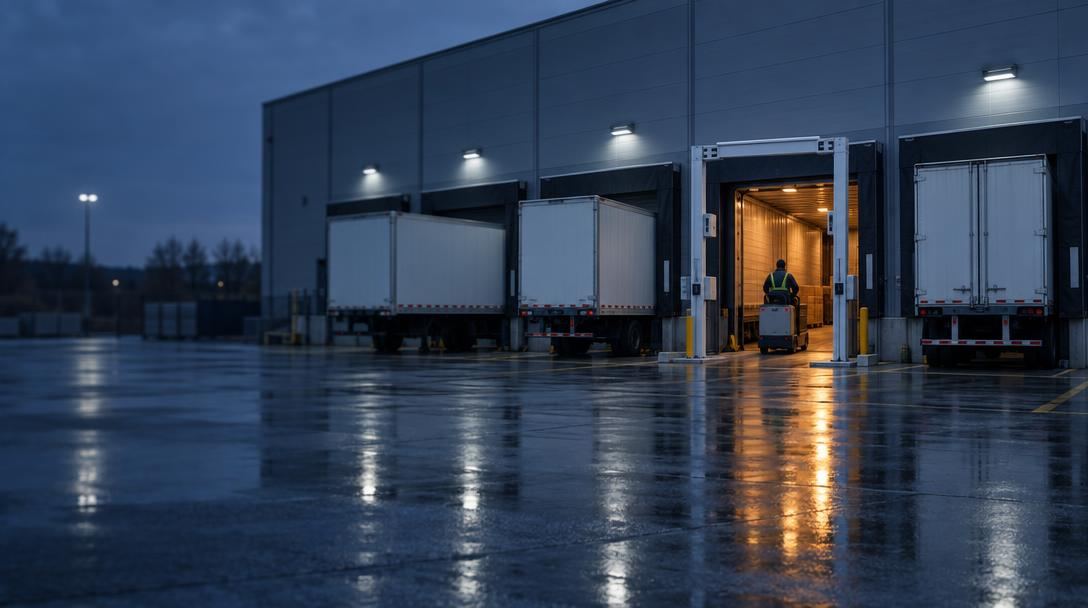
Logistics and warehousing: dock doors reconciled, yards visible, dwell cut.Dock doors not reconciled and dwell creeping up?
TRACIO designs yard tracking and passive RFID programmes for 3PL and DC operators (dock door RFID, trailer dwell, forklift safety and 3PL inventory locating) integrated with Manhattan, Blue Yonder, SAP EWM and your YMS.
Free 30-minute call with an adviser · written proposal with the price after · fixed-scope engagements from £3k.
How it works in Logistics & 3PL.
The right radio for each job, mapped to your use case.
1 · Read
Passive RFID reads every pallet at the dock door, automatically.
2 · Locate
BLE and UWB track trailers, cages and high-value assets across the yard.
3 · Reconcile
Inbound and outbound are matched live into your WMS and TMS.
Passive RFID → dock · BLE → yard · UWB → high-value
Common problems in Logistics.
Manual dock reconciliation
Goods-receipt audits done by humans miss or over-state inbound. Inventory accuracy slowly bleeds away.
Yard 'where is it?'
Trailers parked. Yard truck assignments verbal. Dispatch makes the wrong move because no one has the live picture.
Forklift safety & misuse
Forklift incidents have a human and an insurance cost. Utilisation is misread because there's no operational signal.
Use cases with a clear payback.
Dock-door RFID
Passive RFID portal at every dock door. Auto-reconcile inbound and outbound against ASN. Exception-based investigation instead of full-pallet audit.
Yard truck & trailer
BLE / GPS-hybrid on trailers, GPS-RTK on yard trucks. Dispatch sees the yard live, picks routes optimally.
Forklift safety & utilisation
UWB on forklifts with pedestrian-tag proximity alerts. Speed, dwell, and idle dashboards for fleet optimisation.
Returnable transit items
BLE on RTIs (totes, dollies, cages). Stop accepting RTI losses as 'normal'.
Cold-storage compliance
Temperature + location + dwell logging for cold-chain operators. GDP-aligned reporting.
AGV / AMR fleet
Choosing the right AMRs for goods-to-person and transport workflows, with a VDA 5050 readiness check before mixing brands.
Hardware & software ecosystem
Impinj · Zebra · Mojix · Ubisense · Sewio · MiR · Otto Motors · Locus Robotics · Geek+
Where we plug in
Manhattan Active Warehouse · Blue Yonder · SAP EWM · Körber WMS · Oracle Fusion Warehouse · ServiceNow
What we design and document to
GS1 SSCC / GLN / GTIN · EDI 856 (ASN) · C-TPAT · AEO · ISO 9001
Where it pays back in Logistics & 3PL.
Dock-door & inbound reconciliation
Passive RFID at every dock door auto-reconciles the ASN against what was physically received; claims, shrink and manual scanning fall.
Yard & trailer management
Trailer location and dwell turn detention into a measured, billable metric. Over 2 million euros a year saved in comparable rollouts.
Returnable transit item tracking
Pallets, totes and roll-cages tracked and recovered, cutting asset loss and replacement spend across the network.
Further reading: Passive RFID vs RTLS · RTLS cost guide
Five use cases we see most in warehouses and yards.
1 · Every pallet checked at the dock door
Pain: Deliveries are accepted by eye and load checks can be skipped, so errors show up in claims.
What good looks like: Pallets read in and out, checked against the ASN and the load plan, with stray reads filtered.
Usually fits: UHF RFID portals at dock doors, or scans where volumes are lower, confirmed in the survey. Dock door RFID
2 · Pallet the WMS says is here
Pain: Staff search racking for pallets that are not where the WMS says.
What good looks like: Each pallet read at put-away, with rack and level confirmed and mismatches flagged.
Usually fits: UHF RFID with forklift-mounted readers and location tags or scans, confirmed in the survey. Inventory accuracy
3 · Trailer location and dwell
Pain: Trailers are found on foot, and waiting time is a guess.
What good looks like: Each trailer shows its last reported place and time on site, from gate in to gate out.
Usually fits: GNSS trackers with LPWAN, or gate and dock reads, confirmed in the survey. Yard & trailer
4 · Choosing AMRs and AGVs
Pain: Robots from different manufacturers often have their own control systems, and VDA 5050 support varies.
What good looks like: The right AMR or AGV chosen first. Then we check which robots and fleet managers really support VDA 5050, and which version, and test them together.
Usually fits: the right robot for each job, and a VDA 5050 fleet manager only where every robot supports it, confirmed in the survey. AMR and AGV advisory
5 · Staging lane visibility
Pain: Nobody can see which lanes are full, waiting or ready to load.
What good looks like: A view of what is in each lane and how long it has waited.
Usually fits: UHF RFID or BLE battery tags by lane, or scans at lane entry, confirmed in the survey.
Also covered
- Forklift tracking: where trucks are, utilisation and idle time.
- Collision avoidance: forklift and pedestrian proximity alerts that support existing safety measures and don't replace them.
- Cycle counting and inventory accuracy: RFID counts with fixed readers and handheld scanners.
- Returnable assets: roll cages, totes, stillages and pallets.
- Cold chain monitoring: temperature of stock and zones.
- Flow and layout: travel paths and congestion.
Relevant case studies
More use cases, in detail.
Dock-door receiving reconciliation
Problem: Receiving teams reconcile inbound shipments against ASNs manually or with handheld scans. Discrepancies are found after putaway, creating re-handles.
Tech mix: Passive RFID portals at dock doors, bulk-read of pallets/cases against ASN, WMS integration for automated reconciliation.
What to measure: reconciliation time · putaway errors · supplier-chargeback evidence (baseline each before the pilot).
Yard management: trailer & container visibility
Problem: Yards hold hundreds of trailers and containers; finding the right one for outbound costs 20-60 min per dispatch event.
Tech mix: GNSS or LoRaWAN trackers on every trailer/container, gateway coverage, integration with TMS and gate operations.
What to measure: yard search time · dispatch reliability · yard dwell time (baseline each before the pilot).
Cold-chain monitoring through transport
Problem: Temperature-sensitive cargo (pharma, food, perishables) must be monitored end-to-end. Excursions cause loss and regulatory exposure.
Tech mix: BLE or LoRaWAN temperature loggers in every shipment, gateway coverage at hubs, integration with TMS and compliance evidence.
What to measure: excursion-related write-offs · regulator-audit evidence · customer complaints (baseline each before the pilot).
Cross-dock sortation throughput
Problem: Cross-docks sort thousands of cases per hour; mis-sorted cases create downstream re-handles and missed cut-offs.
Tech mix: Passive RFID on every case, fixed-reader conveyor portals, sortation-control integration with WMS.
What to measure: sortation accuracy · throughput · missed cut-offs (baseline each before the pilot).
Pick-path optimisation with AMR
Problem: Warehouse pickers walk 7-10 miles per shift; pick-and-walk is the biggest labour cost in fulfilment.
Tech mix: AMR fleet (Locus, Geek+, MIR), WMS integration with VDA 5050 orchestration, BLE-AoA for picker-AMR association.
What to measure: picks per hour · pick-walk distance · peak-season throughput without flex labour (baseline each before the pilot).
Returnable-asset (RTI) tracking across the supply chain
Problem: Returnable containers, pallets and dollies cycle between shipper, carrier, customer and back.
Tech mix: Passive RFID on every RTI, fixed readers at chokepoints across the network, integration with logistics platform.
What to measure: RTI loss · working capital tied up in RTI · audit reconciliation effort (baseline each before the pilot).
Time-and-location proof of delivery
Problem: Last-mile delivery requires verifiable proof of place and time. Disputes cost shippers in chargebacks and customer trust.
Tech mix: Driver mobile + GNSS proof, Passive RFID scan of consignment at handover, customer-app confirmation, integration with TMS.
What to measure: delivery disputes · claims processing time · audit-trail completeness for high-value consignments (baseline each before the pilot).
Dock-to-stock cycle time reduction
Problem: Time from dock arrival to inventory availability (D2S) is a key metric. Manual processes often make it slow.
Tech mix: Passive RFID at receiving + putaway, AMR for transport, real-time WMS integration.
What to measure: dock-to-stock time · inventory availability for orders · inbound stockout risk (baseline each before the pilot).
3PL multi-client visibility
Problem: 3PLs run multiple client inventories in shared facilities. Clients demand real-time inventory and movement visibility.
Tech mix: Multi-tenant WMS + Passive RFID, client-facing dashboards, BLE-AoA for labour attribution by client.
Outcome: Client-billable activities accurately captured, client trust improved, new-client onboarding faster.
Freight-forwarding consolidation visibility
Problem: Air and ocean freight consolidation moves many small shipments through hubs. Losing track at hubs is the largest claim category.
Tech mix: Passive RFID on every consolidated piece, fixed readers at consolidator hubs, integration with forwarding TMS.
What to measure: lost-shipment claims · consolidation processing time · hub-throughput visibility (baseline each before the pilot).
Related reading.
What you gain
Dock doors that reconcile themselves
Pallets and cases are read as they cross the door and checked against the ASN or order. Measured as receiving and shipping discrepancies, claims and rework.
In earlier work by our advisers: Dock-door and yard visibility for a European 3PL, see the case study.
Yard and dock throughput you can see
Every trailer has a known spot and status, so shunters stop searching and doors stop waiting. Measured as gate-to-dock dwell, trailer-find tickets and dock-door utilisation.
Faster dock-to-stock
Receipts are confirmed at the door and put-away is tracked, so stock is sellable sooner. Measured as dock-to-stock time and put-away exceptions.
Returnable assets that come back
Pallets, cages and totes are counted through each hand-off in the loop. Measured as loop losses, dwell with customers and replacement spend.
Proof of delivery with time and place
Delivery events carry a location and timestamp, so disputes are settled from records. Measured as disputed deliveries and time to resolve a claim.
Per-client visibility for 3PLs
Inventory and movements are reported by client from the same event stream. Measured as time to produce client reports and inventory-accuracy disputes.
Who else sells into logistics locating and what programmes get wrong.
3PLs and DC operators are pitched Passive RFID portals, yard GPS/telematics, forklift RTLS, WMS add-ons and AMR aisle robots. Hardware OEMs and WMS SIs dominate. Independent RF design is rarer. Dock-door accuracy under load is still where most ROI is won or lost.
What programmes get wrong: copying portal drawings door-to-door; integrating raw reads instead of shipment events; and buying yard systems that do not share identity with the dock. Independent portal and yard design pays back faster than another reader brand bake-off.
Yard, dock and fulfilment locating at logistics scale.
Large logistics and fulfilment operators deploy dock-door RFID, yard tracking and trailer accountability at volume. Names describe the market that buys these systems, not TRACIO clients.
Terminals & ports.
Container terminals, ro-ro and inland ports run the yard problem at a larger scale: thousands of boxes, trailers and chassis, heavy machines moving among people, and gate processes that must match the terminal operating system.
- Container and chassis positioning from GNSS and equipment telematics on straddle carriers, reach stackers and tractors, reconciled with the TOS
- Gate and lane identification with RFID and OCR, matched to bookings
- People-vehicle separation on the quay and in the yard
- Reefer, trailer and returnable-asset tracking across the estate
The method is the same: define the decision the data supports, then choose the radio. Yard & trailer and collision avoidance cover the adjacent patterns.
AMRs and AGVs in warehouses and distribution centres
Robots that do well in a demo can struggle at peak, in busy aisles and at shared dock doors. We help you choose the right AMR or AGV for each flow first, then check what running them together really takes.
- Pallet and tote moves between inbound, storage, picking and despatch.
- Replenishment to pick faces and goods-to-person stations.
- Moves to and from dock doors, where robots meet people and forklifts.
- Replacing or extending an ageing AGV system without stopping the operation.
- Robot fleet management: one fleet manager for robots from different manufacturers, shared doors and chargers, and traffic and priority at peak. We check what it takes and help you make it work.
- Integration with your WMS, so tasks, exceptions and stock moves stay in step.
See AMR and AGV consulting, including AMR/AGV fleet management, or book a free scoping call to talk it through. Free briefs: AMR and AGV fleets, and AMR/AGV fleet management.
How an engagement works in logistics & 3PL.
Stages, with a gate after each
- Scoping call: 30 minutes with our advisers; a written proposal with the price if there is a fit.
- Discovery & business case: use cases, KPIs and technology direction (typically 1 to 5 days on site).
- Supplier selection: requirements, shortlist, RFP and TCO (typically 3 to 6 weeks).
- Pilot: judged against pass/fail criteria written before any equipment goes in (with timings agreed per site).
- Rollout & handover: scoped per project, phased by site or wave.
What we need from you
- A named sponsor who can sign off each gate
- An operations lead and an IT/OT contact for a few hours a week
- Site drawings, floor plans and process maps
- Access to your WMS, YMS and TMS
- DC and yard access during live operations
Warehouse tracking: find pallets, check loads, choose the right AMR
Play the video (1:28). It loads from YouTube when you click.
Frequently asked questions
What is yard management RTLS and how does it cut trailer dwell?
Yard tracking (GPS, gate RFID reads or BLE) locates trailers and yard tractors so appointments, door assignments and trailer dwell are visible in real time. Paired with dock door RFID and 3PL inventory locating, it reduces search time, detention risk and WMS-yard mismatches, without mandating a single RTLS supplier.
What does RTLS/RFID reconcile in logistics?
Trailers, docks, pallets and parcels, in real time, so the yard, dock and warehouse stop relying on manual checks and detention surprises.
Does it cover the yard and the warehouse together?
Yes, gate RFID, yard RTLS or GPS and in-DC location give one continuous picture from arrival to put-away, closing the gaps where assets usually go missing.
How accurate, and which technology?
Presence and dock verification via RFID; trailer and asset location via RTLS or GPS; precise UWB only where needed. We size each to the task.
How does it integrate with our WMS, TMS or YMS?
Events feed your WMS, TMS and YMS via API so appointments, docks and inventory are coordinated end to end. See our SAP EWM, Manhattan WMS, Blue Yonder and Dynamics 365 integration notes.
What is the payback?
Lower detention and demurrage, faster dock turnaround, accurate trailer and stock counts, and less time hunting, fast wins across 3PL and DC operations.
What does a logistics engagement cost?
It depends on scope and the number of sites. Every engagement is scoped per project and priced in writing before work starts: £3k to £30k per project, or £1,200 a day in the UK. Regional ranges for Europe, North America and other regions are on how we work. Extra sites, on-site RF survey and integration into more than one system of record add to the scope. Hardware and licences are extra: you buy them direct from the supplier, and we don't resell them.
How long does a logistics engagement take?
Discovery usually takes 1 to 5 days on site, supplier selection typically 3 to 6 weeks and a pilot with timings agreed per site, with a gate after each. Rollout is scoped per project. Peak season usually sets the rollout window.
What if the pilot fails?
It stops at the gate. The pilot is judged against written pass/fail criteria agreed before any equipment goes in, so a fail is a clear result, not an argument. You pay no rollout costs and keep the artefacts from each stage: requirements, scored shortlist, TCO, RFP pack, pilot criteria and the measured results. Pilot equipment can be rented, so there is no capex to write off.
Do we need to consult the works council or employees before tracking people?
Usually, yes. Locating people is processing personal data, so under UK and EU GDPR you need a lawful basis, normally a data protection impact assessment, and clear limits on purpose: safety and mustering, not performance monitoring. Where you have a works council or recognised employee representatives, involve them before the pilot. In Germany the works council has a co-determination right over systems that can monitor staff. We design for this from the start: zone-level presence rather than continuous tracks where that is enough, pseudonymised IDs, short retention and role-based access. See GDPR and RTLS.
Who owns the data, and can we avoid supplier lock-in?
You own it. Your data and IP stay yours, with full export. We don't sell hardware, so our advice stays independent. During supplier selection we put data export, open APIs and exit terms into the RFP and contract, so you can change supplier later without starting again.