

Aerospace: FOD prevented, tools accounted for, maintenance turns measured.FOD, missing tools and slow turns cost aerospace dearly.
TRACIO designs RFID and RTLS tool tracking for aerospace manufacturing and MRO: FOD prevention, AS9100 audit trails and the full tool lifecycle. UWB where hangar and line accuracy matter; Passive RFID where crib, GSE and stores need to scale; integrated to your CMMS.
Free 30-minute call with an adviser · written proposal with the price after · fixed-scope engagements from £3k.
How is RTLS used in aviation and aerospace MRO? In aerospace MRO, RFID tags every tool so it is accounted for at issue and return, and RTLS adds live location where tools stay out on long jobs. UWB locates tools and assemblies to sub-metre in real time, tools left out of zone raise FOD alerts before the aircraft moves, and passive RFID scales across cribs, GSE and stores, with tool check-out and check-in integrated to your CMMS.
Airports, ground handling and baggage are covered on the aviation page.
How it works in Aerospace & MRO.
The right radio for each job, mapped to your use case.
1 · Account
Every tool is tagged so it is accounted for across the hangar.
2 · Locate
UWB pinpoints tools and assemblies to sub-metre, in real time.
3 · Prevent
Tools left out of zone raise FOD alerts before the aircraft moves.
UWB → tool control · Passive RFID → parts · BLE → zones
Common problems in Aerospace.
FOD risk on the line
One missing tool grounds an aircraft. The cost dwarfs the entire RTLS programme. But human-only audit at shift end isn't enough.
Tool calibration drift
Tools rotate between bays. Calibration windows slip without a system enforcing them.
Heavy Maintenance Visit overruns
HMV is expensive. Days saved compound across the fleet. Visibility on technician location, tool location, and parts location compresses the cycle.
GSE chaos on the apron
Ground support equipment scattered, often misplaced. Tugs, belt loaders, GPUs: high-value mobile assets without continuous visibility.
Use cases with a clear payback.
Tool-lifecycle control
UWB-tagged tools with audit-grade check-out / check-in. Every tool, every shift, accounted for or flagged.
FOD prevention
Sub-metre tool location across the hangar. Tool last seen aircraft-side at end of shift triggers an investigation in minutes.
GSE tracking
BLE / GPS-hybrid tags on tugs, belt loaders, kits. Apron-wide visibility for ground operations.
HMV choreography
RTLS-driven HMV planning. Technician, tool, and part location feeding the planning system. Visible bottlenecks, faster turns.
Line maintenance teams
Real-time crew location during turnarounds. Diversion, delay, and shift-handover reduction.
Parts traceability
Item-level RFID through receiving, kitting, install. ATA Spec 2000 Chapter 9 conformant.
Five use cases on the aerospace build line
Tools accounted for before a section moves
Every tool issue recorded against a person and a work order, with open issues listed before the assembly moves. Supports your FOD programme and lost-tool procedure. Tool control
Serialised parts and the as-built record
Each serialised part identified at goods in and linked to the assembly it goes into, so the as-built record is built as the work happens. Serialisation and custody
Held and nonconforming items kept apart
Held items marked in the system as well as on the label, and flagged if they leave the hold area before release. Your quality team still decides. Quality traceability
Calibration-controlled tools blocked at issue
The crib record and the calibration register agree, so an overdue tool can't be issued, and recall lists come from the issue record. Tool control
Prepreg and shelf-life material out-time
Every trip out of the freezer recorded per roll or batch, with material close to its out life flagged before it is cut. Inventory accuracy
Hardware & software ecosystem
Impinj · Zebra · Ubisense · Sewio · Identec · Iridium / Astrocast for apron-wide GPS-hybrid · MiR / Otto for materials movement
Where we plug in
Your ERP, maintenance (MRO/CMMS) and asset-management systems, via documented APIs and event feeds. For hangar and line maintenance, see Aircraft MRO.
What we design and document to
AS9100D · AS9120 · ATA Spec 2000 Chapter 9 · MIL-STD-129R · MIL-STD-130N · ISO 9001
Where it pays back in Aerospace & MRO.
Tool control & FOD prevention
AS9100 tool-for-tool accountability on the line and the apron, with foreign-object-debris checks built into every shift.
Ground support equipment (GSE)
Locate tugs, ground power units and stairs across the apron: utilisation up, search time and idle assets down.
MRO parts & rotable traceability
Rotable and AOG-critical parts tracked through heavy maintenance visits, integrated with SAP: HMV cycle cut by days.
Also covered in aerospace manufacturing
Relevant case studies
More use cases, in detail.
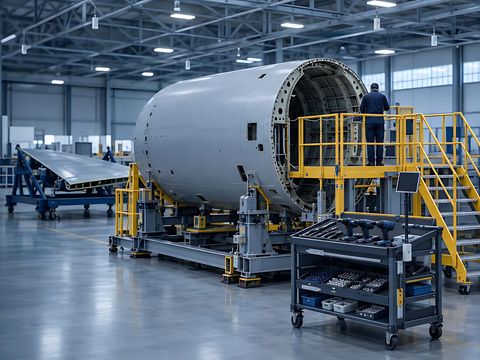
AOG (Aircraft on Ground) parts kitting & dispatch
Problem: An AOG event grounds an aircraft and costs $100k+ per day; spares teams need to find, kit, and dispatch parts in minutes.
Tech mix: Passive RFID on every kit container + bin location, UWB or BLE-AoA on staff for kit-pick attribution, integration with parts inventory and dispatch.
What to measure: kit-pick time · AOG response time · dispatch errors · chain-of-custody completeness for dispatched parts (baseline each before the pilot).
Engine MRO teardown traceability
Problem: Engine overhaul moves 5,000+ parts through teardown, inspection, repair and rebuild; lost or mis-matched parts cause re-work and certification delays.
Tech mix: Passive RFID on every part at teardown station, fixed readers at workstation gates, MES/ERP integration into the work order, optical signage for parts location.
What to measure: part loss · teardown-to-rebuild time · genealogy completeness for FAA/EASA records (baseline each before the pilot).
Composite cure-cycle and autoclave parts tracking
Problem: Composite repair parts must follow a precise cure cycle (temperature, pressure, time) and parts moved out of sequence become scrap.
Tech mix: Passive RFID or ruggedised UHF tags on every layup, autoclave-zone fixed reader, MES integration into cure cycle work instruction.
What to measure: cure-cycle compliance per part · scrap from sequencing errors · AS9100 record completeness (baseline each before the pilot).
Hangar bay aircraft and GSE positioning
Problem: Heavy-maintenance hangars host multiple aircraft and dozens of GSE units (GPUs, ASUs, tow tractors, stairs, lifts), and finding the right unit takes time on every shift.
Tech mix: BLE-AoA or UWB on GSE, fixed anchors in the hangar, integration into maintenance work-order systems.
What to measure: GSE search time · hangar-bay turnover · GSE utilisation (baseline each before the pilot).
Heavy check (C-check, D-check) workflow
Problem: C/D checks take 4-8 weeks and involve thousands of work cards across multiple shifts; tracking technician location, parts arrival and work-card status manually creates bottlenecks.
Tech mix: BLE-AoA badges on technicians, UWB on critical kit, Passive RFID on staged parts, MES integration into work-card progression.
What to measure: check turnaround · work-card status latency · on-time delivery rate · planner workload (baseline each before the pilot).
Time-controlled and life-limited parts (TCP/LLP) management
Problem: Life-limited parts must be replaced at strict flight-hour or cycle thresholds, missing the threshold can ground the fleet.
Tech mix: Passive RFID on every TCP/LLP at install, fixed readers at maintenance entry/exit, integration with MRO software for flight-hour accumulation.
What to measure: LLP threshold breaches · part-genealogy completeness · search time for time-critical replacements (baseline each before the pilot).
NDT (non-destructive testing) workflow and sample tracking
Problem: NDT samples (X-ray plates, eddy-current probes, dye-penetrant test pieces) must be tracked through inspection workflow; lost samples cause re-inspection.
Tech mix: Passive RFID on every sample container, BLE-AoA on NDT technicians, integration into inspection software for sample-to-report linkage.
What to measure: sample loss · NDT throughput · inspection-report traceability (baseline each before the pilot).
Calibrated tool lifecycle & smart cabinets
Problem: Calibrated tools must be tracked through issue, use, return and re-calibration; un-tracked tools delay maintenance and create AS9100 audit risk.
Tech mix: Passive RFID on every tool, smart-cabinet fixed readers, BLE-AoA on technicians for issue/return attribution, integration with calibration management software.
What to measure: tool loss · calibration compliance · technician tool-search time · AS9100 record completeness (baseline each before the pilot).
Wheel & brake pool management
Problem: Airline wheel & brake pools at hub airports must rotate through inspection and maintenance, mis-tracked pool inventory grounds outbound flights.
Tech mix: Passive RFID on every wheel/brake assembly, fixed readers at pool-yard chokepoints, integration with rotable-asset management.
What to measure: pool availability accuracy · dispatch reliability · capital tied up in the pool (baseline each before the pilot).
Counterfeit / SUP (suspect unapproved parts) prevention
Problem: Counterfeit aerospace parts are a serious safety and regulatory issue. Supply-chain visibility back to authorised distributors is mandatory.
Tech mix: GS1 SGTIN-encoded Passive RFID tags from authorised distributors only, fixed readers at receiving and at install workstation, EPCIS integration for full provenance.
Outcome: Counterfeit parts caught at receiving, full pedigree provenance for every install, FAA SUP-compliance audit-ready.
Export-controlled parts tracking for defence aerospace
Problem: Defence-aerospace MRO works under export controls: controlled parts must be tracked, access limited to authorised staff, with a full audit trail.
Tech mix: Passive RFID on each controlled part, BLE-AoA on personnel badges, restricted-zone access control, integration with your document-management system.
What to measure: Export-control record completeness · controlled-parts handling compliance · unauthorised access events (baseline each before the pilot).
Tactical aircraft turnaround (defence)
Problem: Combat-aircraft turnaround on flightline is time-critical. Fuel, weapons, maintenance and inspection all converge in minutes.
Tech mix: UWB on aircraft, fueller and weapons-loaders, BLE-AoA on technicians, integrated turnaround dashboard with safety interlocks.
What to measure: turnaround time · safety-interlock compliance · mission-readiness rate (baseline each before the pilot).
What you gain
FOD risk you can evidence
Tool-for-tool checks close each task and shift, so a missing tool is flagged before the aircraft is released. Measured as FOD events and tools unreconciled at shift close.
Shorter heavy checks
Hangar teams see where tooling, parts and GSE are, so work packages stop waiting on a search. Measured as check duration against plan and time lost waiting for tools or parts.
In the same engagement: −6 days HMV cycle, see the case study.
GSE and tooling utilisation you can see
Location and dwell data show which ground equipment and calibrated tools are used, idle or missing. Measured as utilisation per asset class and search time per job.
Traceable life-limited and serialised parts
TCP/LLP, rotables and teardown parts keep a time-stamped location and custody history. Measured by records completeness and the time it takes to answer an airworthiness or audit query.
Faster AOG response
Kit status and location are live from stores to dispatch, so an AOG kit is not assembled by phone. Measured as time from AOG call to parts dispatched.
Provenance at goods-in
Serialised receiving checks against approved sources catch suspect unapproved parts before they reach the shelf. Measured as receiving exceptions caught and quarantine time.
Running a defence aerospace programme? See Defence & aerospace for accountability, custody and air-gapped deployments.
Who else sells into aerospace locating and what programmes get wrong.
MRO and production programmes see automated tool cribs, RFID FOD suites, UWB bay locating, and baggage/RFID specialists on the airside. Quality and customer FOD standards set a higher evidence bar than general manufacturing. Supplier PS optimises for their cabinet or tag. They rarely redesign the custody process end to end.
What programmes get wrong: equating crib RFID with FOD control; under-integrating work orders; and ignoring foreign/borrowed tooling identity. Independent hybrid design beats a single-OEM stack for audit defensibility.
Where aerospace locating programmes show up in the market.
Large aerospace OEMs and MRO networks (including operators and programmes associated with Boeing, Airbus and Lockheed Martin) publicly invest in tool tracking, FOD control and bay locating. The patterns on this page describe how those market programmes are typically designed. They are industry context, not TRACIO client claims or public references to NDA work.
AMRs and AGVs in aerospace manufacturing
Aerospace parts are high value, often large, and every move has to be traceable. We help you choose the right AMR or AGV for each job, then check what it takes to run them safely around people and aircraft structures.
- Kits, parts and tooling delivered to build stations.
- Moving sub-assemblies and fixtures between work areas.
- Stores-to-line and line-to-inspection moves, with a record of each handover.
- Routes shared with cranes, people and manual transport in the hall.
- Robot fleet management: one fleet manager for robots from different manufacturers, shared doors and chargers, and priority for critical moves. We check what it takes and help you make it work.
- Integration with MES and ERP, so every move is recorded against the build.
See AMR and AGV consulting, including AMR/AGV fleet management, or book a free scoping call to talk it through. Free briefs: AMR and AGV fleets, and AMR/AGV fleet management.
How an engagement works in aerospace & MRO.
Stages, with a gate after each
- Scoping call: 30 minutes with our advisers; a written proposal with the price if there is a fit.
- Discovery & business case: use cases, KPIs and technology direction (typically 1 to 5 days on site).
- Supplier selection: requirements, shortlist, RFP and TCO (typically 3 to 6 weeks).
- Pilot: judged against pass/fail criteria written before any equipment goes in (with timings agreed per site).
- Rollout & handover: scoped per project, phased by site or wave.
What we need from you
- A named sponsor who can sign off each gate
- An operations lead and an IT/OT contact for a few hours a week
- Site drawings, floor plans and process maps
- Access to your MRO/CMMS and tool-crib systems
- Hangar access, with airside or security inductions where required
Aerospace manufacturing: parts custody, kit checks and tool control
Play the video (1:16). It loads from YouTube when you click.
Frequently asked questions
How does aerospace MRO tool tracking support FOD prevention?
Aerospace MRO tool tracking binds each tool to a crib, kit or bay with RFID or UWB events so missing items surface before dispatch. That AS9100 locating trail supports FOD prevention and RTLS for aviation maintenance turns without forcing a single hardware supplier.
How does RTLS/RFID prevent FOD in aerospace?
Tagging and automatic check-in and out of every tool means a missing item is flagged before an aircraft or engine moves on, turning FOD prevention from a manual count into a system guarantee.
Does it support AS9100 and tool accountability?
Yes, automated, auditable custody and calibration records align with AS9100 and customer accountability requirements, replacing paper shadow-boards and logs.
What can we track beyond tools?
Work-in-progress, high-value parts and assemblies, ground equipment, and MRO turn times, so both compliance and throughput improve on one platform.
How does it integrate with our MRO and ERP systems?
Tool, part and WIP data feed your MRO, ERP and quality systems via API so accountability and turn-time metrics live where engineers work.
Are you tied to one hardware supplier?
No, we are independent, so tool-control and RTLS recommendations are chosen for your hangar and its metal-rich environment, not a supplier relationship.
What does an aerospace engagement cost?
It depends on scope and the number of sites. Every engagement is scoped per project and priced in writing before work starts: £3k to £30k per project, or £1,200 a day in the UK. Regional ranges for Europe, North America and other regions are on how we work. Extra sites, on-site RF survey and integration into more than one system of record add to the scope. Hardware and licences are extra: you buy them direct from the supplier, and we don't resell them.
How long does an aerospace engagement take?
Discovery usually takes 1 to 5 days on site, supplier selection typically 3 to 6 weeks and a pilot with timings agreed per site, with a gate after each. Rollout is scoped per project.
What if the pilot fails?
It stops at the gate. The pilot is judged against written pass/fail criteria agreed before any equipment goes in, so a fail is a clear result, not an argument. You pay no rollout costs and keep the artefacts from each stage: requirements, scored shortlist, TCO, RFP pack, pilot criteria and the measured results. Pilot equipment can be rented, so there is no capex to write off.
Who owns the data, and can we avoid supplier lock-in?
You own it. Your data and IP stay yours, with full export. We don't sell hardware, so our advice stays independent. During supplier selection we put data export, open APIs and exit terms into the RFP and contract, so you can change supplier later without starting again.