
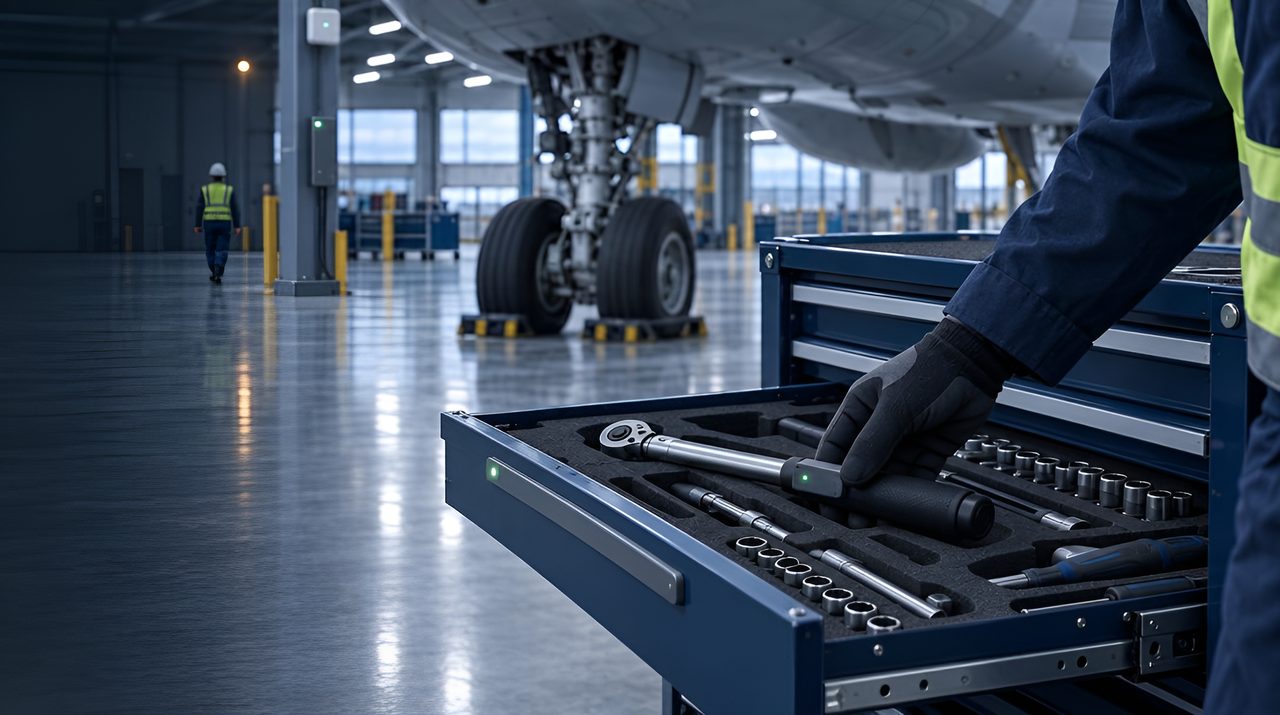
Aerospace FOD prevention: accountability at every torque event.One missing tool can ground an aircraft.
Foreign Object Damage prevention in aerospace MRO and assembly is the highest-stakes tool tracking and tool control use case in industry.
One missed tool can cost a six-figure inspection or worse. The RFID + UWB stack that delivers it is audit-grade and embedded into the work order workflow.
Free 30-minute call with an adviser · written proposal with the price after · fixed-scope engagements from £3k.
What aerospace FOD prevention requires.
Item-level accountability for every tool in the FOD-sensitive zone: engine work, fuel system, control surface, avionics bay.
Real-time alerting on tool absence at shift end or work-order close, before the aircraft moves.
Audit-grade traceability against AS9100, EN 9100 and regulator expectations: chain of custody by worker badge, work order, time-stamp.
Integration into existing CMMS (Maximo, SAP PM, in-house) so the FOD event is tied to the work card, not in a separate system.
The technology stack we recommend.
Passive RFID on every tool, work-station and tool-crib portal for the accountability event stream.
UWB in critical FOD zones (engine work, fuel tank, avionics) for live tool position.
BLE-AoA across larger hangar zones for general tool location at lower density.
Handheld RFID readers for end-of-shift and end-of-work-order cycle counts.
Integration into work-order workflow: FOD check is part of work card close-out, not a separate process.
Why this is structurally different from manufacturing tool control.
Consequence of failure is catastrophic and regulator-driven. The audit standard is higher; the validation requirement is heavier; the implementation is slower and more rigorous.
Aircraft layouts vary. Engine work in a wide-body MRO is a very different RF environment from an avionics bay. Per-zone design is the norm.
Workflow integration matters more than technology elegance. A system that adds friction to engineer workflow will be bypassed. Once bypassed, the FOD protection is gone.
Implementation approach.
Phased rollout: critical FOD zones first, then expanding to broader tool accountability.
Validation pack designed against AS9100 or EN 9100 expectations: URS, FRS, IQ, OQ, PQ documentation that survives regulator audit.
Operator workflow design: the most important success factor. Engineer adoption is binary. Without it, the FOD protection theory does not survive contact with the hangar floor.
Hybrid stack: Passive RFID accountability + UWB live position in FOD zones is the standard recommendation.
Who sells FOD prevention tech and what aerospace programmes get wrong.
Aerospace FOD control attracts automated tool-control cabinets, RFID crib systems, bay RTLS suppliers, and procedure-led consultants who barely touch radio. Snap-on-class automated control, RFID portal specialists and UWB bay locating each claim the audit story. Customer quality reps care about unbroken custody from crib through the aircraft and back, not which supplier logo is on the drawer.
What programmes get wrong: equating cabinet RFID with FOD prevention; leaving foreign-object walks and calibrated-tool processes unlinked to the digital custody trail; deploying bay RTLS without work-order integration; and accepting a single-OEM tag that cannot identify customer or borrowed tooling.
Structurally this is stricter than general manufacturing tool control: AS9100, customer FOD standards and airworthiness exposure change the evidence bar. TRACIO scopes hybrid RFID + selective RTLS, process design and acceptance against those standards without selling the cabinets. Compare manufacturing tool control.
What airworthiness-grade FOD locating has to prove.
FOD prevention is a safety case with a digital custody trail, not a cabinet feature list. Every tool that can enter the aircraft envelope needs accountability from issue through return, including calibrated items, customer tooling and borrowed kits. Cabinet RFID starts the story. Portal or bay events and work-order linkage finish it. Unlinked FOD walks and paper shadow boards leave the exact gaps auditors find.
Bay RTLS helps when tools leave cribs for long open jobs, but only if identity and zone rules match the hangar’s FOD-critical areas. How durable the tags are, metal mounting and battery policy must be written. A dead tag mid-job is a FOD risk of its own if the process assumes the system is truth. Break-glass and lost-tool protocols need the same rehearsal as emergency response drills.
AS9100 and customer FOD standards should drive acceptance language in the RFP so suppliers cannot substitute a demo for evidence. Independent architecture keeps crib, portal and RTLS layers swappable and prevents a single OEM from owning the audit narrative. Training for bay leads and quality is continuous. Shift churn is real in MRO.
Acceptance: zero unexplained open tool issues at defined control points, time-to-reconcile after job close, and successful customer or internal FOD audit using system evidence rather than reconstructed paperwork.
FOD and tool-control programmes in the aerospace market.
FOD prevention and calibrated-tool custody are standard expectations across major airframe and MRO environments (Boeing, Airbus, Lockheed Martin production and sustainment contexts among them). This page covers design patterns used in that market, not named TRACIO engagements.
Frequently asked questions
What is the AS9100 expectation for tool control?
Item-level accountability with audit trail against worker, work order and time-stamp. Specific implementation is not mandated, but the audit standard is. RFID-based systems are a common way to deliver this without operator friction.
Do we need UWB or is Passive RFID sufficient?
Depends on FOD risk zone. Low-risk zones: Passive RFID accountability is sufficient. High-risk (engine work, fuel system, avionics): UWB live position adds defence-in-depth. Most large MROs run a hybrid stack.
How long does FOD prevention implementation take?
Phased zone by zone across a large MRO. Tagging the calibrated tool fleet is a work package of its own. Validation and operator workflow design are typically the slowest stage.
What integration is required with our CMMS?
Tool issue and return events tied to work order ID; FOD check status on work card close-out; calibration interval enforcement against work assignment. Common integration platforms: IBM Maximo, SAP PM, Trax, in-house.
Last updated: