
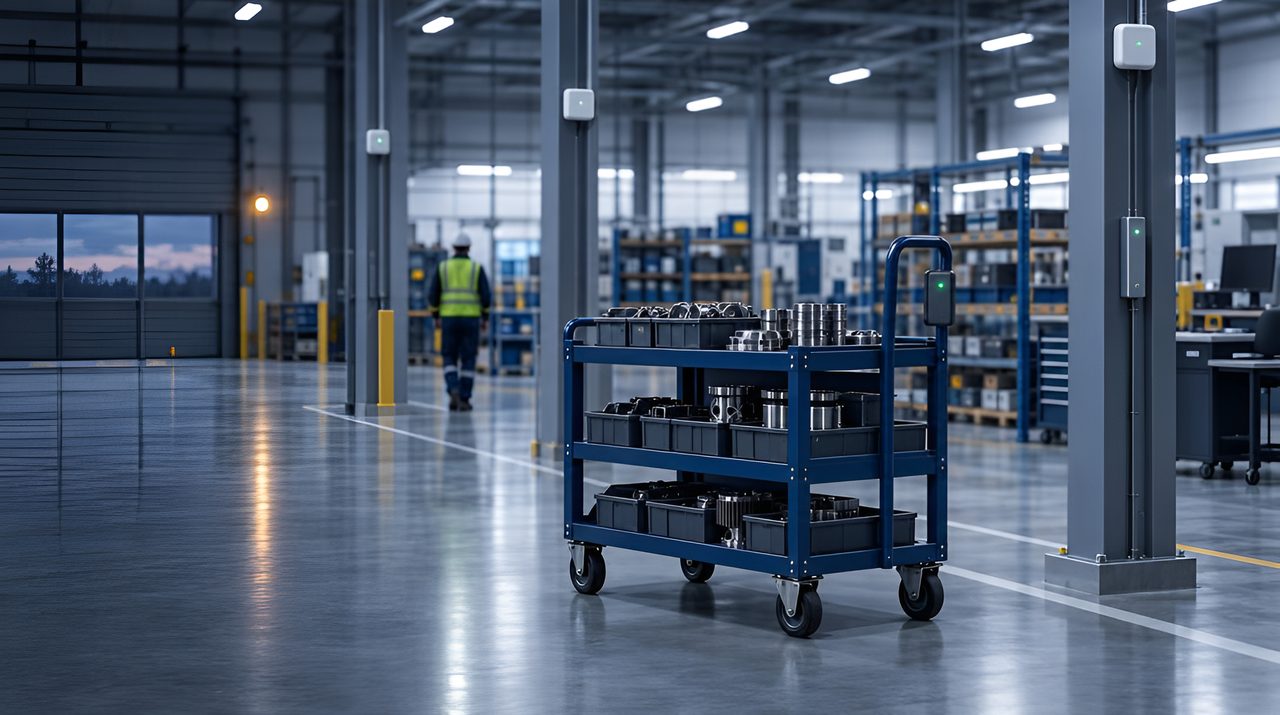
Tracking technology comparison: every option, no supplier in the room.
A full tracking technology comparison (RFID, UWB, BLE, Wi‑Fi, GNSS, vision and more) scored for accuracy, cost and the job, not for a partnership.
UWB: Ultra-WidebandSub-metre
Benefits
- accuracy and low latency (<100 ms)
- reliable to multipath in busy industrial environments
- Great for safety, automation and process-critical use cases
Trade-offs
- Higher infrastructure cost: needs a denser anchor grid
- Tag battery life shorter than BLE
- More install and survey effort
Best for: Tool & WIP tracking, automotive sequencing, forklift safety, sports analytics, collision avoidance.
Pairs well with: BLE (for low-cost coverage in non-critical zones); Passive RFID (for item-level read-points).
Cost profile: $$$, highest infrastructure density.
BLE: Bluetooth Low Energy (incl. 5.x AoA)Zone to ~1 m
Benefits
- Low-cost tags and multi-year battery life
- Ubiquitous; phones can act as beacons/receivers
- 5.x Angle-of-Arrival lifts accuracy where needed
Trade-offs
- Lower accuracy than UWB without AoA
- Susceptible to multipath and interference
- Zone-level for most deployments
Best for: Healthcare equipment locating, zone-level asset tracking, people flow, wayfinding.
Pairs well with: UWB (precision where it matters); Wi-Fi (reuse existing APs).
Cost profile: $$, strong cost/coverage balance.
Passive RFID: passive UHFRead-point
Benefits
- Ultra-low-cost, battery-free tags at item scale
- Very high read rates for inventory
- Mature ecosystem and standards (GS1 / EPC)
Trade-offs
- No continuous location: reads at choke points only
- Read reliability drops around metal & liquid
- Needs reader/antenna infrastructure at key points
Best for: Retail item-level inventory, WIP, dock-door reconciliation, supply-chain track-and-trace.
Pairs well with: RTLS (UWB/BLE) for continuous location; barcodes for fallback.
Cost profile: $ per tag · $$ readers/antennas.
Active RFIDZone / room
Benefits
- Long range from each reader
- Good for large outdoor/indoor areas
- Reliable presence detection for big assets
Trade-offs
- Tag cost and battery maintenance
- Lower precision than UWB/BLE AoA
- Being displaced by BLE/UWB in many cases
Best for: Yard and large-asset tracking, containers, vehicles, gate control.
Pairs well with: GPS (outdoor hand-off); BLE (finer zones).
Cost profile: $$, tag and reader cost.
Wi-Fi / Wi-Fi RTT3-10 m
Benefits
- Uses existing Wi-Fi infrastructure
- Broad coverage with little new hardware
- Useful for coarse asset and people zoning
Trade-offs
- Accuracy varies with AP density and environment
- Not precise enough for process-critical use
- Client/AP support needed for RTT
Best for: Broad asset zoning, occupancy and people-flow analytics.
Pairs well with: BLE (where finer accuracy is needed).
Cost profile: $, reuses existing APs.
GPS / GNSS2-10 m (cm with RTK)
Benefits
- Global outdoor coverage, no on-site anchors
- Mature, low-cost modules
- RTK gives centimetre accuracy where required
Trade-offs
- No indoor coverage
- Power draw on battery assets
- Urban canyons / dense structures degrade it
Best for: Yard, fleet and outdoor asset tracking, logistics, plant in transit.
Pairs well with: Indoor RTLS (UWB/BLE) for clean indoor↔outdoor hand-off.
Cost profile: $$, modules & data.
LoRaWANCoarse / wide-area
Benefits
- Very long range, very low power
- Excellent for wide-area sensing & condition data
- Few gateways cover a large site
Trade-offs
- Low location precision
- Low bandwidth: small payloads only
- Not for real-time precision tracking
Best for: Wide-area asset & condition sensing, cold-chain telemetry, outdoor/utilities.
Pairs well with: GPS (precise outdoor position); BLE (indoor zones).
Cost profile: $ (low-power, wide-area).
SLAM / vision & LiDARcm-dm (relative)
Benefits
- Little or no fixed infrastructure
- Builds a live map of the environment
- Ideal for AMR/AGV navigation
Trade-offs
- Compute-heavy; can drift without references
- Sensitive to lighting / featureless spaces
- Relative, not absolute, location
Best for: AMR / AGV navigation, robotics, dynamic indoor environments.
Pairs well with: UWB anchors for an absolute global reference frame.
Cost profile: $$$, sensors & compute.
Passive RFID vs RTLS vs passive RTLS: what's the difference?
"RFID" and "RTLS" get used interchangeably, but they answer different questions. RFID tells you something was seen at a point. RTLS tells you where it is, continuously.
| APPROACH | TAG | LOCATION OUTPUT | TYPICAL USE |
|---|---|---|---|
| Passive RFID (passive UHF) | Battery-free, ultra-low cost | Read-point: "seen here, now" | Item-level inventory, track-and-trace, dock / portal reads |
| Active RFID | Battery beacon | Zone / room over wide areas | Yard, large assets, containers, vehicles |
| Passive RTLS (passive UHF + dense / overhead / phased-array readers) | Battery-free (or battery-assisted, BAP) | Inferred zone / coarse position | Cost-sensitive zoning where full RTLS is overkill |
| RTLS (UWB / BLE / active) | Battery tag | Continuous, real-time x/y coordinates | Live tracking, safety, automation, analytics |
Fixed choke points vs RTLS vs handheld.
Fixed RFID: choke points
Readers and antennas at a line you cross: dock doors, conveyors, portals, doorways. Answers "did it pass this point, in or out?" Automatic and high-throughput, but it only sees items at those gates, nothing in between.
RTLS (RFID / UWB / BLE)
Anchors blanket the whole space and continuously compute each tag's position. Answers "where is it right now, anywhere?" (live location, dwell, geofencing, routing and safety, not just gate events).
Mobile / handheld RFID
An operator scans with a handheld or cart-mounted reader. Flexible and low-infrastructure; best for cycle counts, search and ad-hoc audits where fixed gates or full RTLS aren't justified.
In one line: fixed choke points detect items crossing a gate; RTLS tracks them continuously everywhere in between. Many programmes combine both: Passive RFID at the dock plus RTLS on the high-value assets. Full Passive RFID vs RTLS guide →
The best answer is usually more than one technology.
Real programmes rarely use a single radio. These are the combinations we reach for most, and when each makes sense.
UWB + BLE
Precision where it pays, low-cost coverage everywhere else: UWB in process-critical zones, BLE across the rest of the site.
Passive RFID + RTLS
Item-level read-points (RFID) for inventory, plus continuous RTLS for the high-value assets that must be tracked live.
GPS + UWB/BLE
clean indoor↔outdoor: GPS in the yard and on the road, indoor RTLS inside the four walls, one unified view.
LoRaWAN + GPS
Wide-area, low-power: LoRaWAN for condition telemetry and coarse zones, GPS for precise outdoor position.
SLAM + UWB
Autonomous fleets that stay aligned to plant coordinates: SLAM for navigation, UWB anchors for an absolute reference.
Deep-dive explainers
BLE explained
Indoor positioning fundamentals.
GNSS-RTK explained
Centimetre-grade outdoor.
GPS vs GNSS
Multi-constellation outdoor.
LoRaWAN explained
Wide-area IoT.
Multipath explained
Why indoor RTLS misbehaves.
RFID explained
Passive vs active vs RAIN.
RTLS accuracy
CEP50 vs CEP95.
Visual SLAM
Camera + IMU positioning.
Wi-Fi RTLS
Wi-Fi for indoor location.
Comparing options? See the independent technology comparisons or work through choosing a locating technology. For the advisory view: independent RTLS consulting and industrial RFID strategy.
Last updated: 5 October 2026