
Passive RFID vs RTLS: what's the difference?Passive RFID or RTLS? The wrong choice is costly to undo.
They sound similar and get confused constantly. The difference is simple and it changes every shortlist: identity-at-choke-points versus continuous location, often both, rarely either alone.
The core difference
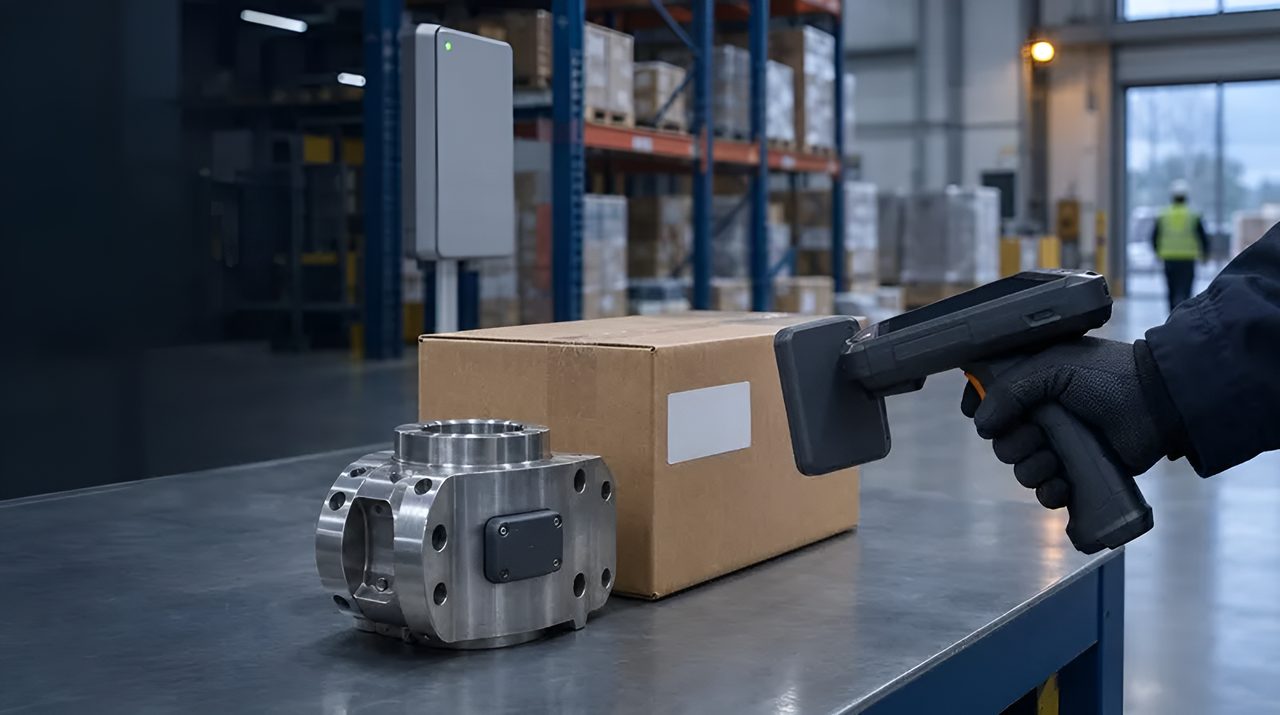
RAIN (UHF) RFID tells you an item was seen at a known read point (a door, dock or conveyor) at a moment in time. It is identity at choke-points, with cents-per-tag economics, so you can tag everything.
RTLS tells you where an asset is, continuously, across an area. That continuous position needs more infrastructure and costs more per tag and per square metre.
See independent RFID consulting. For what RTLS costs compared with RFID, see our RTLS cost guide.
When to use which
- Use Passive RFID when you need item-level identity at portals: inventory, WIP at stations, dispatch and receiving
- Use RTLS when you need live position or zone presence: finding equipment, safety, flow, dwell analytics
- Use both when item identity at gates plus live location of high-value assets each pay back: a common hybrid
Cost implications
RFID concentrates spend in readers, antennas and install at a few read points. Tags are cheap. RTLS spreads spend across anchors/locators and tags throughout the space. Choosing the lighter option where it suffices is the single biggest cost lever in most programmes.
Locating question first: gate event, zone presence, or continuous position
Passive RFID and RTLS answer different locating questions. Passive RFID at a portal tells you that an identity crossed a choke-point now. RTLS (UWB, BLE AoA, or active RFID) tells you where a tagged asset is continuously across a space. Teams that buy RTLS because they really needed dock reconciliation waste infrastructure. Teams that buy only portals when they need live WIP visibility never get the KPI.
Choose Passive RFID when the decision is inventory accuracy, shipping verification, returnable-asset custody, or serialisation at doors, cages and conveyors. Tag cost at volume is cents; there is no battery fleet; GS1 / EPC event data maps cleanly into WMS and ERP. Read physics around metal and liquids still must be designed, but you are not paying for floor-wide anchors.
Choose RTLS when someone must act on live position: find a piece of medical equipment on a ward, alert on forklift-pedestrian proximity, measure dwell in a cell, or orchestrate AGV/AMR advisory logic. Accuracy and update rate become first-class requirements, and so do battery logistics and locator density.
Hybrid locating is normal. Many logistics and manufacturing sites run Passive RFID at docks and cages for identity + custody, BLE for yard or aisle-level visibility of high-value assets, and UWB only where centimetre-class safety or process control pays back. Cost the layers separately against the KPI each layer moves, do not force one radio to pretend it is the other.
Decision test. If the operator’s question can be answered by “last seen at Door 4 at 14:02,” start with Passive RFID. If the question is “where is it on the floor right now, and has it been dwelling too long?” you need RTLS. If both questions matter, design a hybrid and prove each layer on a production-load pilot with written go/no-go criteria.
Architecture patterns when identity and continuous locating both matter
When the operating model needs both custody and live position, design the event model first. Passive RFID emits identity + timestamp + read-point. RTLS emits identity + timestamp + x/y or zone. Downstream systems should consume a unified locating event schema so analytics do not fork by radio. That architectural discipline prevents a second dashboard culture.
Cost control comes from refusing continuous RTLS for questions already answered by a gate. Conversely, refuse portal-only designs when operators must hunt assets between doors or when safety geofences need distance, not presence. Document the decision table in the business case so later scope creep cannot silently convert every zone into UWB.
Pilot each layer on its own KPI: portal read-rate and dock-to-stock for Passive RFID; zone/accuracy and search-time or dwell for RTLS. A combined pilot that only checks “map looks good” will not tell you which layer earned its keep.
Practical examples of the identity vs position split
Example: a DC needs perfect-order verification at twelve docks, Passive RFID portals with shielding and tag-orientation rules. The same site wants forklift proximity alerts in two busy aisles: UWB geofences, not more portals. A plant needs quarantine release confirmation, RFID at the cage door, plus WIP age on one machining line: BLE or UWB on that line only. Write examples like these into the business case so stakeholders stop debating radios in the abstract.
When in doubt, prototype the cheapest layer that can answer the question. Escalate to continuous RTLS only when gate events leave a measurable operational gap. That discipline keeps locating programmes affordable without starving safety or flow use cases that truly need live position.
One-line locating decision rule
If the operator can act on last-seen-at-a-door, choose Passive RFID first; if they must act on where-it-is-now across a floor, choose RTLS; if both, design a hybrid and pilot each layer on its own KPI. That single rule prevents most radio-first debates from wasting a quarter.
Frequently asked questions
Is Passive RFID a type of RTLS?
No. RFID gives identity at read points. RTLS gives continuous position. Some active-RFID systems blur the line by giving zone-level location.
Which is cheaper?
Passive RFID is usually cheaper for item-level identity at gates. RTLS costs more because it tracks position everywhere.
Can one system do both?
A well-designed hybrid can: Passive RFID at portals plus an RTLS layer for the assets that need live location.
How do I decide?
Map each use case to whether it needs identity-at-a-point or continuous-position. We can do that with you in a short workshop.
Related: choosing a locating technology, the independent technology comparisons, and industrial RFID strategy.
Last updated:
Advisory note
This guide is written for operators selecting and deploying location technology, not for selling a radio. Use it to frame questions for suppliers and integrators. Bring TRACIO in when you want those answers scored independently against your site.