
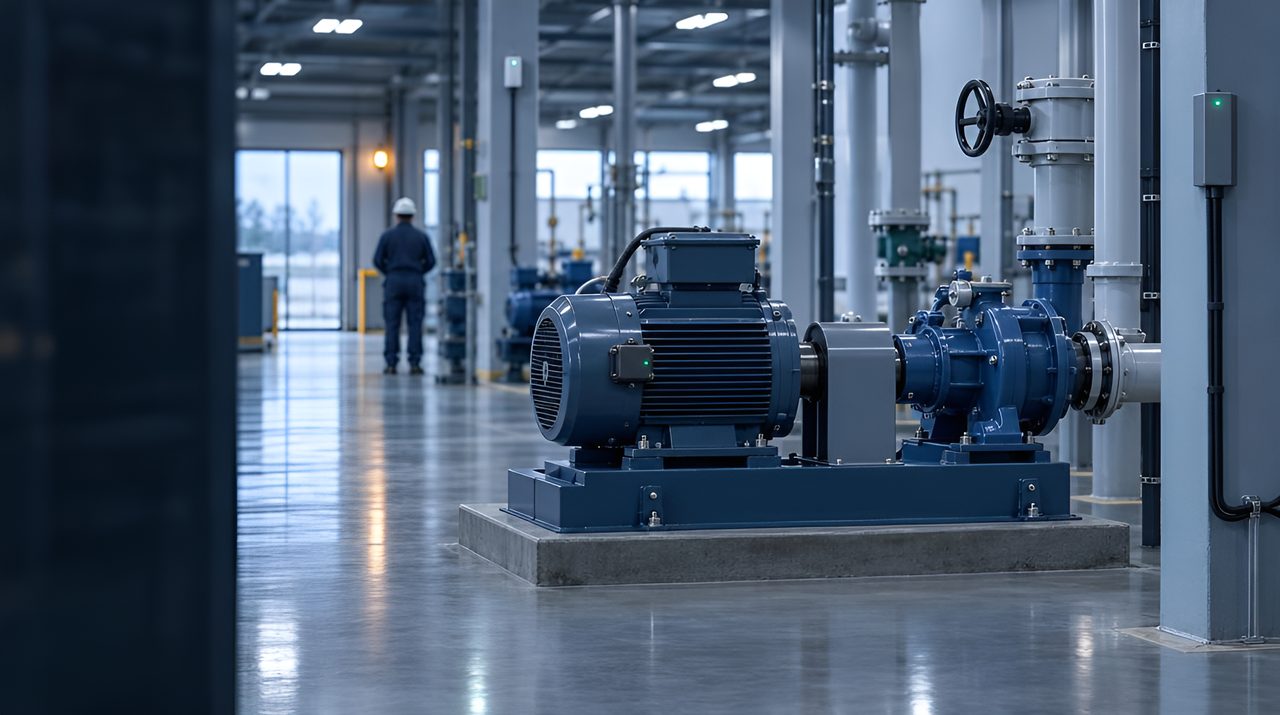
Predictive maintenance: running hours and vibration beat a calendar service.Servicing by calendar while machines fail in between?
Predictive maintenance where hours and utilisation beat a calendar PM. Location and use data that make maintenance decisions accurate. A threshold rule is not AI.
Free 30-minute call with an adviser · written proposal with the price after · fixed-scope engagements from £3k.
PdM stalls when alerts never become work orders with parts attached.
CMMS closed loop
Vibration without a work order is a science project. Integrate priority, parts and craft skill.
Model humility
Early models over-alert. Budget a tuning period and a human triage queue.
Criticality first
Tag the constraint assets first. Spreading sensors across everything dilutes attention.
Predictive maintenance & condition monitoring: how it works, and what it pays back.
The right radio for the job, mapped to your use case.
1 · Sense
IIoT sensors stream vibration, temperature, current and runtime from the asset.
2 · Predict
Models learn the normal signature and flag drift before it becomes a failure.
3 · Act
A work order is raised at the right time, not too early, not too late.
IIoT sensors → condition · edge / ML → prediction
Which technology fits.
We work for you, not for the technology providers.
IIoT sensors
Vibration, temperature, runtime.
Edge/MQTT
Real-time processing.
Integration
CMMS work orders.
Industries this solution suits
Service at the right time, not too early, not too late.
A plant streams vibration and temperature from its critical assets. A model flags a bearing drifting from its normal signature roughly 120 hours before failure, and a work order is raised, turning a breakdown into a planned stop.
Typically bought by: Maintenance / reliability, plant engineering, CMMS owners, operations.
Relevant case studies
Where this solution wins: examples by sector.
Critical line equipment in automotive (automotive)
Press lines and robotic cells.
Pumps and compressors in oil & gas (oil-gas)
Rotating equipment health monitoring.
Wind turbines in energy (energy)
Wind-turbine vibration and component health.
Conveyors and mill equipment in mining (mining)
Mill and conveyor health monitoring.
Pharma manufacturing utilities (pharma)
WFI, clean steam, HVAC critical-equipment health.
Who needs this kind of programme.
Plant and fleet maintenance leaders moving from calendar PM to condition-triggered work without drowning in sensor noise.
Reliability engineers who need vibration, temperature and duty-cycle context tied to asset identity and location.
OT/IT teams connecting LoRaWAN/IoT sensors to CMMS without a science-project integration.
What buyers compare in this market.
The market splits between CMMS-native condition modules, industrial IoT platforms, and LPWAN sensor ecosystems (Semtech/LoRa, Actility, The Things Industries-class) plus cellular trackers. Telematics suppliers (Geotab/Samsara) pitch predictive features for vehicles; plant buyers see Augury-class vibration analytics. Location matters when the asset moves, otherwise a fixed sensor and CMMS ID may be enough.
TRACIO advises when locating is required for the maintenance use case versus when condition sensing alone is the cheaper path.
Why predictive programmes stall.
Alerts without work orders. Predictions that never open a planned job create alert fatigue.
Sensor sprawl. Every machine gets a kit before criticality ranking is done.
Identity gaps. Moving assets lose their condition history when tags and CMMS IDs diverge.
Independent.
We don't sell hardware, so our advice stays independent. We scope the criticality model, the radio/backhaul that fits the site, and the CMMS events that make predictions operational.
Frequently asked questions
How does condition monitoring enable predictive maintenance?
Wireless sensors track vibration, temperature, current or run-hours and flag the early signatures of failure, so you service on evidence rather than on a fixed calendar or after a breakdown.
Do we need to wire up every machine?
No, battery-powered wireless sensors retrofit to existing assets, so you can start with the critical or failure-prone equipment and expand.
How does it integrate with our CMMS or SCADA?
Alerts and trends feed your CMMS to raise work orders automatically and your SCADA or historian for context, turning data into scheduled action.
Is this just for fixed plant?
No, the same sensors monitor mobile assets, tools and fleet, and combine with RTLS so you know both the health and the location of an asset.
What is the payback?
Less unplanned downtime, longer asset life, lower spare-parts and overtime cost, and avoided catastrophic failures, typically a strong ROI on critical lines.
Last updated: 5 October 2026