
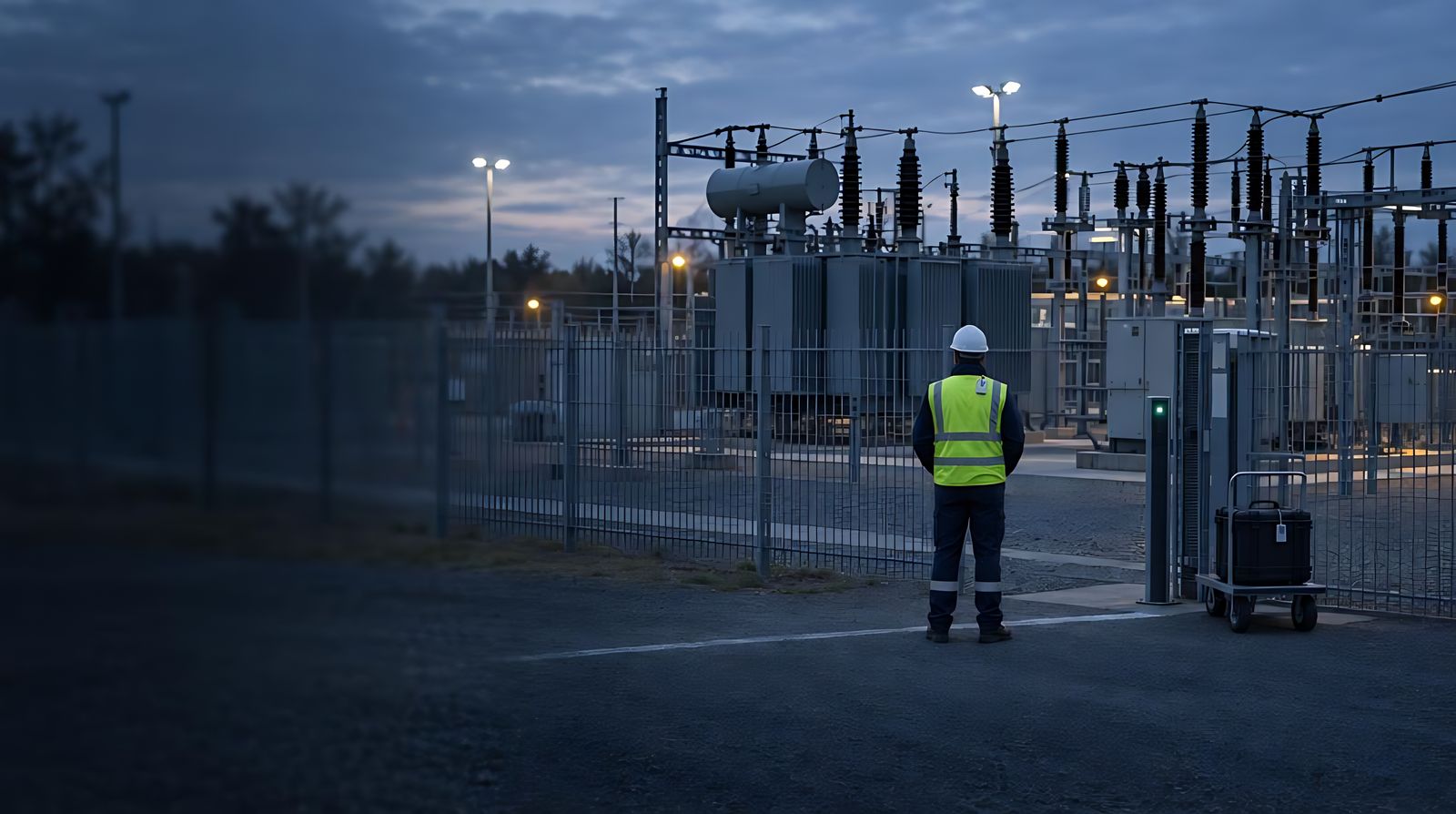
Contractor and lone-worker safety across 38 substations.
A European transmission operator needed worker safety and contractor control across 38 substations during outages.
The programme and figures on this page come from an earlier work by our advisers. The client name is withheld under NDA. Figures are as reported at the time. Named references are available under NDA when you engage.
What they were up against.
Lone workers invisible
Technicians at remote substations had no reliable way to raise an alarm.
Clipboard contractor control
Outage contractor control was a manual, paper exercise.
HV clearance by procedure
Keeping people clear of energised equipment relied on procedure, not interlocks.
Earlier work by our advisers. Client name withheld under NDA. Client name withheld under NDA; figures as reported at the time. Named references available under NDA. We model your own numbers when you engage.
Independent, tied to a named KPI.
We delivered contractor and lone-worker tracking with geofenced high-voltage safety zones during outages, across 38 substations.
What the engagement delivered.
- Lone-worker SOS and man-down detection
- Geofenced high-voltage exclusion zones
- Contractor on-site register with exit reconciliation
Results in this engagement
The stack behind it
Baseline, method, period and what we excluded.
This page describes an engagement our advisers led in earlier roles. The client name is withheld under NDA. Figures are as reported at the time, with published industry sources where noted.
- Baseline: Contractor control via paper permits; lone-worker response ad hoc.
- Method: Geofenced HV exclusion reading permit state; lone-worker duress; time-to-verified muster on outage work.
- Period: Substation cohort across planned outages.
- Excluded: Generation-plant anecdotes pasted onto TSO/DNO sites without permit join.
Programme context
TSO/DNO programmes focus on contractor control, inductive hazard zones, and emergency accountability across many small sites. Tags and processes must work for infrequent visitors, not only employees.
Central security operations need exception queues. Local site leads need simple devices and clear SOPs.
Outcomes in this engagement and how they were earned
Outcomes: improved visitor compliance, faster incident location, better evidence for regulators and insurers. Multi-site rollout governance matters more than any single pilot dashboard.
Lessons from this engagement
Lessons: do not copy office badge RTLS; join permits; budget for device logistics across dozens of substations.
Deeper problem framing
Dozens of substations, infrequent visitors, inductive hazards, and principal-contractor duties create a control problem that a single-site RTLS demo never reveals.
Approach
Standard kit + central exception queue; permit join; device logistics model; multi-site rollout playbook; privacy-minimised zone events.
Outcomes and measurement
Visitor compliance, incident locate time, contractor scorecards. Governance across sites beats any single dashboard.
Governance, risk and what we refuse to claim
This engagement was earlier work by our advisers. The client name is withheld under NDA. We will not attribute percentages to a confidential site. When you engage, we rebuild baselines from your incidents, labour samples and system logs.
We refuse vanity accuracy claims without a coverage map, and we refuse programmes that silently add productivity surveillance onto a safety business case without a fresh DPIA or labour consultation.
Implementation sequence and change management
Design the multi-site operating model before RF: central SOC queue, local device kits, induction workflow, permit join. Pilot 3-5 representative substations (urban, rural, indoor GIS).
KPIs: visitor compliance, time-to-locate on drill, kit loss rate. Expand only when logistics works. Public/regulatory evidence packs should be reproducible, not screenshot-based.
Reject commercial office badge analogies in the RFP response scoring.
Buyer checklist, supplier challenges and engagement shape
For multi-substation estates, evaluate device logistics and central exception queues as carefully as radio choice.
Buyer checklist before you sign: (1) written system of record for events; (2) acceptance tests with 95th-percentile performance under real interference; (3) integration owner named in IT/OT; (4) privacy or labour consultation path if people are tagged; (5) cybersecurity zoning sketch; (6) five-year TCO including batteries, spares, recalibration and SLA escalations; (7) exit/export terms so you are not hostage to a cloud tenant; (8) a pilot that can fail without political punishment.
Supplier claims to challenge in this pattern: brochure accuracy without production load; 'compliance included' without artefacts; ROI that assumes perfect adoption in 30 days; references that cannot be called under NDA; install partners who have never worked your vertical's overlays; shared support accounts; and any design that dumps locating onto a flat plant or clinical VLAN.
How TRACIO typically engages: stage-1 architecture and measurement design; independent shortlist and RFP language; pilot acceptance criteria; then optional implementation oversight or programme rescue if a prior pilot stalled. We don't sell hardware, so our advice stays independent. Pages like this one exist so you can prepare the workshop. Your numbers replace every planning band when we model payback.
Risk register themes that recur: mute fatigue on alerts; shadow spreadsheets reappearing beside the platform; battery logistics understaffed; master data too weak to support identity; works-council or IG review starting too late; and success declared on demo day before night-shift reality.
Document baseline windows explicitly: what you measured, for how long, which shifts, and what you excluded. Investment committees and auditors both punish fuzzy before/after stories. If your baseline is weak, spend two to four weeks fixing measurement before ordering anchors or portals. That discipline is cheaper than a stranded deployment and is the difference between a locating programme and a technology souvenir.
Last updated:
Network safety and access
Independent advisory means the radio is chosen last. After the job, the constraints and the system of record are clear.
Permit and substation reality
People accountability and asset jobs scoped to live network rules.
OT-aware shortlists
Independence matters when OEMs push their own locating stack.
Design to the control room
Events for the operators who already own the alarm philosophy.
Measurement
Baseline: lone-worker check-in gaps, permit-to-work exceptions, and time-to-muster. Pilot: one site or substation with RTLS/wearables tied to the EHS workflow. Steady-state: check-in compliance, muster time, and open permit exceptions. Safety claims stay within what the site’s EHS lead will sign.