
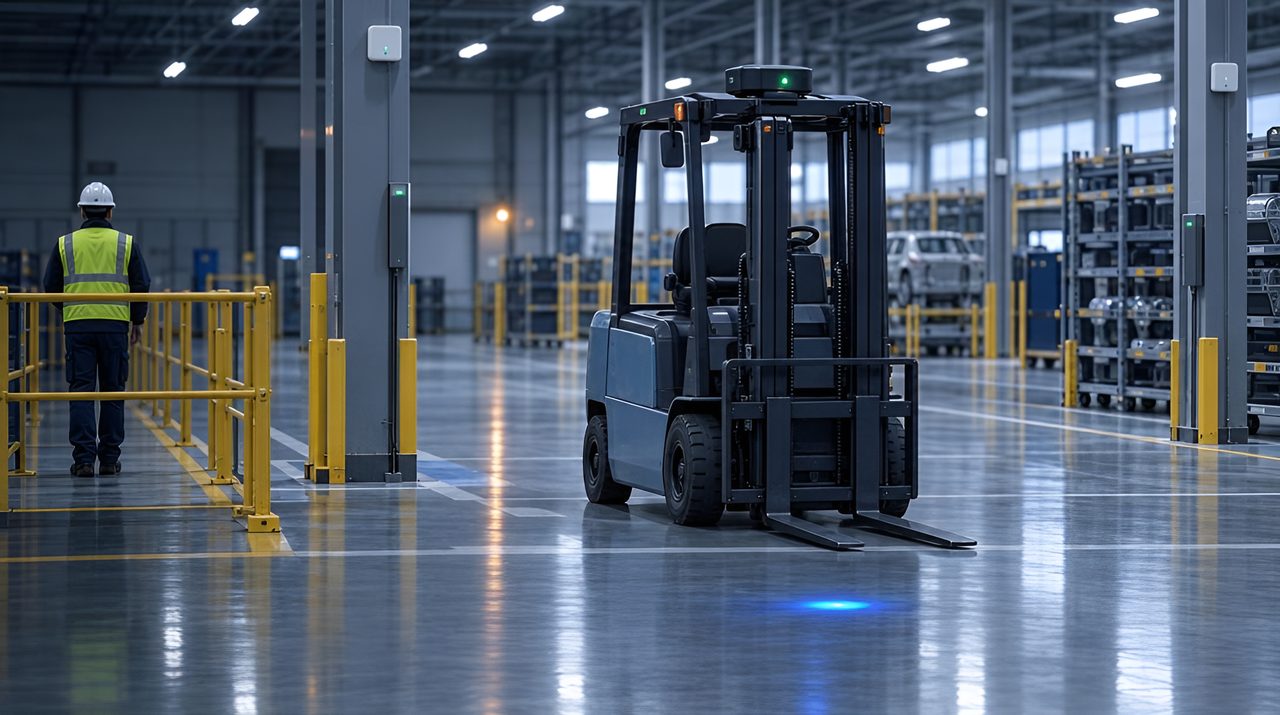
Forklift collision avoidance: warn before steel and a person share a metre.Collision alarms that drivers learn to ignore?
Proximity alerts for forklifts, pedestrians and shared aisles, designed for the metal and multipath you actually have, not a lab demo.
Free 30-minute call with an adviser · written proposal with the price after · fixed-scope engagements from £3k.
What is RTLS collision avoidance? People wear tags and vehicles carry units that measure the distance between them, usually by UWB ranging. When a person comes inside a defined zone around a vehicle, the driver and the pedestrian get an instant alert and, where the vehicle is engineered for it, the vehicle slows. Every near-miss is logged for safety review.
Collision avoidance fails when warnings are constant and slowing is optional.
Actionable zones
If every aisle is a red zone, drivers ignore it. Shape zones to real risk and enforce slowdown where required.
People and plant
Pedestrian tags and vehicle tags need a shared coordinate story. Mixed suppliers without a fusion plan create blind pairs.
Incident review
Near-miss logs without a weekly review will not change behaviour. Make the ritual non-negotiable.
For what drives the price of a collision warning system, see our RTLS cost guide.
Collision avoidance & pedestrian safety: how it works, and what it prevents.
The right radio for the job, mapped to your use case.
1 · Equip
Forklifts and people carry UWB or proximity tags. Danger zones are mapped to each vehicle.
2 · Detect
Tag-to-tag ranging measures closing distance many times a second, even around blind corners.
3 · Warn & log
Drivers and pedestrians get an instant alert. Every near-miss is logged for safety review.
UWB → precise proximity · zones → speed & access rules
Which technology fits.
We work for you, not for the technology providers.
UWB
Precise, low false-alarm proximity.
Active RFID
Reliable proximity at low cost.
Zones
Slow-down & exclusion zones.
Industries this solution suits
Warned before they ever meet.
On a mixed-traffic floor, forklifts and people carry UWB tags. As a truck closes on a pedestrian around a blind corner, both get an instant in-cab and wearable alert, and the near-miss is logged for the safety review.
Typically bought by: EHS / safety, plant managers, warehouse operations, insurers.
Relevant case studies
Where this solution wins: examples by sector.
Automotive plant pedestrian safety (automotive)
UWB on forklifts and pedestrians, with near-miss events logged and reviewed.
3PL DC pedestrian-vehicle safety (logistics)
Multi-shift DCs with high pedestrian-vehicle interaction.
Mining underground proximity detection (mining)
Miner-LHD-haul truck proximity is the leading underground injury cause.
Manufacturing maintenance-engineering safety (manufacturing)
Maintenance walks during operations need proximity protection.
Retail DC peak-season pedestrian safety (retail)
Seasonal hires need extra safety protection.
What buyers care about.
Fewer serious near-misses and injuries, not more beeps. Pedestrian-truck and truck-truck collisions in warehouses and plants kill and maim. Buyers want warnings that operators trust, and where risk justifies it, controlled slowdown or stop, measured by incident and near-miss trends, not alert volume.
Physics that match the aisle. Blind rack intersections and through-rack approaches need non-line-of-sight ranging (typically UWB tag-to-vehicle). Dock doors with mixed visitors may need AI vision because guests will not wear tags. Many serious sites buy a layered design, not a single gadget.
Tag discipline and visitor policy. UWB proximity only protects tagged people. Permanent staff, contractors and pedestrians need a wearables programme. Untagged zones need cameras or physical segregation.
Integration without false safety. Cab alerts alone are assistive. Functional safety interlocks on braking demand OT engineering, fail-safe behaviour and clear ownership, not a marketing claim of “automatic stop.”
Where collision programmes fail.
Constant warnings, optional slowing. If every aisle edge triggers a tone, operators mute the system. Zone thresholds, severity tiers and mute policies must be designed with operators, then audited.
Camera-only in racking forests. Vision fails when the pedestrian is behind steel. UWB-only fails when the visitor has no tag. Choosing one technology for the whole site is usually the wrong RFP.
No pedestrian side of the loop. Warning only in the cab leaves walkers unaware. Wearable haptics or zone lights close the loop where traffic is dense.
Pilot on an empty weekend. Peak-season density, agency labour and mixed fleets are when systems prove themselves: schedule acceptance tests then.
Competitors (advisory view).
Industrial locating and safety suppliers (Litum, Sewio, Pozyx, Ubisense, Trio Mobil and similar) pitch UWB proximity between trucks and badges, often with geofenced slow zones. Parallel markets sell AI camera / vision anti-collision kits that detect untagged pedestrians in line of sight. Sensor companies (e.g. SICK-class safety sensing) address different layers of machine safety. Quuppa-class angle-of-arrival locating is stronger for presence and flow than for millisecond truck interlocks.
How suppliers pitch vs what to buy. Suppliers pitch centimetre accuracy and automatic slowdown. Buyers should purchase: a risk map by aisle and intersection; UWB (or equivalent) for tagged NLOS coverage; vision where tags will not exist; operator-accepted alert logic; and only then any vehicle control with proper OT safety design. We don't sell hardware, so our advice stays independent. We advise and integrate the layered stack against your traffic reality.
Mustering and e-POB · Lone worker safety and man-down · Restricted-zone access · Oil & gas · Mining · ATEX / IECEx
Frequently asked questions
How does collision avoidance actually work?
Tags on people and units on vehicles detect each other directly, commonly via UWB ranging, triggering escalating alerts, and optionally slowing or stopping the vehicle, when a person enters a defined zone.
Does it need fixed infrastructure?
Not always. Peer-to-peer proximity works tag-to-vehicle without anchors for warnings. Add fixed UWB anchors when you also want to log incidents and locations for analytics.
Can it integrate with the forklift or AGV to slow or stop it?
Yes, where the vehicle supports it, proximity units can feed the vehicle's speed or interlock system. We scope what each fleet's controls allow before committing.
How accurate is it, and does it cause nuisance alerts?
UWB ranging is accurate to tens of centimetres, so zones can be tuned tightly to cut the false alarms that lead workers to ignore warnings altogether.
What standards and outcomes should we expect?
It supports your traffic-management and risk-assessment obligations. The outcome is fewer near-misses, an evidence trail of incidents, and data to redesign hazardous routes.
UWB or active RFID for collision avoidance?
UWB ranging is precise, which keeps false alarms low when zones have to be tight, for example at blind corners and in narrow aisles. Active RFID proximity is reliable and lower cost but less precise, so zones have to be wider. Camera-only systems struggle in racking where people are hidden behind steel. The right choice depends on your aisles, vehicle mix and whether you need near-miss data for analysis. Dock doors with mixed visitors may also need vision, because guests will not wear tags.
Does collision avoidance work with AGVs and AMRs?
Yes, as an added layer: the robots' built-in safety functions stay in charge. A locating layer can add pedestrian awareness, speed zones and near-miss logs in aisles that people and robots share, and it has to be scoped together with the fleet manager. See our AMR & AGV advisory and fleet orchestration.
Last updated: 5 October 2026