
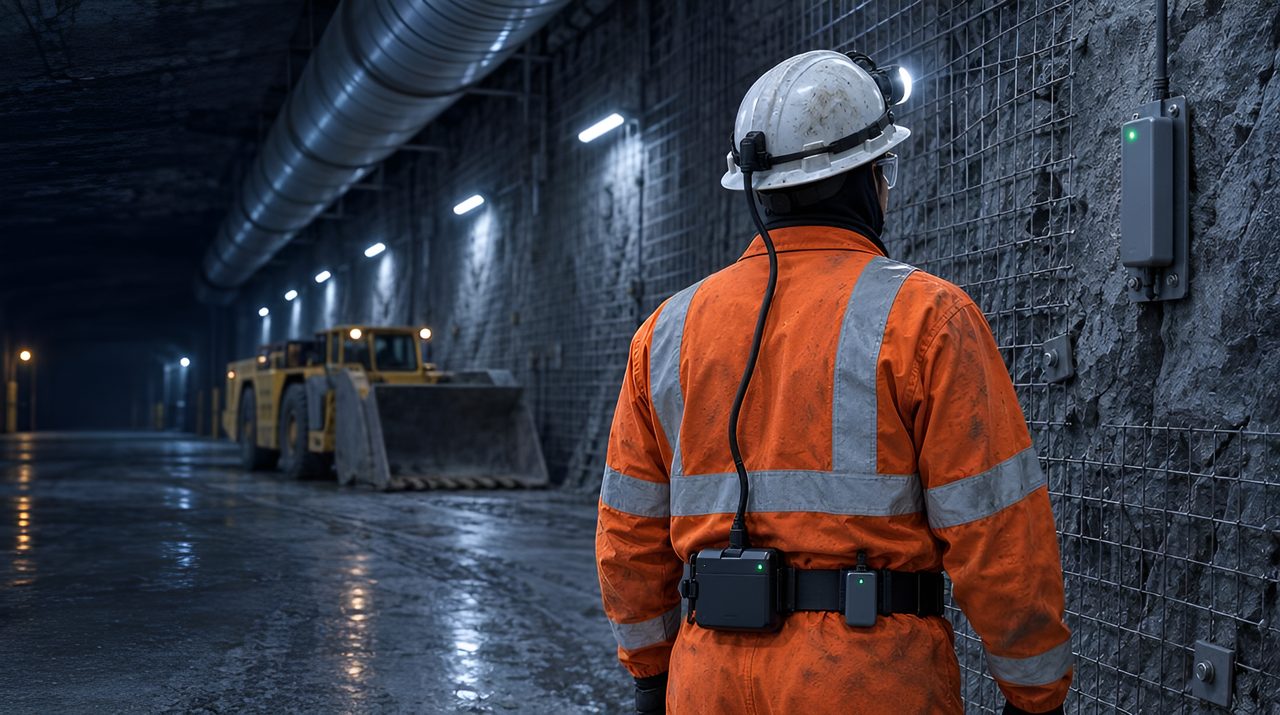
Keep people and machines apart and account for everyone in an emergency.
A mine or heavy-industrial site needs to prevent vehicle-pedestrian incidents and account for every worker fast in an evacuation, across pits, plant and underground.
The programme and figures on this page come from an earlier work by our advisers. The client name is withheld under NDA. Figures are as reported at the time. Named references are available under NDA when you engage.
Results in this engagement
Vehicle-pedestrian proximity alerts in blind spots.
Headcount accountability at muster.
Evacuation accountability vs manual roll-call.
Earlier work by our advisers. Client name withheld under NDA. Client name withheld under NDA; figures as reported at the time. Named references available under NDA. We model your own numbers when you engage.
The challenge
Blind spots around heavy machinery are a fatality risk. Manual mustering is slow and uncertain when minutes matter.
Our approach
- UWB / proximity tags for vehicle-pedestrian detection zones.
- In-cab alerts and zone speed enforcement.
- Real-time mustering points with headcount verification.
- Lone-worker and duress for isolated areas.
- Integrate with safety and fleet systems.
Technology & integration
Stack deployed: UWB / proximity RTLS, ruggedised wearables, in-cab units; LoRaWAN for wide-area.
Integration: Safety / EHS systems, fleet management, access control.
Related: Mining RTLS · Mining safety & mustering · UWB vs BLE
Baseline, method, period and what we excluded.
This page describes an engagement our advisers led in earlier roles. The client name is withheld under NDA. Figures are as reported at the time, with published industry sources where noted.
- Baseline: Radio call-outs and line-of-sight between haul trucks and people; near-misses captured inconsistently.
- Method: UWB/proximity on people and vehicles with escalating zones; incidents logged against shift and vehicle ID.
- Period: Underground/open-pit pilot on one production level, then fleet expansion.
- Excluded: Lab accuracy specs without a live near-miss review ritual.
Programme context
Surface and underground mines typically phase collision avoidance: instrument a high-risk fleet slice and one production level, prove escalating proximity zones and in-cab alerts, then expand. UWB or dedicated proximity radios dominate where GNSS fails. LoRaWAN often carries wide-area telemetry and SOS.
Integration targets are EHS incident systems, fleet dispatch and access control, not a standalone safety app. Mustering is usually co-designed so the same wearable identity supports evacuation headcount.
Outcomes and how they are earned
Comparable programmes aim for fewer vehicle-pedestrian near-misses in instrumented zones, faster verified muster, and a review ritual that ties alerts to coaching, not mute fatigue. Figures vary with fleet mix and culture. We model yours from baseline near-miss and roll-call data.
Success looks like supervisors trusting the alert ladder and workers trusting that privacy is limited to safety purposes.
Lessons from this engagement
Failure modes: alerting without zone calibration in metal-dense headings; no ownership of false-positive review; treating lab ranging specs as underground truth; skipping union/workforce consultation on wearables.
Keep productivity tracking out of the safety business case. It poisons adoption.
Deeper problem framing
Haul-truck and light-vehicle interactions in pits, plus pedestrian exposure at crushers and workshops, create fatality risk that radio call-outs cannot manage at shift scale. Near-miss reporting is inconsistent. Culture may punish reporting. Underground headings add multipath and infrastructure limits that invalidate open-pit GNSS assumptions.
Procurement pressure often pushes 'collision avoidance' as a single SKU. In practice you are buying a system of wearables, vehicle units, alerting logic, training and EHS review rituals.
Approach that survives underground and surface reality
Phase instrumentation on the worst fleet segment; calibrate escalating zones with operators aboard; integrate alerts into in-cab workflow without mute culture; co-design muster identity on the same wearable where possible.
Run RF surveys in representative headings, not only workshops. Define false-positive review owners before go-live. Align with existing isolation and traffic management rules so digital alerts do not contradict site law.
Outcomes and measurement discipline
Comparable programmes seek fewer serious near-misses in instrumented zones, faster verified headcount in drills, and a coaching loop tied to alert data. Exact percentages vary; measure your own baseline for 4-8 weeks first.
Exclude lab ranging sheets and any period without a live review ritual from claimed success.
Governance, risk and what we refuse to claim
This engagement was earlier work by our advisers. The client name is withheld under NDA. We will not attribute percentages to a confidential site. When you engage, we rebuild baselines from your incidents, labour samples and system logs.
We refuse vanity accuracy claims without a coverage map, and we refuse programmes that silently add productivity surveillance onto a safety business case without a fresh DPIA or labour consultation.
Implementation sequence and change management
Week 0-2: baseline near-miss and roll-call timing; traffic rules review; union/workforce briefing on safety-only purpose. Week 3-6: instrument pilot fleet and one level; calibrate zones with operators; mute-prevention training. Week 7-12: expand fleet; connect EHS logging; first scored drill.
Budget for spare wearables, charger discipline and a named false-positive owner. If supervisors treat every alert as noise, redesign zones before buying more tags. Technology last: traffic management and training first.
Competitive note: several proximity suppliers will claim plug-and-play. Ask for underground references, spoofing/security posture, and integration to your incident system, not only ranging charts.
Last updated:
People and machines apart
Independent advisory means the radio is chosen last. After the job, the constraints and the system of record are clear.
Safety and utilisation as separate jobs
Mustering, collision and asset utilisation get different success tests.
Environment-first shortlists
ATEX, dust and network reality eliminate pretty demos early.
Operate with site systems
Events into the platforms supervisors already run on shift.
Measurement
Baseline: proximity/collision events (where logged), muster times, and “person not found” incidents. Pilot: one decline/panel with RTLS mustering and vehicle proximity. Steady-state: muster completion time, proximity alert quality, and open safety actions. Safety figures stay within what site leadership will publish.