
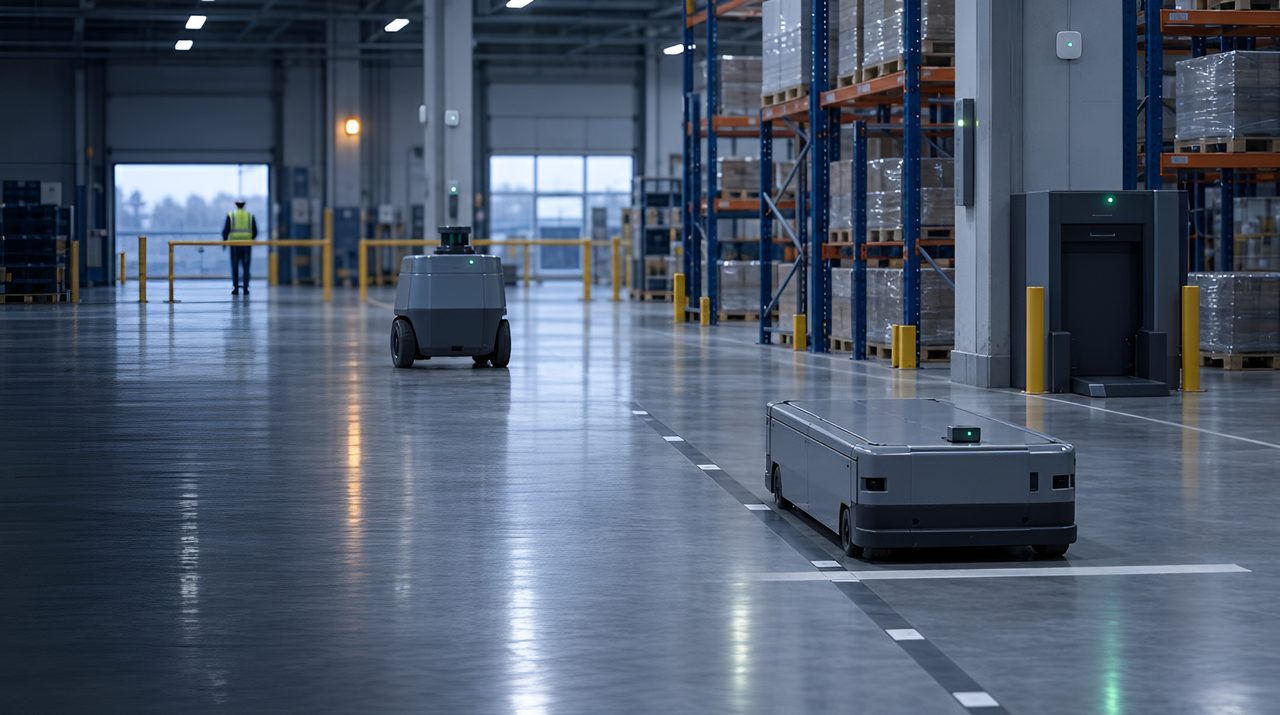
AMR and AGV integration, from choice to go-live
We advise, supply the hardware and integrate it with your WMS, ERP or MES. Or we just advise, if that’s all you need.
- Hardware
- Integration
- EMEA · NA · APAC
We reply within one working day with questions or a written price. No obligation. Fixed-scope engagements from £3k.
Prefer to talk? Book a free 30-minute call · +44 20 3918 1134 · or send a short message.
Not ready for a call? ··
An independent AMR and AGV specialist for operations and automation teams buying their first mobile robots, adding a second supplier, or bringing legacy AGVs under one traffic plan. We cover AMR vs AGV fit, AMR/AGV fleet management and fleet-manager selection under VDA 5050, safety-standard readiness, and WMS/MES integration. We advise first. If you decide integration is the right next step, we can do that too, and we'll always say so upfront.
For warehouse and factory mobile robots, not vehicle fleets. Tracking trucks or heavy equipment instead? See fleet locating here.
A manufacturer running AMRs and AGVs: higher AMR/AGV utilisation and lower idle charging time.
“We stopped managing robots as individual machines and started optimising them as an intelligent fleet.”Director of operations, industrial manufacturing (client anonymised)
Earlier work by our specialists; client name withheld under NDA. Read the case study
Prefer to talk? Book a free 30-minute call.
- Who it is for
- Sites weighing AMRs or AGVs, or struggling with a fleet that is already live
- What you get
- Flow analysis, the AMR-or-AGV call, a supplier shortlist and a WMS/ERP integration plan
- How long
- Discovery 1 to 5 days on site; supplier selection typically 3 to 6 weeks
- Price
- Fixed-scope engagements from £3k. Written proposal after a free call
What you leave with
- Requirements briefYour flows, volumes and constraints, written down and agreed.
- Supplier shortlist and like-for-like quote comparisonQuotes on the same scope, so you compare price and risk, not wording.
- Flow simulation findingsHow many robots you need, where they queue and what throughput to expect.
- WMS/ERP interface spec with ownersWho sends which task and status, and who owns each part.
- Deployment roadmap and site-readiness checklistWhat the site needs before the robots arrive, in order.
- Pilot pass/fail criteria and handover planA clear go or no-go, and a team ready to run the fleet.
Fixed-scope engagements from £3k.
Free AMR Readiness Score
Answer 14 questions about your site and see where a robot project is most likely to struggle. About 5 minutes, no sign-up.
Your robot project in five steps
- AssessKnow which flows suit robots, and which do not.
- ShortlistTwo or three suppliers that fit your site, with quotes you can compare.
- SimulateFleet size, traffic and throughput checked before you sign.
- PilotA pilot judged against pass/fail criteria agreed in writing.
- Go-liveRobots working with your WMS, and a named owner for the fleet.
Test fleet size, traffic and throughput before you sign
See how many robots you need, where they will queue and how your peak hour runs, with your own layout and volumes, not a supplier demo.
How we get you from a wide field of suppliers to one decision

What AMR/AGV guidance covers, fleet management, mixed fleets, what we deliver, and the market we assess Show
What AMR & AGV guidance covers
We help you decide whether mobile robots fit your flows, which type (AMR, AGV or autonomous forklift), which robot manufacturers and which fleet manager, then we specify the integration and acceptance tests so the fleet scales across suppliers. We work for the buyer from start to finish.
Typical triggers:
- First fleet: a business case and shortlist for goods-to-person, tugger replacement, line-side replenishment or pallet moves.
- Second supplier: a new robot brand is arriving and the two fleets start blocking each other at shared doors and aisles.
- Brownfield AGVs: legacy AGVs need to coexist with new AMRs without ripping out infrastructure.
- Autonomous forklifts: pallet automation on mixed floors with people and manual trucks.
- Stalled pilot: robots work in the demo zone but throughput, uptime or safety sign-off doesn't hold at peak.
From the right AMR or AGV to AMR/AGV fleet management that works on your site
We work with operations, engineering and estates teams in healthcare, warehousing and logistics, manufacturing, and airports and ports. Our specialists have spent around twenty years on RTLS and RFID (UWB, BLE AoA, active and passive RFID), and a good part of that working with AMR and AGV manufacturers and with fleet manager providers on sites running more than one fleet.
- Independent review of an existing fleet: what works, what doesn't, and whether to fix, extend or replace it.
- Requirements and specification: what the robots, the fleet manager and your building need to do, written down before anyone quotes.
- Market and options review: which types of AMR and AGV, and which technology providers, suit your loads, routes and site.
- Independent specifications and acceptance criteria: one specification every supplier prices against, and a clear definition of what “accepted” means.
- Tender evaluation support: comparing bids like for like, and finding what a quote leaves out.
- Install and acceptance support: on your side through installation, commissioning and sign-off.
- Robot fleet management for mixed fleets: planning how robots from different manufacturers work under one fleet manager and supporting your team through set-up, including shared lifts, doors and chargers, traffic and priority across fleets, and links to WMS, MES and hospital or estates systems with your IT and OT teams, under your change control.
Robots from different manufacturers under one fleet manager
It can work, but seldom on day one. Pick the right AMR or AGV for each job first. Then test what each robot and each fleet manager actually supports on your site, because the brochure and the site rarely agree.
What to watch for
- Compatibility claims that cover basic tasks, while traffic, charging or error recovery stay with each manufacturer's own software.
- Lifts, doors, fire doors and chargers that more than one fleet wants to control.
- Traffic and priority rules that suit one fleet but block another at peak times.
- Links to WMS, MES or hospital and estates systems that nobody owns once the robots are live.
- Software updates to robots or the fleet manager that change behaviour without warning.
Questions to ask before you sign
- Which functions will the fleet manager control for each robot type, and which stay with the manufacturer?
- Who is responsible when robots from two suppliers block each other at a door or in a lift?
- How are updates to the robots and the fleet manager tested before they reach your site?
- What does acceptance mean for the whole fleet, not just for each robot?
Get a written price to talk through your fleet, your site and what a mixed fleet would take.
What we deliver
| Stage | Deliverable | Why it matters |
|---|---|---|
| 1 · Fit assessment | AMR vs AGV vs autonomous forklift vs conveyor/manual, per flow, with throughput and layout assumptions | Avoids buying flexible robots for fixed routes, or fixed routes for changing ones |
| 2 · Business case & TCO | Five-year cost model: robots, fleet licences, integration, network, charging, safety, support, change management | The robot is rarely the biggest line. Board approval needs the whole picture |
| 3 · Supplier & fleet-manager selection | Requirements, RFP, scripted demos on your flows, scoring matrix; robot manufacturers plus independent fleet managers | Keeps the next purchase open to competition |
| 4 · Interoperability & integration architecture | VDA 5050 scope, WMS/MES/ERP interfaces, traffic rules, map ownership, event schema, cybersecurity (IEC 62443) | Mixed fleets deadlock where maps and control planes meet |
| 5 · Safety & standards readiness | Checklist against ISO 3691-4, ANSI/A3 R15.08 and the EU Machinery Regulation; zoning and speed policies for shared aisles | Safety sign-off is where schedules slip |
| 6 · Simulation, pilot & acceptance | Peak-density simulation, pilot KPIs (jobs/hour, blocked time, mission success, uptime), acceptance tests | Demo-day averages hide peak-hour failure |
| 7 · Scale-up & optimisation | Fleet analytics, utilisation truth for CapEx decisions, post-go-live audit | Grow the fleet on evidence, not on the supplier's roadmap |
Your robot project from site survey to steady operation
| Step | What you receive |
|---|---|
| 1 · Site survey | A survey report on your floor, routes, network, charging space and the areas robots share with people. |
| 2 · Supplier shortlist | A shortlist of robot makers and fleet managers that fit your site, with the reasons in writing. |
| 3 · Integration plan | A plan for the links to your WMS, MES or ERP, the VDA 5050 scope and who owns each interface. |
| 4 · Installation | Robots, fleet software and chargers installed and set up, with progress reported to you. |
| 5 · Acceptance testing | Agreed acceptance tests run on your site, with a written result before you sign off. |
| 6 · First 90 days after go-live | Regular reviews of uptime and throughput, and an open-issues list followed up with the suppliers. |
Is your site ready for robots? Take the 10-question self-check.
After go-live
What you get once the robots are running:
- Support period: support for an agreed period after go-live, set out in the quote.
- Issue handling: one contact for issues, followed up with the robot maker, integrator or fleet manager supplier until they are closed.
- KPI reviews: regular reviews of uptime, throughput and blocked time with your team.
- Adding robots later: help when you add robots, new routes or another brand to the fleet.
Why buyers are standardising now
The market is growing quickly and consolidating. Interact Analysis (January 2026) expects mobile-robot revenues to grow from just under $5 billion in 2024 to $14 billion by 2030, with order-fulfilment robots accounting for about half of shipments and mobile forklifts about a third of revenue by 2030. MarketsandMarkets (February 2026) sizes the narrower AMR market at $2.75 billion in 2026, reaching $7.07 billion by 2032. Suppliers enter and exit (Zebra sold its Fetch-based AMR business to Skild AI, per Skild AI's announcement of 15 April 2026), so an architecture that lets you swap or add robot brands protects the investment.
Standards we work with
| Standard | Scope | What we do with it |
|---|---|---|
| VDA 5050 (v3.0, released March 2026, announced April 2026) | Open interface between AGVs/AMRs and a master control system; v3.0 improves support for free-navigating robots, zones and path sharing | Define the VDA 5050 scope in the RFP; test adapters and the master controller before go-live |
| MassRobotics Interoperability Standard | Shared status and position data across robot brands (monitoring, not control) | Use for cross-fleet visibility where full VDA 5050 control isn't needed |
| Open-RMF | Open-source framework coordinating multiple fleets and building infrastructure (doors, lifts) | Assess for multi-fleet facilities such as hospitals |
| ISO 3691-4:2023 | Safety requirements for driverless industrial trucks and their systems | Requirement checklist and acceptance evidence |
| ANSI/A3 R15.08-1 / -2 | Industrial mobile robot safety (manufacturer; integration and user); Part 3 in development | North American specification and acceptance |
| EU Machinery Regulation 2023/1230 | Replaces the Machinery Directive from January 2027; covers autonomous mobile machinery | Plan conformity responsibilities in contracts |
Robot manufacturers and fleet managers we assess
We evaluate on your requirements and don't hold a preferred list. Robot manufacturers we assess include, for example, OTTO (Rockwell Automation), MiR (Teradyne), Geek+, HIK Robot, ABB Robotics, Seegrid, Daifuku, Vecna Robotics, Locus Robotics and forklift OEM automation. Independent AMR/AGV fleet-management and orchestration layers include SYNAOS, idealworks, NAiSE, Meili FMS, Navitec Navithor, BlueBotics ANT and Kollmorgen NDC. See our supplier reviews.
Platforms we've worked with
- ABB
- KUKA
- MiR
- OMRON
- Geek+
- OTTO Motors
- HIKROBOT
- Zebra
- Seegrid
- AGILOX
We've worked with all of these on client projects. Trademarks belong to their owners.
AMR or AGV fleet arriving and no one to own it yet?
If an AGV or AMR fleet is coming in and no one owns it yet, we can cover it by the project or by the day while you hire.
- Commissioning support: we check the system against what the contract says it should do, including route and traffic rules, charging, alarms and recovery, and support for the integrator's safety sign-off against ISO 3691-4 and your own risk assessment. We flag anything not yet met before acceptance is signed.
- Linking the fleet manager to MES or WMS: we agree which events become transactions and what happens when a message is lost, then test it. We work with your IT and OT teams through OPC UA or the WMS interface, under your change control.
- VDA 5050 and mixed fleets: whether you need a VDA 5050 master control, what to ask each supplier about their support for it, and how to test it before you rely on it.
- Handover: we write the runbook (daily checks, alarm handling, who to call, spares and software versions) and take your new hire through it on site.
For hospitals, see hospital goods transport with AGVs and AMRs.
What we don't do
- Advice first. We also supply, lease and integrate if you choose.
- We don't act as the machine builder or system integrator of record, and we don't issue CE or conformity declarations. We specify, check and accept that work on your behalf.
- We don't run your fleet day to day or sit on call for production.
- We don't push RTLS into robot projects. We recommend UWB localisation assurance only where it solves a measured problem.
Engagement models and fees
Engagements usually start with a discovery and scoping stage (typically 1 to 5 days on site) or with supplier selection and RFP support. Every engagement is scoped per project and priced in writing before work starts: £3k to £30k per project, or £1,200 a day. Regional ranges for Europe, North America and other regions are on how we work.
Typical timeline: discovery stage (typically 1 to 5 days on site), then supplier selection (typically 3 to 6 weeks), then pilot design and oversight (with timings agreed per site), with a gate after each where you can stop and keep the artefacts. Fleet rollout after the pilot is scoped per project.
Proof: see AMR/AGV fleet intelligence and automotive AGV material flow. Both are engagements our specialists led in earlier roles; client names are withheld under NDA.
Frequently asked questions
When do you need an AMR or AGV specialist?
When the decision is expensive and hard to reverse: a first fleet, a second robot brand joining the first, legacy AGVs that must coexist with new AMRs, or a pilot that works in the demo zone but not at peak. An independent specialist is useful when every other specialist in the room sells robots or fleet software.
What does AMR supplier selection include?
A fit assessment per flow, a requirements specification, a shortlist of robot manufacturers and fleet managers, an RFP with integration and acceptance criteria, scripted demonstrations on your site data, and evidence-based scoring. For the underlying comparison, see our AGV vs AMR page.
Can you rescue a stalled robot pilot?
Often. Typical causes are unrealistic throughput assumptions, Wi-Fi or network gaps, traffic conflicts at shared doors and aisles, and missing WMS/MES integration or acceptance criteria. We diagnose against measured data, then agree a recovery plan with the supplier or recommend stopping.
Which safety standards apply to AMRs and AGVs?
ISO 3691-4:2023 covers driverless industrial trucks and their systems. In North America, ANSI/A3 R15.08-1 and R15.08-2 cover industrial mobile robots, with Part 3 in development. In the EU the Machinery Regulation (EU) 2023/1230 applies from January 2027. The manufacturer or integrator performs the risk assessment and conformity work. We help you specify, check and accept it.
Do you sell robots or fleet software?
Advice first. You pay us for the advice; if you choose, we can also supply, lease and integrate the robots, as a separate service priced openly. We assess robot manufacturers and independent fleet managers against your requirements, for example SYNAOS, idealworks, NAiSE, Meili FMS, Navitec, BlueBotics ANT and Kollmorgen NDC.
Do you work with multi-supplier fleets under VDA 5050?
Yes. VDA 5050 lets one master controller task robots from different manufacturers. Version 3.0 was released in March 2026 (announced April 2026). We write the VDA 5050 scope into the RFP and test adapters before go-live. Our fleet orchestration page covers the technical detail.
Can one fleet manager run robots from different manufacturers?
Yes, but seldom on day one. Most fleet managers can send basic jobs to other brands, while traffic, charging and error recovery stay with each manufacturer's own software. We test what each one handles on your site (shared lifts, doors and chargers, priority between fleets, links to WMS, MES or hospital and estates systems) before you sign.
What happens after go-live?
We stay involved for an agreed support period: one contact for issues, regular reviews of uptime and throughput, and help when you add robots later. The details are in the quote.
Prefer a monthly fee?
Robots, software and support as one monthly service, no large upfront cost. Ask for both options in your proposal.
Where is your project?
Also useful: Rental pilot · Second opinion on a quote
Related: fleet orchestration (VDA 5050), VDA 5050 guidance, AGV vs AMR, logistics, automotive and manufacturing.
Talk it through in 30 minutes
Free, with no obligation. After the call you get a written price for your project.
Prefer it in writing? Get a written price
Last updated: