
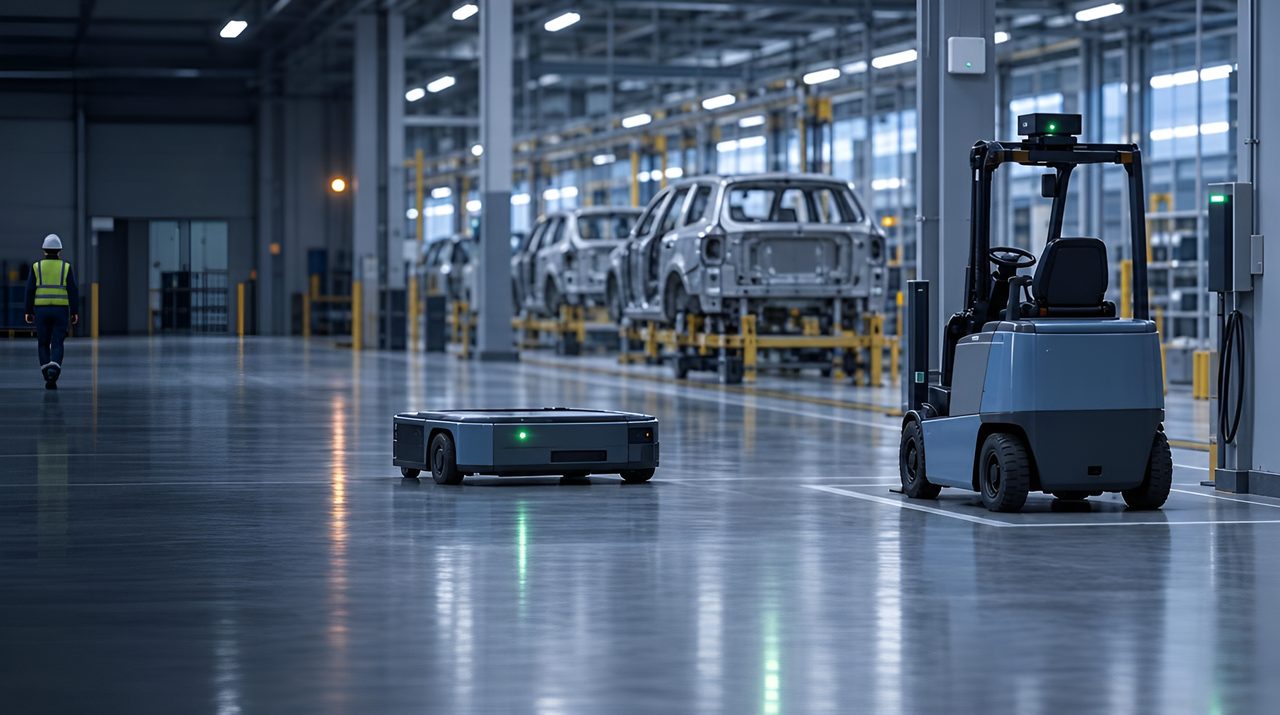
Line-side flow, optimised, from reactive to predictive.
A global automotive supplier faced bottlenecks from delayed line-side replenishment, AGV congestion and poor live visibility of pallets, carts and WIP inventory.
The programme and figures on this page come from an earlier work by our advisers. The client name is withheld under NDA. Figures are as reported at the time. Named references are available under NDA when you engage.
What they were up against.
Replenishment delays
Line-side material arrived late, stalling production.
AGV congestion
Route conflicts slowed the robotic fleet and created collision zones.
No live WIP visibility
Pallets, carts and WIP were invisible in real time.
Earlier work by our advisers. Client name withheld under NDA. Client name withheld under NDA; figures as reported at the time. Named references available under NDA. We model your own numbers when you engage.
Independent, tied to a named KPI.
Hybrid orchestration: UWB for high-accuracy AGV routing and collision zones, BLE on pallets, bins and material carts, AGV telemetry for route intelligence, and AI heatmaps for bottleneck and idle-time analysis.
What the engagement delivered.
- UWB RTLS for high-accuracy AGV routing & collision zones
- BLE tags on pallets, bins and material carts
- AGV telemetry integration for route intelligence
- AI heatmaps: bottleneck & idle-time visibility
Results in this engagement
“Location intelligence transformed our production logistics from reactive to predictive.”
Plant logistics manager, Tier-1 automotive (client anonymised)
The stack behind it
More case studies like this.
Baseline, method, period and what we excluded.
This page describes an engagement our advisers led in earlier roles. The client name is withheld under NDA. Figures are as reported at the time, with published industry sources where noted.
- Baseline: AGV routes static; lineside starvation discovered when the operator calls.
- Method: AGV/AMR location joined to lineside buffer min/max; starvation and wait-for-material events timed.
- Period: One model line through a colour-change week.
- Excluded: Robot OEM utilisation alone without a production KPI.
Programme context
AGV/AMR material-flow programmes need locating plus fleet orchestration awareness (VDA 5050 contexts in Europe). Advisory focus: traffic rules, handoff accuracy, and integration, not selling robots.
Pilot one loop with mixed traffic before site-wide claims.
Outcomes in this engagement and how they were earned
Outcomes: stable cycle times, fewer lost loads, clearer bottleneck heatmaps for industrial engineering.
Lessons from this engagement
Lessons: happy-path demos fail in mixed traffic; cybersecurity zoning for fleet masters; keep human-driven tugs in the model.
Deeper problem framing
AGV loops look fine in demos then fail in mixed traffic. Multiple supplier consoles hide blocked-time truth.
Approach
Advisory on orchestration and locating; one pilot loop; event schema; cyber zoning; include human tugs.
Outcomes and measurement
Mission success, blocked-time, cycle stability, not robot count.
Governance, risk and what we refuse to claim
Figures from this engagement only. Your payback depends on adoption, integration quality and exception labour, not tag unit cost. Named references under NDA on engagement.
We challenge any supplier who asks you to accept demo-day averages as production truth.
Implementation sequence and change management
Advisory first: traffic rules, mixed traffic pilot, event schema, VDA 5050-aware orchestration where relevant. Cyber zoning for fleet masters. Human tug inclusion in the model.
KPIs: blocked-time, mission success, cycle variance. We don't sell hardware, so our advice stays independent. We prevent stranded fleets.
Buyer checklist, supplier challenges and engagement shape
For AGV material flow, pilot mixed traffic and blocked-time KPIs; treat robot count as a vanity metric.
Buyer checklist before you sign: (1) written system of record for events; (2) acceptance tests with 95th-percentile performance under real interference; (3) integration owner named in IT/OT; (4) privacy or labour consultation path if people are tagged; (5) cybersecurity zoning sketch; (6) five-year TCO including batteries, spares, recalibration and SLA escalations; (7) exit/export terms so you are not hostage to a cloud tenant; (8) a pilot that can fail without political punishment.
Supplier claims to challenge in this pattern: brochure accuracy without production load; 'compliance included' without artefacts; ROI that assumes perfect adoption in 30 days; references that cannot be called under NDA; install partners who have never worked your vertical's overlays; shared support accounts; and any design that dumps locating onto a flat plant or clinical VLAN.
How TRACIO typically engages: stage-1 architecture and measurement design; independent shortlist and RFP language; pilot acceptance criteria; then optional implementation oversight or programme rescue if a prior pilot stalled. Pages like this one exist so you can prepare the workshop. Your numbers replace every planning band when we model payback.
Risk register themes that recur: mute fatigue on alerts; shadow spreadsheets reappearing beside the platform; battery logistics understaffed; master data too weak to support identity; works-council or IG review starting too late; and success declared on demo day before night-shift reality.
Document baseline windows explicitly: what you measured, for how long, which shifts, and what you excluded. Investment committees and auditors both punish fuzzy before/after stories. If your baseline is weak, spend two to four weeks fixing measurement before ordering anchors or portals. That discipline is cheaper than a stranded deployment and is the difference between a locating programme and a technology souvenir.
Last updated:
Line-side truth
Independent advisory means the radio is chosen last. After the job, the constraints and the system of record are clear.
JIS / WIP that procurement can audit
Start from the sequence problem and the stations that break first.
Score radios against the plant
Metal, conveyors and existing MES integrations beat brochure accuracy claims.
Feed the systems the plant already runs
Position and identity events into MES/WMS, not a second glass the line ignores.
Measurement
Baseline: mission success, blocked-path events, and lineside starve/block minutes. Pilot: one loop or cell with fleet telemetry reconciled to MES/WMS moves. Steady-state: mission success rate, mean recovery time, and starvation minutes on the same ops dashboard. Figures are as reported in this engagement.