
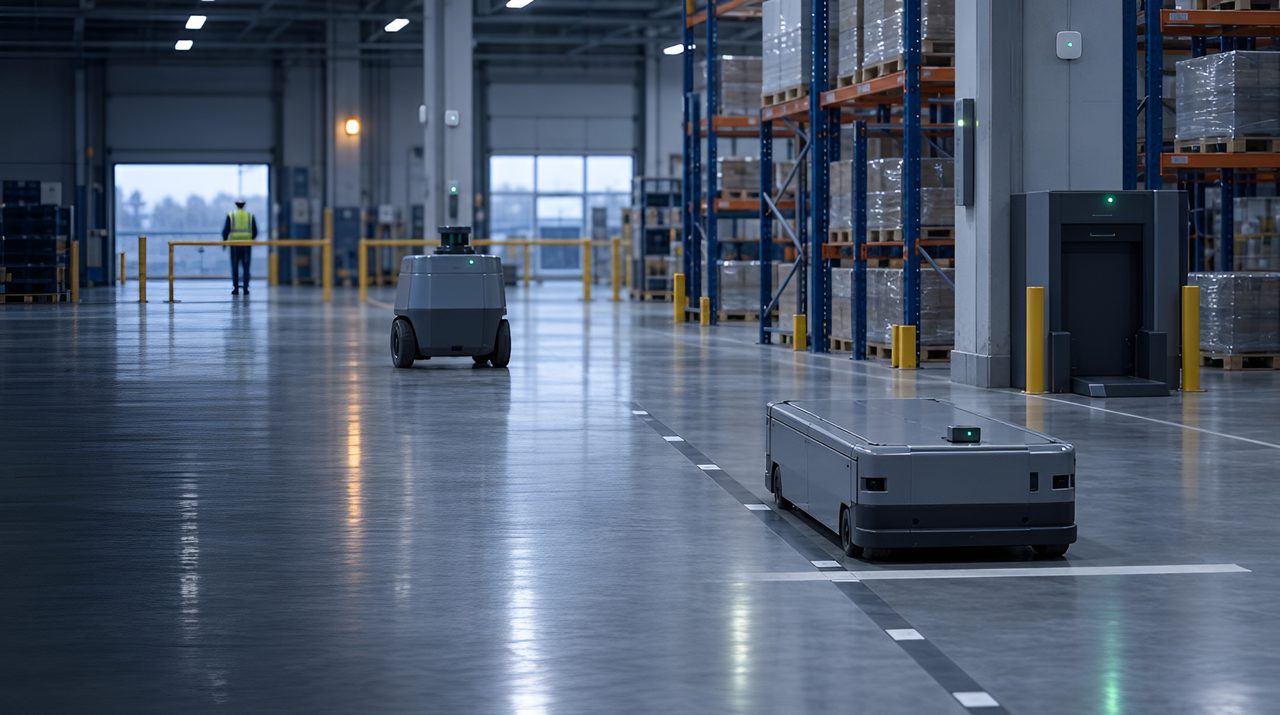
AGV vs AMR: independent comparison of when each wins.
AGV vs AMR is a job fit decision, not a brand decision. Fixed paths and throughput versus flexible missions. Pick before you buy a fleet brand.
Reviewed September 2026. No universal winner. How we assess suppliers.
AGVs follow fixed paths defined by magnetic tape, wire-guidance or barcode markers. AMRs navigate dynamically with LiDAR or visual SLAM. This is the operator-level comparison for procurement teams choosing between them, and the case for hybrid fleets governed by VDA 5050.
The category difference
AGVs (Automated Guided Vehicles) are fixed-path robots that follow markers: magnetic tape, embedded wires, optical lines, or fixed-position QR codes. They're deterministic, reliable, and proven at scale in high-volume repeatable tasks.
AMRs (Autonomous Mobile Robots) use onboard sensors (LiDAR, depth cameras, IMU) to build a map of the environment and navigate dynamically. They replan around obstacles, share dynamic paths with peers, and adapt to layout changes without re-tape-laying.
AGVs win on deterministic throughput in stable layouts. AMRs win on flexibility and faster deployment in changing environments.
Navigation and infrastructure
AGV: needs floor preparation (tape, wires, QR codes). Layout changes require re-laying the path infrastructure. Strong in environments where the layout is fixed and throughput is predictable.
AMR: needs a clean-floor scan during commissioning, plus charging stations. Layout changes handled by re-mapping (minutes to hours, not weeks). Strong in environments where workflows or layouts shift over time.
Throughput, cost and TCO
AGV: capital cost per unit can be higher for tugger / lifting vehicles, but lifetime TCO is well-understood and predictable; high-throughput applications (kitting, line replenishment, finished-goods buffer) are AGV's traditional strong suit.
AMR: faster deployment, lower per-unit capex on lighter-duty vehicles, but software, integration, fleet management and traffic-control engineering add cost. Payback is usually faster on AMR for variable workflows; AGV wins on steady high-volume routes.
Supplier landscape
AGV: Daifuku, Dematic and the wider KION Group (Linde, STILL), Toyota Material Handling, and vehicles built on Kollmorgen NDC or BlueBotics navigation. Fork-truck-shaped AGVs from forklift OEMs are mainstream.
AMR: Mobile Industrial Robots (MiR, owned by Teradyne), Geek+, OTTO (Rockwell Automation), Locus Robotics, Vecna Robotics, Seegrid, 6 River Systems (Ocado). Zebra announced in December 2025 that it is exiting the Fetch AMR business. The market consolidated rapidly post-2020 with major industrial groups acquiring AMR suppliers.
VDA 5050: the interoperability standard
VDA 5050 is the interface standard between mixed-fleet AGVs/AMRs and a master control system, published by the German Association of the Automotive Industry. It's now broadly adopted across European and growing North American deployments.
VDA 5050 is designed to let AGVs from one supplier and AMRs from another take orders from one master control, but support varies, so each vehicle has to be tested. This dramatically de-risks supplier commitment and enables phased rollout. See AMR and AGV fleet management, and what VDA 5050 covers.
Version 3.0, released in March 2026 (announced April 2026), adds zones and path sharing so free-navigating AMRs can plan their own routes while a central master keeps traffic control. Independent masters such as SYNAOS, idealworks, NAiSE and Meili FMS now compete with the robot manufacturers’ own fleet managers; see fleet orchestration.
Hybrid fleets and when each fits
Mature deployments often layer both. AGV for high-volume repeatable trunk routes (line-side replenishment, finished-goods buffer to dispatch).
AMR for variable goods-to-person picking, ad-hoc moves, and routes that change with seasonality or product mix. VDA 5050 binds the fleet under one master control. We pick the right vehicle for the right route in stage 1. See AMR and AGV fleet management, and what VDA 5050 covers.
Decision criteria
AGVs follow fixed physical or virtual guidepaths. AMRs localise with onboard sensing (often SLAM) and replan around obstacles. VDA 5050 (version 3.0 released March 2026, announced April 2026) standardises fleet-manager to robot messaging (typically MQTT/JSON) so mixed fleets can share a master controller. It does not replace safety cases, traffic logic, cybersecurity or WMS integration.
TRACIO advises on locating and fleet orchestration overlays. We don't sell hardware, so our advice stays independent. Score route stability, layout change frequency, brownfield versus greenfield, throughput predictability, and how completely each supplier implements VDA 5050.
When AGVs win
- Stable, high-volume loops expected to last years, where simplicity beats autonomy.
- Greenfield sites where guidepath infrastructure can be designed in cheaply.
- Lower per-vehicle cost and deterministic behaviour outweigh flexibility.
- Lanes are segregated enough that stopping on blockage is operationally acceptable.
When AMRs win
- Brownfield warehouses with frequent layout change, software remaps beat ripping tape or reflectors.
- Shared aisles with people and dynamic obstacles need local replanning.
- Multi-supplier growth path via VDA 5050-capable fleet managers matters strategically.
- Time-to-first-value must avoid long infrastructure install outages.
TCO traps
Trap: comparing only robot sticker price (AMRs cost more sensors and compute; AGVs hide install and re-route cost). Trap: ignoring AMR map maintenance labour in dynamic plants. Trap: assuming VDA 5050 “supported” means full feature parity across suppliers. Trap: buying fleets without a locating and traffic plan for mixed human-robot zones. Trap: under-scoping WMS/MES tasking interfaces. Trap: forgetting charger strategy and peak shift concurrency.
Locating and fleet control
Regardless of AGV or AMR, large fleets need traffic management, tasking from WMS/MES, charger strategy and often a locating overlay for shared human-robot spaces. VDA 5050 can help robots from different manufacturers talk to one fleet manager where they really support it; safety PLCs, zone rules and cybersecurity remain your programme. TRACIO’s role is advisory on locating and orchestration interfaces.
Ask suppliers to demonstrate obstacle behaviour, recovery from blocked paths, map update workflows (AMR), guidepath change cost (AGV), and how location events flow into your digital twin or YMS. Hybrid fleets (AGVs on frozen highways, AMRs in variable pick faces) are a legitimate 2026 pattern when economics and flexibility both matter.
Procurement questions that separate demos from deployments
- What VDA 5050 version and feature coverage is certified in production?
- Who owns the master fleet controller licence and multi-site expansion rights?
- What is the measured throughput on a path that matches your aisle width and dwell?
- How are emergency stops, human exclusion zones and mustering linked to locating?
- What is five-year TCO including map labour or guidepath rework?
Decision summary
Choose AGVs for frozen high-volume paths with lower vehicle complexity; choose AMRs for brownfield flexibility and dynamic aisles; choose hybrids when both exist on one site. Insist on VDA 5050 clarity, WMS tasking and a locating/traffic plan. TRACIO advises on orchestration and locating only. Robot CapEx stays with the OEM and integrator you select on merit.
Frequently asked questions
Which is cheaper: AGV or AMR?
Depends on workflow. AMR is typically cheaper to deploy initially (no floor prep, faster commissioning). AGV has lower lifetime TCO on stable high-throughput routes. The right comparison is total-cost-per-completed-move over the deployment lifetime.
Can AGVs and AMRs share a master control system?
Yes, VDA 5050 is designed exactly for this. We assess VDA 5050 readiness and help specify the master control; see AMR and AGV selection and fleet management.
Do AMRs need WMS integration to be useful?
Yes, for any production deployment beyond proof-of-concept. AMR fleet management software integrates with WMS (SAP EWM, Manhattan, Blue Yonder, Körber) via standard APIs. We design integration patterns in stage 1.
Will AMRs replace AGVs over time?
Partly. AMR market share is growing fast in goods-to-person picking and variable workflows. AGVs retain advantages in deterministic high-volume trunk routes and heavy-load tugger applications. Start by choosing the right AGV or AMR for each job; VDA 5050 is something to assess and work towards, not assume.
How accurate is AMR navigation in practice?
The accuracy depends on your site, and we confirm it in the survey. Docking and load-handling accuracy is higher (mm-level) using fiducial markers at pickup points. Accuracy is bounded by sensor quality and mapping discipline.
More head-to-heads in the independent technology comparisons. Not sure which family fits yet? Start with choosing a locating technology, then independent RTLS consulting for the advisory view. Mixing robot brands? See VDA 5050 consulting. Robots for a hospital? Read hospital goods transport with AGVs and AMRs. Fleet already on its way? See who owns the fleet after go-live.
Last updated: