
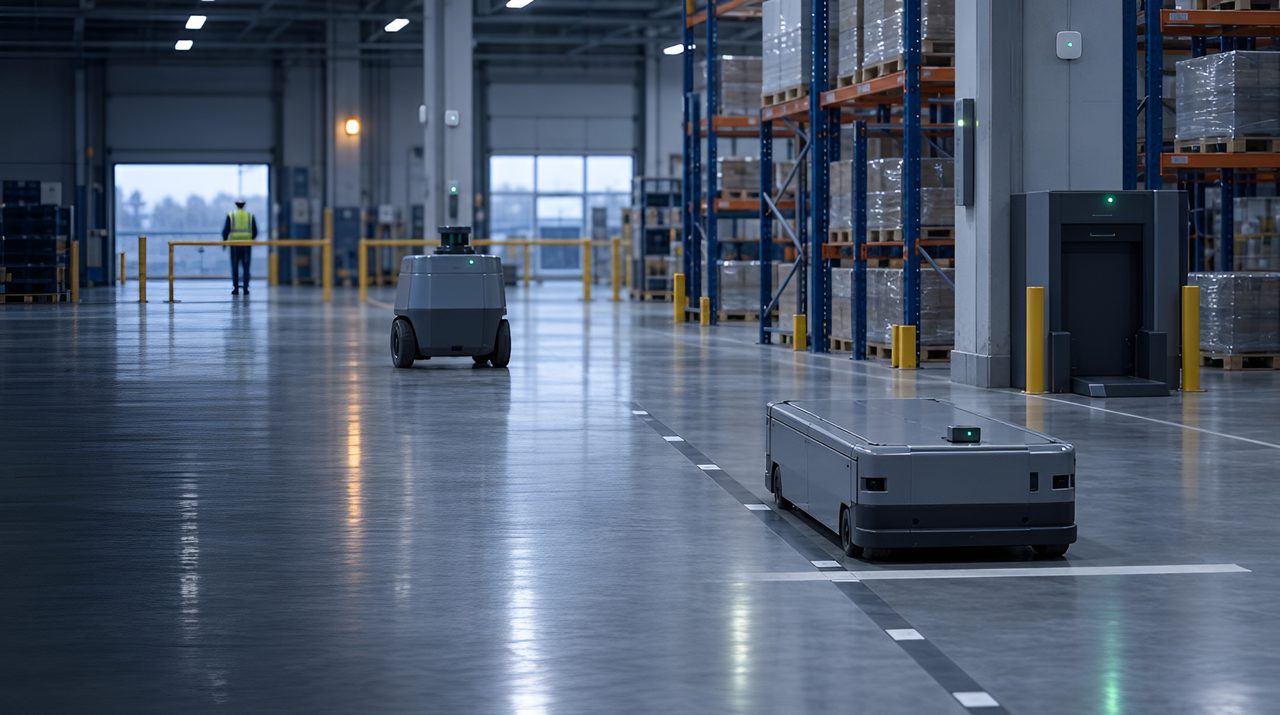
AGV vs AMR : quand chacun gagne.
Les AGV s et AMR sont des générations différentes de robotique mobile d’entrepôt et d’usine, avec des hypothèses différentes concernant la navigation, l’infrastructure, la flexibilité et le TCO.
Les AGV suivent des trajectoires fixes définies par bande magnétique, guidage filaire ou marqueurs de codes-barres ; Les AMR naviguent dynamiquement avec du LiDAR ou un SLAM visuel.
C’est la comparaison au niveau opérateur pour les équipes d’approvisionnement qui choisissent entre elles et le cas pour les flottes hybrides régies par VDA 5050.
La différence de catégorie
AGV s (Véhicules guidés automatisés) sont des robots à voie fixe qui suivent des marqueurs : bande magnétique, fils intégrés, lignes optiques ou codes QR en position fixe. Ils sont déterministes, fiables et éprouvés à grande échelle dans des tâches répétables à grand volume.
AMR s (Robots mobiles autonomes) utilisent des capteurs embarqués (LiDAR, caméras de profondeur, IMU) pour construire une carte de l’environnement et naviguer dynamiquement. Ils replanifient autour des obstacles,
partagent des chemins dynamiques avec leurs pairs et s’adaptent aux changements de disposition sans re-pose de bandes.
AGV s gagne sur le débit déterministe dans des configurations stables ; Les AMR l’emportent en termes de flexibilité et de déploiement plus rapide dans des environnements changeants.
Navigation et infrastructures
AGV: nécessite une préparation du sol (ruban adhésif, fils, codes QR). Les modifications de la disposition nécessitent de reconfigurer l’infrastructure des chemins. Fort dans des environnements où la disposition est fixe et le débit prévisible.
AMR: nécessite un scan du sol propre lors de la mise en service, ainsi que des stations de recharge.
Les changements de disposition sont gérés par un re-mappage (minutes en heures, pas semaines). Fort dans des environnements où les flux de travail ou les agencements évoluent avec le temps.
Débit, coût et TCO
AGV: le coût d’investissement par unité peut être plus élevé pour les véhicules remorqueurs / leveurs, mais le TCO à vie est bien compris et prévisible ;
les applications à haut débit (kitting, renouvellement de ligne, tampon pour produits finis) sont la force traditionnelle de AGV.
AMR: déploiement plus rapide, capital d’investissement par unité plus faible sur les véhicules plus légers, mais logiciels, intégration, gestion de flotte et ingénierie de contrôle du trafic ajoutent des coûts.
Le retour sur investissement est généralement plus rapide sur AMR pour les flux de travail variables ; AGV l’emporte sur des trajets réguliers à fort volume.
Paysage des fournisseurs
AGV: Dematic, Daifuku, KION (Linde / Dematic / STILL), Toyota Handling matériaux, Egemin. Les AGV en forme de chariot élévateur provenant des fabricants de chariots élévateurs sont courants.
AMR: Robots industriels mobiles (MiR, propriété de Teradyne), Geek+, OTTO Motors (Rockwell), Locus Robotics, Fetch (Zebra), Vecna Robotics, 6 River Systems (Ocado).
Le marché s’est rapidement consolidé après 2020, avec l’acquisition de fournisseurs de AMR par de grands groupes industriels.
VDA 5050 : la norme d’interopérabilité
VDA 5050 est la norme d’interface entre les AGV s/AMR s à flotte mixte et un système de contrôle maître, publié par l’Association allemande de l’industrie automobile. Il est désormais largement adopté dans les déploiements européens et en Amérique du Nord en croissance.
Avec VDA 5050, vous pouvez faire fonctionner une flotte hétérogène (des AGV d’un fabricant, des AMR d’un autre) sous une seule couche d’orchestration.
Cela réduit considérablement le risque d’engagement des fournisseurs et permet un déploiement par étapes. Voir Orchestration de flotte AGV & AMR.
La version 3.0, publiée en mars 2026 (annoncée en avril 2026), ajoute des zones et le partage de trajectoires pour que les AMR en navigation libre planifient leurs itinéraires tandis qu’un contrôleur maître central garde la gestion du trafic. Des contrôleurs indépendants comme SYNAOS, idealworks, NAiSE et Meili FMS concurrencent désormais les gestionnaires de flotte des constructeurs ; voir l’orchestration de flotte.
Flottes hybrides et quand chacune s’adapte
Les déploiements matures superposent souvent les deux. AGV pour les routes principales à grand volume et répétables (ravitaillement côté ligne, tampon pour marchandises finies jusqu’à la livraison).
AMR pour la sélection variable de biens à personne, des déplacements ad hoc, et des itinéraires qui changent selon la saisonnalité ou la composition des produits.
VDA 5050 relie la flotte sous un seul contrôle maître. Nous choisissons le véhicule adapté au bon itinéraire lors de l’étape 1, voir Orchestration de flotte AGV & AMR.
Questions fréquemment posées
Lequel est le moins cher : AGV ou AMRC ?
Cela dépend du flux de travail. Le AMR est généralement moins cher à déployer au départ (pas de préparation au sol, mise en service plus rapide) ; AGV a un TCO plus faible sur des routes stables à haut débit.
La bonne comparaison est le coût total par déménagement accompli sur toute la durée de vie du déploiement.
Les AGV s et AMR s peuvent-ils partager un système de contrôle maître ?
Oui, VDA 5050 est conçu exactement pour cela. Nous concevons un contrôle maître conforme à VDA 5050 dans le cadre de Orchestration de flotte AGV & AMR.
Les AMR S ont-ils besoin d’une intégration WMS pour être utiles ?
Oui, pour tout déploiement en production au-delà de la preuve de concept. Le logiciel de gestion de flotte AMR s’intègre avec WMS (SAP EWM, Manhattan, Blue Yonder, Körber) via des API standard. Nous concevons des schémas d’intégration à l’étape 1.
Les AMR s remplaceront-ils les AGV S avec le temps ?
En partie. La part de marché de AMR croît rapidement dans la cueillette de biens à personne et les flux de travail variables.
Les AGV conservent des avantages dans les routes trunk déterministes à grand volume et les applications de remorqueurs à forte charge. Nous nous attendons à ce que la solution à long terme, VDA 5050 - orchestrate soit une flotte mixte.
Quelle est la précision de la navigation AMR en pratique ?
La précision dépend de votre site, et nous la confirmons lors de l’audit sur site.
La précision de l’amarrage et de la gestion de la charge est plus élevée (au niveau MM) à l’aide de marqueurs fiduciaux aux points de ramassage. La précision dépend de la qualité des capteurs et de la discipline cartographique.
Dernière mise à jour: