
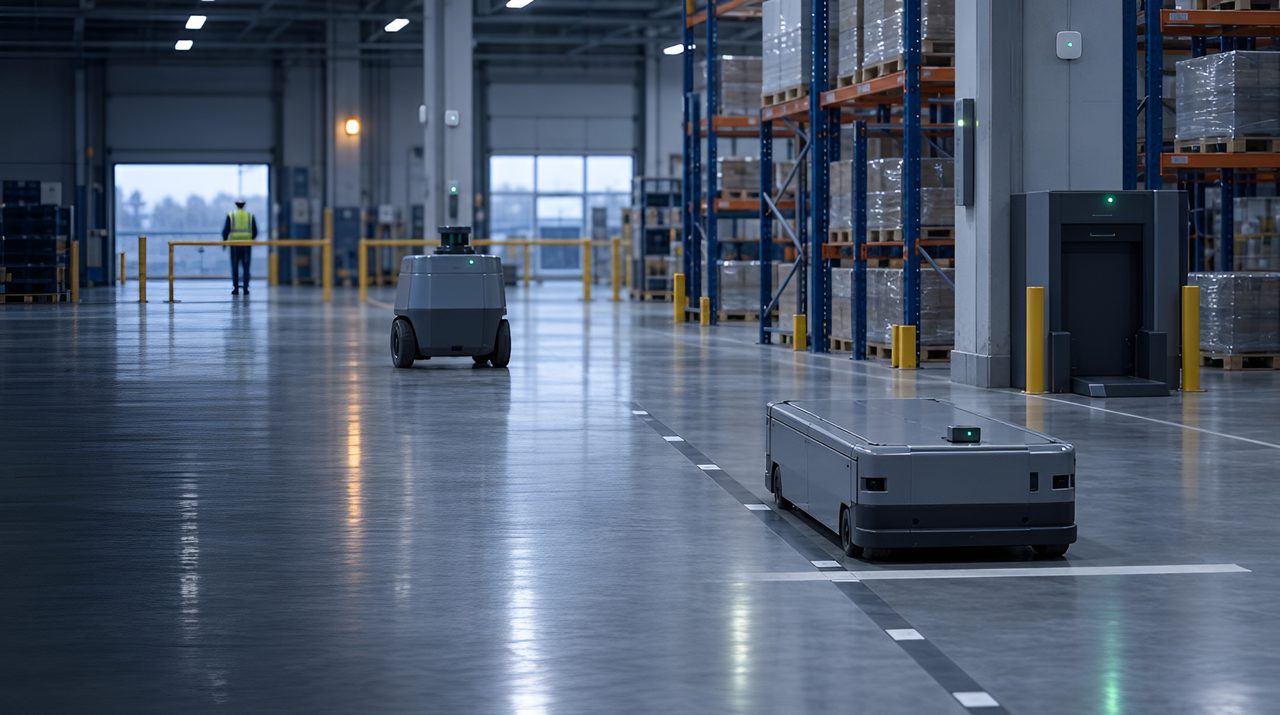
AGV vs AMR: wanneer ieder wint.
AGV en AMR zijn verschillende generaties magazijn- en fabrieksrobotrobotica, met verschillende aannames over navigatie, infrastructuur, flexibiliteit en TCO.
AGV's volgen vaste paden die worden gedefinieerd door magneetband, draadgeleiding of barcodemarkers; AMR navigeert dynamisch met LiDAR of visuele SLAM.
Dit is de operator-niveau vergelijking voor inkoopteams die tussen deze teams kiezen en het geval voor hybride vloten die worden beheerd door VDA 5050.
Het verschil in de categorie
AGV s (Geautomatiseerde Geleide Voertuigen) zijn robots met een vaste baan die markeringen volgen: magneetband, ingesloten draden, optische lijnen of QR-codes met vaste positie. Ze zijn deterministisch, betrouwbaar en bewezen op schaal bij herhaalbare taken met groot volume.
AMR s (Autonome Mobiele Robots) gebruik ingebouwde sensoren (LiDAR, dieptecamera's, IMU) om een kaart van de omgeving te maken en dynamisch te navigeren. Ze herplannen om obstakels heen,
delen dynamische paden met collega's en passen zich aan aan indelingswijzigingen zonder opnieuw tape te leggen.
AGV wint op deterministische doorvoersnelheid in stabiele layouts; AMR wint op flexibiliteit en snellere inzet in veranderende omgevingen.
Navigatie en infrastructuur
AGV: vloervoorbereiding nodig (tape, draden, QR-codes). Indelingswijzigingen vereisen het opnieuw leggen van de padinfrastructuur. Sterk in omgevingen waar de lay-out vast is en de doorvoer voorspelbaar.
AMR: heeft een schone vloerscan nodig tijdens de inbedrijfstelling, plus laadstations. Lay-outwijzigingen worden geregeld door opnieuw in kaart te brengen (minuten tot uren, niet weken). Sterk in omgevingen waar workflows of lay-outs in de loop van de tijd veranderen.
Doorvoer, kosten en TCO
AGV: de kapitaalkosten per eenheid kunnen hoger zijn voor sleep- en liftvoertuigen, maar de levensduur van de TCO is goed begrepen en voorspelbaar; Toepassingen met hoge doorvoer (kitting, lijnaanvulling, eindproductenbuffer) zijn de traditionele sterkste kant van AGV.
AMR: snellere inzet, lagere capex per eenheid op lichtere voertuigen, maar software, integratie, wagenparkbeheer en verkeersregelingstechniek verhogen de kosten. Payback is meestal sneller op AMR voor variabele workflows; AGV wint op gestage routes met veel volume.
Leveranciers
AGV: Dematic, Daifuku, KION (Linde / Dematic / STILL), Toyota Material Handling, Egemin. Vorktruckvormige AGV's van heftruckfabrikanten zijn gangbaar.
AMR: Mobile Industrial Robots (MiR, eigendom van Teradyne), Geek+, OTTO Motors (Rockwell), Locus Robotics, Fetch (Zebra), Vecna Robotics, 6 River Systems (Ocado). De markt consolideerde snel na 2020, waarbij grote industriële groepen AMR-leveranciers overnamen.
VDA 5050: de interoperabiliteitsstandaard
VDA 5050 is de interfacestandaard tussen gemengde vloot AGV s/AMR en een masterbesturingssysteem, uitgegeven door de Duitse Vereniging van de Autoindustrie. Het wordt nu breed toegepast in Europese en groeiende Noord-Amerikaanse inzet.
Met VDA 5050 kun je een heterogene vloot runnen (AGV van de ene leverancier, AMR van een andere) onder één orkestratielaag. Dit vermindert het risico van leveranciersverplichtingen aanzienlijk en maakt gefaseerde uitrol mogelijk. Zie AGV & AMR vlootorkestratie.
Versie 3.0, gepubliceerd in maart 2026 (aangekondigd in april 2026), voegt zones en het delen van routes toe, zodat vrij navigerende AMR’s hun eigen routes kunnen plannen terwijl een centrale master de verkeersregeling behoudt. Onafhankelijke masters zoals SYNAOS, idealworks, NAiSE en Meili FMS concurreren inmiddels met de eigen fleetmanagers van robotfabrikanten; zie vlootorkestratie.
Hybride vloten en wanneer elk past
Volwassen implementaties combineren vaak beide. AGV voor herhaalbare hoofdroutes met groot volume (lijnbevoorrading, afgewerkte goederenbuffer naar verzending).
AMR voor variabele goods-to-person picking, ad-hoc verplaatsingen en routes die veranderen met seizoensgebondenheid of productmix. VDA 5050 bindt de vloot onder één hoofdcontrole. We kiezen in fase 1 het juiste voertuig voor de juiste route, zie AGV & AMR vlootorkestratie.
Beslissingscriteria
AGV's volgen vaste fysieke of virtuele geleidingsroutes; AMR's bepalen hun positie met sensoren aan boord (vaak SLAM) en plannen om obstakels heen. VDA 5050 (inclusief het werk aan v3.x) standaardiseert de berichten tussen fleetmanager en robot (meestal MQTT/JSON), zodat gemengde vloten één centrale controller kunnen delen. Het vervangt geen veiligheidsdossiers, verkeerslogica, cybersecurity of WMS-integratie.
TRACIO adviseert over lokalisatie en een overkoepelende laag voor vlootbeheer. Wij verkopen geen hardware, dus ons advies blijft onafhankelijk. Beoordeel de stabiliteit van routes, hoe vaak de lay-out verandert, brownfield of greenfield, de voorspelbaarheid van de doorvoer en hoe volledig elke leverancier VDA 5050 implementeert.
Wanneer AGV's winnen
- Stabiele routes met hoog volume die jaren meegaan, waar eenvoud belangrijker is dan autonomie.
- Nieuwbouwlocaties waar de geleidingsinfrastructuur goedkoop kan worden ingepland.
- Lagere kosten per voertuig en voorspelbaar gedrag wegen zwaarder dan flexibiliteit.
- Rijbanen zijn zo gescheiden dat stoppen bij een blokkade operationeel acceptabel is.
Wanneer AMR's winnen
- Bestaande magazijnen met frequente layoutwijzigingen, kaarten opnieuw instellen via software is beter dan tape of reflectoren verwijderen.
- Gangpaden die met mensen worden gedeeld en dynamische obstakels vragen om lokale herplanning.
- Een groeipad met meerdere leveranciers via VDA 5050-geschikte fleetmanagers is strategisch belangrijk.
- De eerste waarde moet worden bereikt zonder lange stilstand voor de installatie van infrastructuur.
TCO-valkuilen
Trap: comparing only robot sticker price (AMRs cost more sensors and compute; AGVs hide install and re-route cost). Trap: ignoring AMR map maintenance labour in dynamic plants. Trap: assuming VDA 5050 “supported” means full feature parity across suppliers. Trap: buying fleets without a locating and traffic plan for mixed human-robot zones. Trap: under-scoping WMS/MES tasking interfaces. Trap: forgetting charger strategy and peak shift concurrency.
Lokalisatie en vlootsturing
Of het nu om AGV's of AMR's gaat: grote vloten hebben verkeersmanagement nodig, opdrachten vanuit WMS/MES, een laadstrategie en vaak een extra locatielaag voor ruimtes die mensen en robots delen. VDA 5050 helpt gemengde vloten van verschillende fabrikanten met één fleetmanager te communiceren, maar veiligheids-PLC's, zoneregels en cybersecurity blijven uw verantwoordelijkheid. TRACIO adviseert over locatiebepaling en orkestratie-interfaces. Wij verkopen geen hardware, dus ons advies blijft onafhankelijk.
Vraag leveranciers om obstakelgedrag te demonstreren, herstel na geblokkeerde routes, workflows voor kaartupdates (AMR), de kosten van een gewijzigde geleidingsroute (AGV) en hoe locatie-events in uw digital twin of YMS terechtkomen. Hybride vloten (AGV's op vaste hoofdroutes, AMR's in wisselende orderpickzones) zijn in 2026 een legitiem patroon wanneer zowel kosten als flexibiliteit tellen.
Inkoopvragen die demo's van deployments scheiden
- Welke VDA 5050-versie en welke functiedekking zijn in productie gecertificeerd?
- Wie bezit de licentie voor de centrale fleetcontroller en de rechten voor uitbreiding naar meerdere locaties?
- Wat is de gemeten doorvoer op een route die past bij uw gangbreedte en verblijftijd?
- Hoe zijn noodstops, uitsluitingszones voor mensen en mustering gekoppeld aan locatiebepaling?
- Wat is de TCO over vijf jaar, inclusief werk aan kaarten of aanpassing van geleidingsroutes?
Beslissingssamenvatting
Kies AGV's voor vaste routes met hoog volume en minder complexe voertuigen; kies AMR's voor flexibiliteit in bestaande gebouwen en dynamische gangpaden; kies een hybride vloot als beide op één locatie voorkomen. Eis duidelijkheid over VDA 5050, opdrachten vanuit het WMS en een plan voor locatiebepaling en verkeer. TRACIO adviseert alleen over orkestratie en locatiebepaling. De investering in robots gaat naar de fabrikant en integrator die u op basis van kwaliteit selecteert.
Veelgestelde vragen
Welke is goedkoper: AGV of AMR?
Het hangt af van de workflow. AMR is doorgaans goedkoper om in eerste instantie in te zetten (geen vloervoorbereiding, snellere ingebruikname); AGV heeft een TCO met een lagere levensduur op stabiele routes met hoge doorvoer.
De juiste vergelijking is de totale kosten per voltooide verhuizing over de implementatietijd.
Kunnen AGV s en AMRS een master control systeem delen?
Ja, VDA 5050 is hier precies voor ontworpen. We ontwerpen VDA 5050-conforme master control als onderdeel van AGV & AMR vlootorkestratie.
Hebben AMR-systemen WMS-integratie nodig om nuttig te zijn?
Ja, voor elke productie-implementatie die verder gaat dan proof-of-concept. De vlootbeheersoftware van AMR integreert met WMS (SAP EWM, Manhattan, Blue Yonder, Körber) via standaard API's. We ontwerpen integratiepatronen in fase 1.
Zullen AMR s na verloop van tijd de AGV vervangen?
Gedeeltelijk. Het marktaandeel van AMR groeit snel in goods-to-person picking en variabele workflows.
AGV behoudt voordelen in deterministische hoofdroutes met hoog volume en toepassingen voor zware sleepwagens. We verwachten dat een gemengde vloot, VDA 5050-georkestreerd de langetermijnoplossing zal zijn.
Hoe nauwkeurig is de navigatie van de AMR in de praktijk?
De nauwkeurigheid hangt af van uw locatie, en we bevestigen die in de site survey. De nauwkeurigheid van aandocken en ladingen is hoger (mm-niveau) met fiduciale markeringen op ophaalpunten. Nauwkeurigheid wordt begrensd door sensorkwaliteit en de juiste discipline in het kaarten.
Laatst bijgewerkt: