
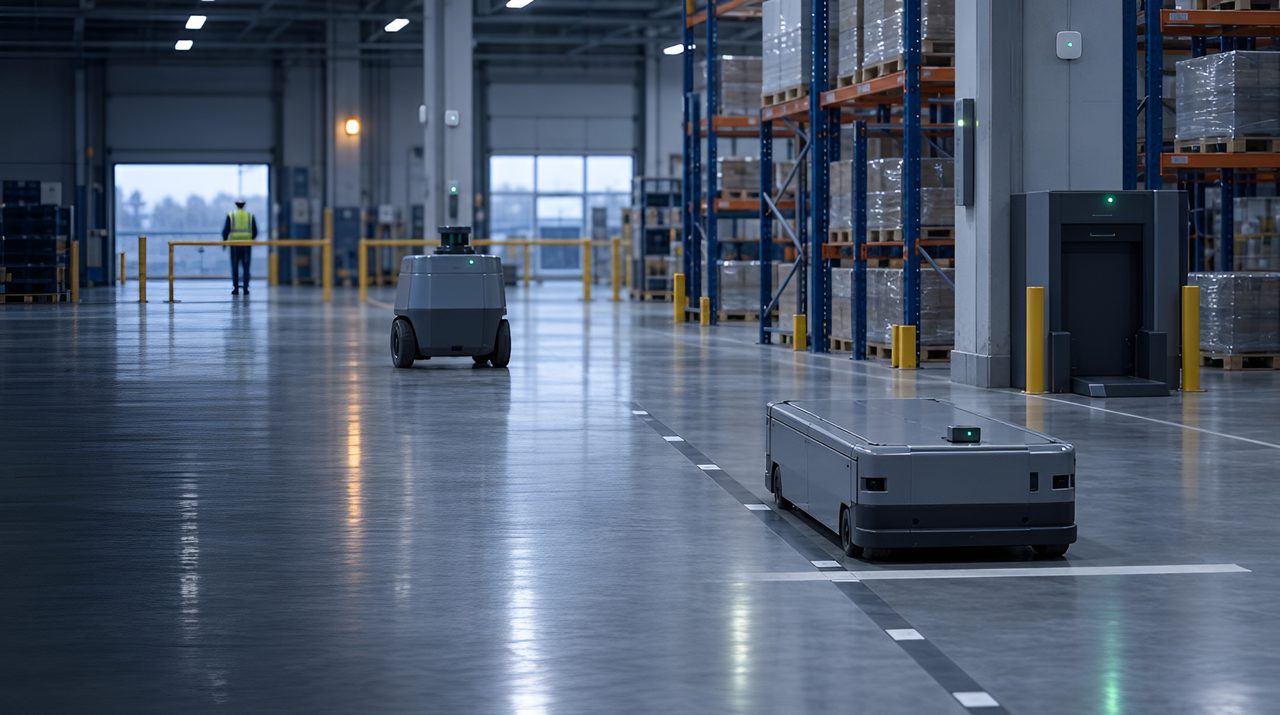
AGV vs AMR: quando vincono ciascuno.
AGV s e AMR s sono generazioni diverse di robotica mobile per magazzini e fabbriche, con assunzioni differenti su navigazione, infrastruttura, flessibilità e TCO.
Le AGV seguono percorsi fissi definiti da nastro magnetico, guida a fili o marcatori di codice a barre; Gli AMR navigano dinamicamente con LiDAR o SLAM visivo.
Questo è il confronto a livello di operatore per i team di approvvigionamento che scelgono tra loro e il caso per le flotte ibride governate da VDA 5050.
La differenza di categoria
AGV s (Veicoli Guidati Automatici) sono robot a percorso fisso che seguono i marcatori: nastro magnetico, fili incorporati, linee ottiche o codici QR a posizione fissa. Sono deterministiche, affidabili e comprovate su larga scala in compiti ad alto volume e ripetibili.
AMR s (Robot Mobili Autonomi) usano sensori di bordo (LiDAR, telecamere di profondità, IMU) per costruire una mappa dell'ambiente e orientarsi dinamicamente. Ripianificano attorno agli ostacoli,
condividono percorsi dinamici con i pari e si adattano ai cambiamenti di layout senza dover riposizionare il nastro.
AGV s win sul throughput deterministico in layout stabili; AMR S vince per flessibilità e rapidità di implementazione in ambienti in evoluzione.
Navigazione e infrastrutture
AGV: ha bisogno di preparazione del pavimento (nastro, fili, codici QR). I cambiamenti nel layout richiedono il riposizionamento dell'infrastruttura dei percorsi. Forte in ambienti dove la disposizione è fissa e la capacità di throughput prevedibile.
AMR: richiede una scansione del pavimento pulito durante la messa in servizio, oltre alle stazioni di ricarica. I cambiamenti di layout sono gestiti tramite la rimappatura (minuti a ore, non settimane). Forte in ambienti dove i flussi di lavoro o i layout cambiano nel tempo.
Throughput, costi e TCO
AGV: il costo di capitale per unità può essere più alto per veicoli rimorchiatori / sollevatori, ma il costo costante a vita è ben compreso e prevedibile;
Le applicazioni ad alta produttività (kitting, rifornimento di linee, buffer per beni finiti) sono il punto di forza tradizionale di AGV.
AMR: distribuzione più rapida, minore capitale per unità sui veicoli più leggeri, ma software, integrazione, gestione della flotta e ingegneria del controllo del traffico aggiungono costi.
Il payback è solitamente più veloce su AMR per flussi di lavoro variabili; AGV vince su percorsi costanti ad alto volume.
Panorama dei fornitori
AGV: Dematic, Daifuku, KION (Linde / Dematic / STILL), Toyota Handling Materiali, Egemin. Le AGV a forma di carrello elevatore provenienti da produttori di carrelli elevatori sono le norme di maggior uso.
AMR: Robot Industriali Mobili (MiR, di proprietà Teradyne), Geek+, OTTO Motors (Rockwell), Locus Robotics, Fetch (Zebra), Vecna Robotics, 6 River Systems (Ocado).
Il mercato si è rapidamente consolidato dopo il 2020 con importanti gruppi industriali che hanno acquisito fornitori AMR.
VDA 5050: lo standard di interoperabilità
VDA 5050 è lo standard di interfaccia tra la flotta mista AGV s/ AMR s e un sistema di controllo master, pubblicato dall'Associazione Tedesca dell'Industria Automobilistica. Ora è ampiamente adottata in ambito europeo e in quelle in crescita nordamericana.
Con VDA 5050, puoi gestire una flotta eterogenea (AGV s da un fornitore, AMR s da un altro) sotto un unico livello di orchestrazione. Questo riduce drasticamente il rischio dell'impegno dei fornitori e consente un lancio a fasi. Vedi Orchestrazione della flotta AGV & AMR.
La versione 3.0, pubblicata a marzo 2026 (annunciata ad aprile 2026), aggiunge zone e condivisione dei percorsi perché gli AMR a navigazione libera pianifichino i propri percorsi mentre un master centrale mantiene il controllo del traffico. Master indipendenti come SYNAOS, idealworks, NAiSE e Meili FMS competono ormai con i fleet manager dei costruttori; vedi orchestrazione della flotta.
Flotte ibride e quando ciascuna è adatta
Le implementazioni mature spesso sovrappongono entrambi. AGV per le rotte principali ad alto volume ripetibile (rifornimento lato linea, buffer merci finite fino alla spedizione).
AMR per la scelta variabile di beni a persone, spostamenti ad hoc e percorsi che cambiano con la stagionalità o la miscela di prodotti.
VDA 5050 lega la flotta sotto un unico controllo principale. Scegliamo il veicolo giusto per la strada giusta nella prima fase, vedi Orchestrazione della flotta AGV & AMR.
Domande frequenti
Quale è più economico: AGV o AMR?
Dipende dal flusso di lavoro. AMR è tipicamente più economico da installare inizialmente (senza preparazione del pavimento, messa in servizio più veloce); AGV ha un TCO di durata inferiore su rotte stabili ad alta produttività.
Il confronto corretto è il costo totale per ogni trasferimento completato durante la vita del dispiegamento.
Possono AGV s e AMR s condividere un sistema di controllo principale?
Sì, VDA 5050 è progettato proprio per questo. Progettiamo il master control conforme a VDA 5050 come parte di Orchestrazione della flotta AGV & AMR.
Gli AMR S hanno bisogno dell'integrazione con WMS per essere utili?
Sì, per qualsiasi distribuzione in produzione oltre la prova di concetto. Il software di gestione flotta AMR si integra con WMS (SAP EWM, Manhattan, Blue Yonder, Körber) tramite API standard. Progettiamo modelli di integrazione nella fase 1.
La AMR s sostituirà la AGV s nel tempo?
In parte. La quota di mercato di AMR sta crescendo rapidamente nel picking merci-to-person e nei flussi di lavoro variabili.
Gli AGV conservano vantaggi nelle rotte trunk deterministiche ad alto volume e nelle applicazioni di rimorchiatori a carico pesante. Ci aspettiamo che la soluzione a lungo termine sia la flotta mista, VDA 5050 orchestrata.
Quanto è accurata la navigazione AMR nella pratica?
La precisione dipende dal tuo sito e la confermiamo nel sopralluogo. La precisione dell'attracco e della gestione del carico è maggiore (a livello mm) utilizzando marcatori fiduciali nei punti di prelievo.
La precisione è limitata dalla qualità del sensore e dalla disciplina della mappatura.
Ultimo aggiornamento: