
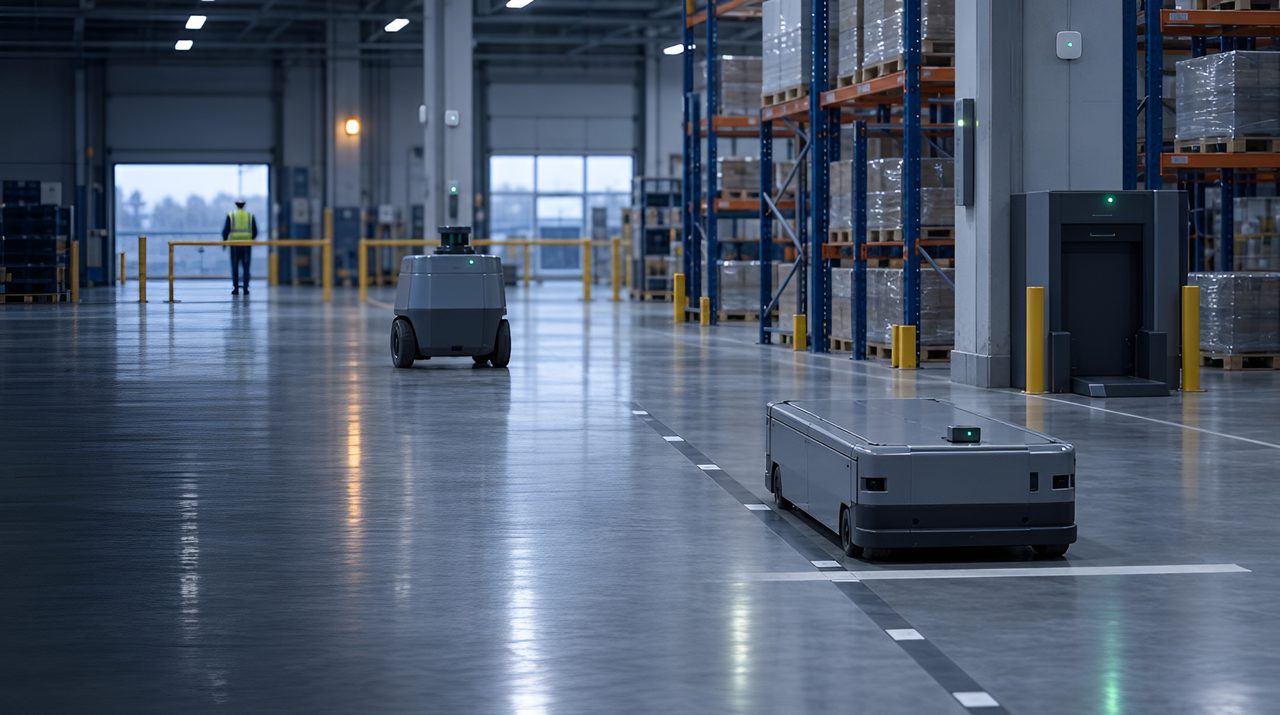
AGV vs AMR: quando cada um vence.
AGV s e AMR s são gerações diferentes de robótica móvel de armazém e fábrica, com pressupostos distintos sobre navegação, infraestrutura, flexibilidade e TCO.
Os AGV seguem caminhos fixos definidos por fita magnética, guiagem de fios ou marcadores de código de barras; AMR navegam dinamicamente com LiDAR ou visual SLAM.
Esta é a comparação em nível de operador para equipes de compras que escolhem entre elas e o caso das frotas híbridas governadas pela VDA 5050.
A diferença de categoria
AGV s (Veículos Guiados Automatizados) são robôs de caminho fixo que seguem marcadores: fita magnética, fios embutidos, linhas ópticas ou códigos QR de posição fixa. Eles são determinísticos, confiáveis e comprovados em escala em tarefas repetidas de alto volume.
AMR s (Robôs Móveis Autônomos) usar sensores a bordo (LiDAR, câmeras de profundidade, IMU) para construir um mapa do ambiente e navegar dinamicamente. Eles replanejam obstáculos em torno de obstáculos,
compartilham caminhos dinâmicos com colegas e se adaptam a mudanças de layout sem precisar recolocar fitas.
AGV s vence em taxa determinística em layouts estáveis; Os AMR ganham em flexibilidade e implantação mais rápida em ambientes em mudança.
Navegação e infraestrutura
AGV: precisa de preparação para o piso (fita, fios, códigos QR). Mudanças no layout exigem a reformulação da infraestrutura de caminhos. Forte em ambientes onde o layout é fixo e o throughput é previsível.
AMR: precisa de uma varredura do piso limpo durante a comissionamento, além de estações de recarga. Mudanças de layout feitas por re-mapeamento (minutos para horas, não semanas). Forte em ambientes onde fluxos de trabalho ou layouts mudam com o tempo.
Throughput, custo e TCO
AGV: o custo de capital por unidade pode ser maior para veículos de reboque/elevação, mas o TCO ao longo da vida é bem compreendido e previsível; Aplicações de alto rendimento (kitting, reabastecimento de linha, buffer de produtos acabados) são o ponto forte tradicional do AGV.
AMR: implantação mais rápida, menor capacidade por unidade em veículos leves, mas software, integração, gestão de frotas e engenharia de controle de tráfego adicionam custos.
O retorno geralmente é mais rápido no AMR para fluxos de trabalho variáveis; A AGV vence em rotas constantes de alto volume.
Cenário de fornecedores
AGV: Dematic, Daifuku, KION (Linde / Dematic / STILL), Movimentação de Materiais Toyota, Egemin. Os AGV em formato de empilhadeira, feitos por empilhadeiras são comuns.
AMR: Robôs Industriais Móveis (MiR, propriedade da Teradyne), Geek+, OTTO Motors (Rockwell), Locus Robotics, Fetch (Zebra), Vecna Robotics, 6 River Systems (Ocado). O mercado se consolidou rapidamente após 2020, com grandes grupos industriais adquirindo fornecedores de AMR.
VDA 5050: o padrão de interoperabilidade
VDA 5050 é o padrão de interface entre frotas mistas AGV s/ AMR s e um sistema mestre de controle, publicado pela Associação Alemã da Indústria Automotiva. Agora, ele é amplamente adotado em implantações europeias e crescentes na América do Norte.
Com o VDA 5050, você pode rodar uma frota heterogênea (AGV s de um fornecedor, AMR s de outro) sob uma única camada de orquestração. Isso reduz drasticamente o compromisso dos fornecedores e possibilita o lançamento faseado. Veja Orquestração de frotas AGV & AMR.
A versão 3.0, publicada em março de 2026 (anunciada em abril de 2026), acrescenta zonas e partilha de trajetos para que os AMR de navegação livre planeiem as suas rotas enquanto um mestre central mantém o controlo do tráfego. Mestres independentes como SYNAOS, idealworks, NAiSE e Meili FMS competem agora com os gestores de frota dos próprios fabricantes; veja orquestração de frotas.
Frotas híbridas e quando cada uma se encaixa
Implantações maduras frequentemente colocam ambos. AGV para rotas tronco de alto volume e repetíveis (reabastecimento no lado da linha, buffer de mercadorias acabadas até despacho).
AMR para escolha variável de bens para pessoas, movimentos ad hoc e rotas que mudam conforme a sazonalidade ou a matriz de produtos.
O VDA 5050 vincula a frota sob um único controle mestre. Escolhemos o veículo certo para a rota certa na etapa 1, veja Orquestração de frotas AGV & AMR.
Perguntas frequentes
Qual é mais barato: AGV ou AMR?
Depende do fluxo de trabalho. O AMR normalmente é mais barato de implantar inicialmente (sem preparação do piso, comissionamento mais rápido); O AGV tem menor TCO ao longo da vida útil em rotas estáveis de alta cadência.
A comparação correta é o custo total por transferência concluída ao longo da vida útil do implantação.
Os AGV s e os AMR S podem compartilhar um sistema de controle mestre?
Sim, o VDA 5050 foi projetado exatamente para isso. Projetamos controle mestre compatível com VDA 5050 como parte da orquestração de Orquestração de frotas AGV & AMR.
Os AMR S precisam de integração com o WMS para serem úteis?
Sim, para qualquer implantação em produção além da prova de conceito. O software de gerenciamento de frota AMR se integra com WMS (SAP EWM, Manhattan, Blue Yonder, Körber) via APIs padrão. Projetamos padrões de integração na etapa 1.
Será que o AMR s vai substituir o AGV s com o tempo?
Em parte. A participação de mercado do AMR está crescendo rapidamente na escolha de bens para pessoas e fluxos de trabalho variáveis.
Os AGV mantêm vantagens em rotas de tronco determinísticas de alto volume e aplicações de rebocadores de carga pesada. Esperamos que a frota mista, VDA 5050 - orquestrada - seja a resposta de longo prazo.
Quão precisa é a navegação do AMR na prática?
A precisão depende do seu local, e nós a confirmamos na vistoria. A precisão no acoplamento e no manuseio de cargas é maior (nível mm) usando marcadores fiduciais nos pontos de retirada. A precisão é limitada pela qualidade do sensor e pela disciplina de mapeamento.
Última atualização: