
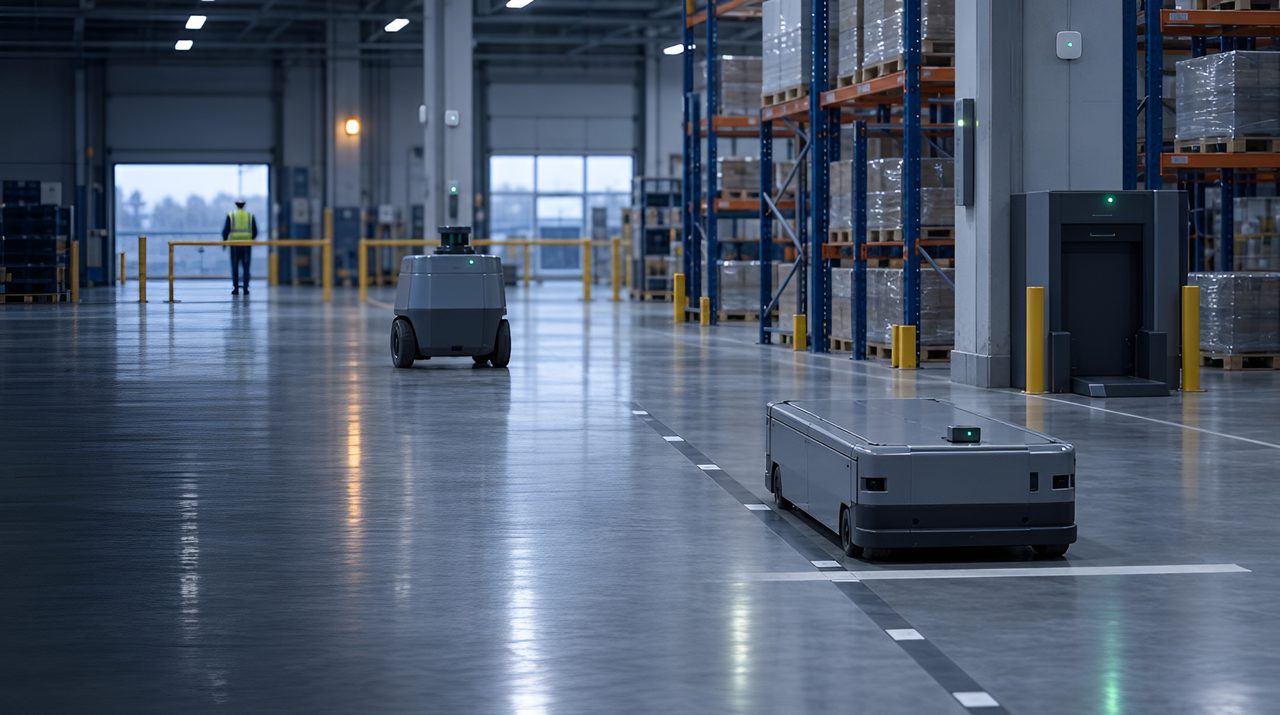
AGV vs AMR, cuando gana cada uno.
Los AGV s y AMR son generaciones diferentes de robótica móvil de almacenes y fábricas, con supuestos distintos sobre navegación, infraestructura, flexibilidad y TCO.
Las AGV siguen trayectos fijos definidos por cinta magnética, guía de alambre o marcadores de código de barras; Los AMR navegan dinámicamente con LiDAR o SLAM visual.
Esta es la comparación a nivel de operador para los equipos de compras que eligen entre ellos y el caso de las flotas híbridas gobernadas por VDA 5050.
La diferencia de categorías
AGV s (Vehículos Guiados Automatizados) son robots de trayectoria fija que siguen marcadores: cinta magnética, cables incrustados, líneas ópticas o códigos QR de posición fija. Son deterministas, fiables y demostradas a gran escala en tareas repetibles de alto volumen.
AMR s (Robots Móviles Autónomos) utilizan sensores a bordo (LiDAR, cámaras de profundidad, IMU) para construir un mapa del entorno y navegar dinámicamente. Replanifican alrededor de obstáculos,
comparten rutas dinámicas con sus compañeros y se adaptan a cambios de disposición sin volver a colocar cintas.
AGV s ganan en rendimiento determinista en layouts estables; Los AMR ganan en flexibilidad y despliegue más rápido en entornos cambiantes.
Navegación e infraestructuras
AGV: necesita preparación del suelo (cinta, cables, códigos QR). Los cambios en la disposición requieren recolocar la infraestructura de caminos. Fuerte en entornos donde la disposición es fija y el rendimiento es predecible.
AMR: necesita un escaneo de suelo limpio durante la puesta en marcha, además de estaciones de carga. Los cambios de diseño se gestionan mediante reasignación (minutos a horas, no semanas). Fuerte en entornos donde los flujos de trabajo o los diseños cambian con el tiempo.
Rendimiento, coste y TCO
AGV: el coste de capital por unidad puede ser mayor para vehículos remolcadores o elevadores, pero el TCO a lo largo de la vida es bien entendido y predecible;
las aplicaciones de alto rendimiento (kitting, reposición de líneas, buffer de productos acabados) son el punto fuerte tradicional de AGV.
AMR: despliegue más rápido, menor capacidad por unidad en vehículos ligeros, pero software, integración, gestión de flotas e ingeniería de control de tráfico añaden costes.
El retorno suele ser más rápido en AMR para flujos de trabajo variables; AGV gana en rutas constantes de alto volumen.
Panorama de proveedores
AGV: Dematic, Daifuku, KION (Linde / Dematic / STILL), Manejo de Materiales Toyota, Egemin. Los AGV con forma de carretilla elevadora de fabricantes de carretillas elevadoras son el mercado habitual.
AMR: Robots Industriales Móviles (MiR, propiedad de Teradyne), Geek+, OTTO Motors (Rockwell), Locus Robótica, Fetch (Zebra), Vecna Robotics, 6 River Systems (Ocado). El mercado se consolidó rápidamente tras 2020, con grandes grupos industriales adquiriendo proveedores de AMR.
VDA 5050: el estándar de interoperabilidad
VDA 5050 es el estándar de interfaz entre la AGV s/AMR s de flota mixta y un sistema de control maestro, publicado por la Asociación Alemana de la Industria Automotriz. Ahora se ha adoptado ampliamente en despliegues europeos y en crecimiento en Norteamérica.
Con VDA 5050, puedes ejecutar una flota heterogénea (AGV s de un fabricante, AMR s de otro) bajo una única capa de orquestación. Esto reduce drásticamente el compromiso del proveedor y permite un despliegue gradual. Ver Orquestación de flotas AGV y AMR.
La versión 3.0, publicada en marzo de 2026 (anunciada en abril de 2026), añade zonas y uso compartido de trayectorias para que los AMR de navegación libre planifiquen sus propias rutas mientras un maestro central mantiene el control del tráfico. Controladores independientes como SYNAOS, idealworks, NAiSE y Meili FMS compiten ya con los gestores de flota de los fabricantes; consulte orquestación de flotas.
Flotas híbridas y cuándo encaja cada una
Los despliegues maduros suelen tener ambas capas. AGV para rutas troncales de alto volumen y repetibles (reabastecimiento en línea lateral, buffer de mercancías terminadas hasta despacho).
AMR para selección variable de bienes a personas, movimientos ad hoc y rutas que cambian según la estacionalidad o la mezcla de productos.
VDA 5050 mantiene la flota bajo un solo control maestro. Elegimos el vehículo adecuado para la ruta correcta en la fase 1, véase Orquestación de flotas AGV y AMR.
Preguntas frecuentes
¿Cuál es más barato: AGV o AMR?
Depende del flujo de trabajo. El AMR suele ser más barato de desplegar inicialmente (sin preparación de suelo, puesta en marcha más rápida); AGV tiene un menor TCO de vida útil en rutas estables de alto rendimiento y trayecto.
La comparación correcta es el coste total por traslado completado a lo largo de la vida útil del despliegue.
¿Pueden los AGV s y los AMR s compartir un sistema de control maestro?
Sí, VDA 5050 está diseñado exactamente para esto. Diseñamos control maestro compatible con VDA 5050 como parte de Orquestación de flotas AGV y AMR.
¿Necesitan los AMR S la integración con WMS para ser útiles?
Sí, para cualquier despliegue en producción más allá de la prueba de concepto. El software de gestión de flotas AMR se integra con WMS (SAP EWM, Manhattan, Blue Yonder, Körber) mediante APIs estándar. Diseñamos patrones de integración en la fase 1.
¿Sustituirá el AMR s al AGV S con el tiempo?
En parte. La cuota de mercado de AMR está creciendo rápidamente en la recogida de productos a personas y en flujos de trabajo variables.
Los AGV conservan ventajas en rutas troncals deterministas de alto volumen y aplicaciones de remolcadores de carga pesada. Esperamos que la flota mixta, VDA 5050 -orchestrada, sea la solución a largo plazo.
¿Qué precisión tiene la navegación AMR en la práctica?
La precisión depende de tu emplazamiento, y la confirmamos en el estudio del sitio. La precisión del acoplamiento y el manejo de carga es mayor (a nivel de mm) usando marcadores fiduciales en los puntos de recogida. La precisión está limitada por la calidad del sensor y la disciplina de mapeo.
Última actualización: