
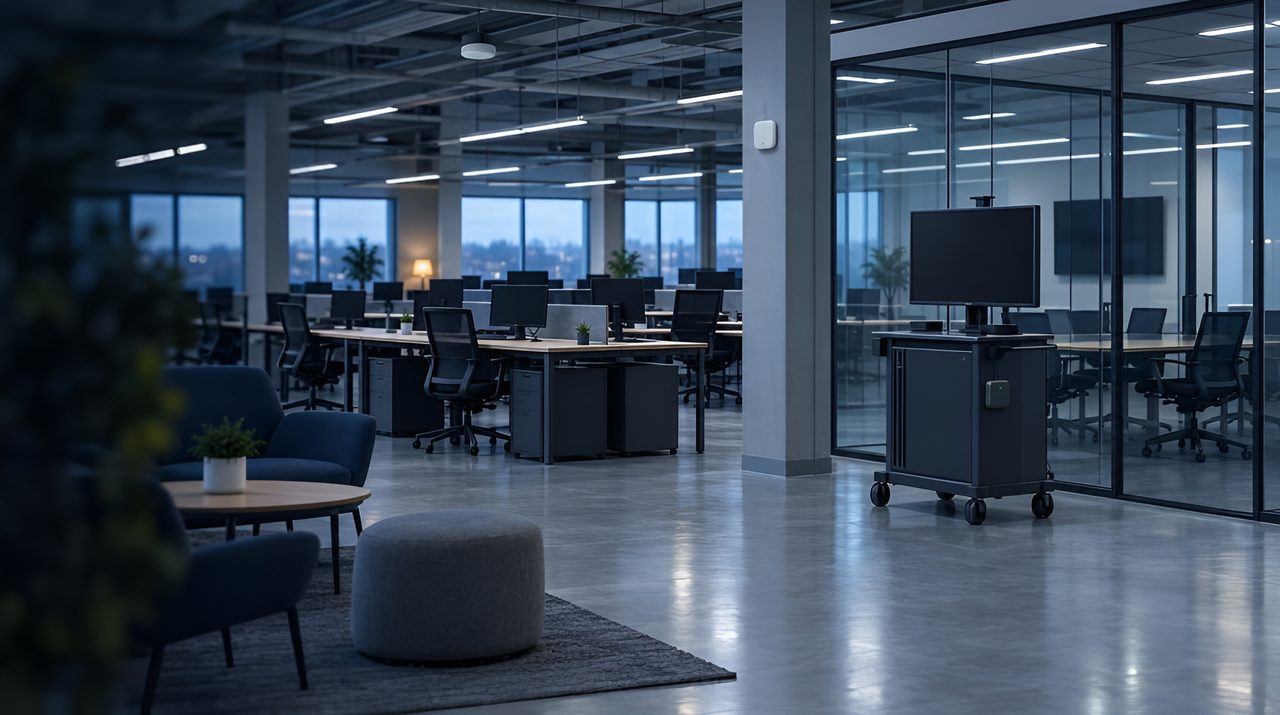
Space and occupancy monitoring: space is not free inside the fence.Paying for space nobody really uses?
Space and occupancy monitoring inside the fence: utilisation is not people-tracking. Zone and desk occupancy privacy counsel can defend.
Free 30-minute call with an adviser · written proposal with the price after · fixed-scope engagements from £3k.
Occupancy fails when the sensor story is divorced from the booking system.
Ghost occupancy
Badges and PIR say a desk is free while Outlook still shows it booked, or the reverse. The KPI is not “sensors installed”. It is agreement between presence and reservation.
Right radio for the room
Dense open plan is not a cleanroom. BLE/Wi‑Fi fingerprinting, ceiling PIR, and desk-level sensors solve different failure modes. Pick for the floorplate, not the catalogue.
Privacy by design
People analytics without a published retention and access policy will be blocked by works councils and legal. Anonymised counts beat named trails unless the use case demands identity.
Space & occupancy optimisation: how it works, and what it pays back.
The right radio for the job, mapped to your use case.
1 · Sense
Anonymised occupancy sensors and BLE report desk, room and zone use, live.
2 · Analyse
Real utilisation, peak times and ghost bookings emerge across the estate.
3 · Right-size
Consolidate floors, fix room ratios and design hybrid space around real demand.
BLE → zone occupancy · sensors → desk & room
Which technology fits.
We work for you, not for the technology providers.
BLE
Low-cost occupancy sensing.
UWB
Asset & wayfinding precision.
Analytics
Utilisation insight.
Industries this solution suits
Right-size the estate on real demand.
An employer uses anonymised sensors to measure real desk and room use. Ghost bookings and half-empty floors emerge, two floors consolidate into one, and hybrid space is designed on evidence, not a one-off survey.
Typically bought by: Corporate real estate, facilities, workplace experience, finance.
Suppliers we evaluate for this use case
Where this solution wins: examples by sector.
Workplace utilisation analytics (workplace)
Meeting-room and desk utilisation for IWMS decisions.
Retail store footfall and dwell (retail)
Customer-flow analytics in physical stores.
Hospital bed and chair utilisation (healthcare)
Inpatient and outpatient capacity analytics.
Venue and event analytics (workplace)
Visitor flow at museums, venues, and events.
Library and learning-space utilisation (education)
Education-space utilisation for capital planning.
Who needs this kind of programme.
Corporate real-estate and workplace teams right-sizing portfolios after hybrid work shifted peak vs average occupancy.
Universities, hospitals and civic estates that need anonymous utilisation evidence for capital and lease decisions.
Facilities and IT/OT choosing between dedicated occupancy sensors and network-derived presence.
What buyers compare in this market.
VergeSense and Density lead the sensor-first occupancy analytics category (optical vs radar people-counting, portfolio planning). Cisco Spaces and Aruba compete when the building already has dense enterprise Wi-Fi/BLE and buyers want wayfinding plus space insights without a second sensor grid. Badge-based RTLS (Kontakt.io and peers) appears when you also need named-zone workflows, usually a different privacy posture.
The advisory question is rarely “which sensor brand”. It is whether lease decisions need anonymous desk/room counts, named employee tracking, or both, and which stack your network, privacy and FM owners will actually run for three years.
Why occupancy programmes fail.
Counting without portfolio decisions. Dashboards that never change lease, fit-out or booking rules waste the sensor spend.
Privacy mismatch. Named RTLS sold into a problem that only needed anonymous counts creates works-council and DPO friction.
Two sources of truth. Badge RTLS, Wi-Fi presence and optical sensors disagree unless you design a single utilisation model.
Independent.
We don't sell hardware, so our advice stays independent. We help you pick the sensing layer that matches the decision (anonymous utilisation vs operational RTLS) and wire it into IWMS/CAFM without inflating the estate with hardware you will not maintain.
Frequently asked questions
What can occupancy data tell us?
How desks, rooms, zones and equipment are actually used versus assumed, peak occupancy, utilisation, and which spaces are wasted or oversubscribed.
Is it sensors, RTLS, or both?
Anonymous occupancy sensors answer 'is this space used'. RTLS adds 'by what or whom and for how long' where needed. We pick the least-intrusive option that answers your question.
How do you handle privacy?
Most workplace occupancy is measured anonymously at the space level, with clear governance. You get utilisation insight without tracking individuals.
How does it integrate with our building or booking systems?
Data feeds your IWMS, room-booking and BMS so spaces can be released, cleaned on use, and right-sized on evidence.
What is the business case?
Real estate is usually the second-largest cost after people, even a modest reduction in wasted space, or deferring a fit-out, pays for the system many times over.
Last updated: 5 October 2026