
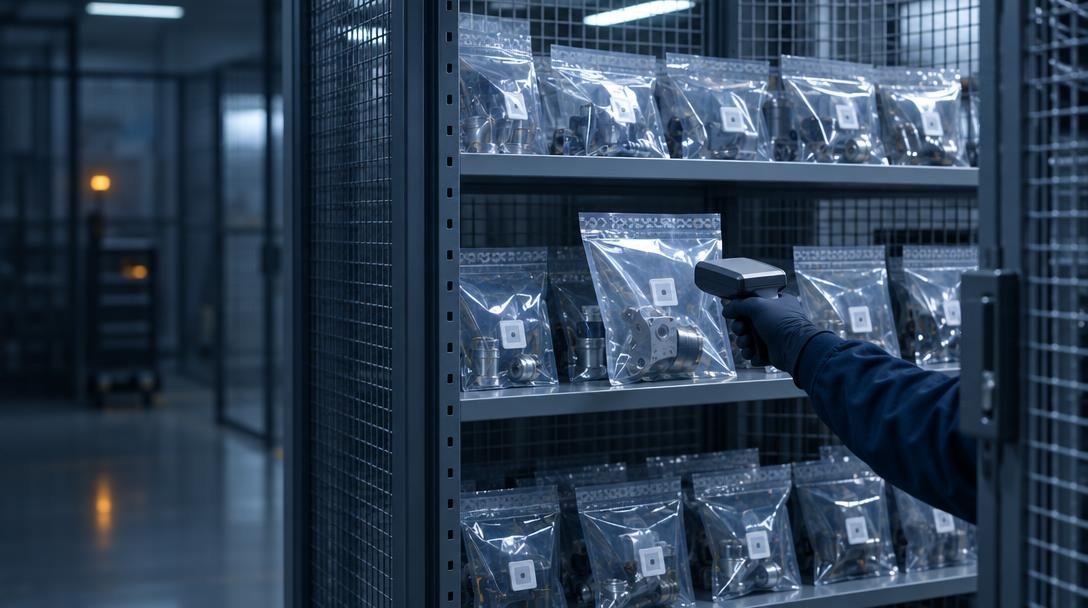
Serialized-parts chain-of-custody, from production to dispatch.
A defence-aerospace supplier needed full traceability of high-value serialized parts moving between production, QA, secure storage and outbound logistics.
The programme and figures on this page come from an earlier work by our advisers. The client name is withheld under NDA. Figures are as reported at the time. Named references are available under NDA when you engage.
What they were up against.
Lost serialized parts
High-value parts went missing between production, QA and storage.
Weak audit trail
Chain-of-custody could not be evidenced on demand.
Slow QA handoffs
Manual tracking delayed quality handoffs.
Earlier work by our advisers. Client name withheld under NDA. Client name withheld under NDA; figures as reported at the time. Named references available under NDA. We model your own numbers when you engage.
Independent, tied to a named KPI.
RFID for serialized asset identity, BLE gateways for zone visibility, UWB for exact secure-cell movement tracking, and AI alerts for unauthorized movement and dwell breaches.
What the engagement delivered.
- RFID serialized asset identity
- BLE gateways for zone visibility
- UWB exact secure-cell movement tracking
- AI alerts: unauthorized movement & dwell breaches
Results in this engagement
“For high-value components, visibility is no longer optional. It is operational security.”
Quality & compliance director, defence aerospace (client anonymised)
The stack behind it
Baseline, method, period and what we excluded.
This page describes an engagement our advisers led in earlier roles. The client name is withheld under NDA. Figures are as reported at the time, with published industry sources where noted.
- Baseline: Serialized CoC in documents; gaps found at receipt or audit.
- Method: Serial custody events from production through dispatch; sample audits vs paperwork; discrepancy ageing.
- Period: One serialized product family through a full custody chain.
- Excluded: Printer yield as a substitute for custody completeness.
Programme context
Serialized chain of custody for defence-aerospace parts joins identity, location and quality status through MRB and shipping.
Hybrid DataMatrix + RFID with controlled reads is typical.
Outcomes in this engagement and how they were earned
Outcomes: custody completeness, faster shipping verification, cleaner customer/government audit response.
Lessons from this engagement
Lessons: custody completeness ≠ read rate; quarantine joins; long retention design.
Deeper problem framing
Serialized parts need custody through MRB and ship. Read rate ≠ custody completeness.
Approach
DataMatrix + RFID hybrid; quarantine joins; long retention; customer/government audit drills.
Outcomes and measurement
Custody completeness, shipping verification time.
Governance, risk and what we refuse to claim
Figures from this engagement only. Your payback depends on adoption, integration quality and exception labour, not tag unit cost. Named references under NDA on engagement.
We challenge any supplier who asks you to accept demo-day averages as production truth.
Implementation sequence and change management
Serialize identity strategy; hybrid carriers; MRB quarantine join; retention architecture; customer audit drills.
KPIs: custody completeness, shipping verification time, not raw read rate.
Buyer checklist, supplier challenges and engagement shape
For serialized CoC, optimise custody completeness and MRB quarantine joins, not isolated read-rate demos.
Buyer checklist before you sign: (1) written system of record for events; (2) acceptance tests with 95th-percentile performance under real interference; (3) integration owner named in IT/OT; (4) privacy or labour consultation path if people are tagged; (5) cybersecurity zoning sketch; (6) five-year TCO including batteries, spares, recalibration and SLA escalations; (7) exit/export terms so you are not hostage to a cloud tenant; (8) a pilot that can fail without political punishment.
Supplier claims to challenge in this pattern: brochure accuracy without production load; 'compliance included' without artefacts; ROI that assumes perfect adoption in 30 days; references that cannot be called under NDA; install partners who have never worked your vertical's overlays; shared support accounts; and any design that dumps locating onto a flat plant or clinical VLAN.
How TRACIO typically engages: stage-1 architecture and measurement design; independent shortlist and RFP language; pilot acceptance criteria; then optional implementation oversight or programme rescue if a prior pilot stalled. We don't sell hardware, so our advice stays independent. Pages like this one exist so you can prepare the workshop. Your numbers replace every planning band when we model payback.
Risk register themes that recur: mute fatigue on alerts; shadow spreadsheets reappearing beside the platform; battery logistics understaffed; master data too weak to support identity; works-council or IG review starting too late; and success declared on demo day before night-shift reality.
Document baseline windows explicitly: what you measured, for how long, which shifts, and what you excluded. Investment committees and auditors both punish fuzzy before/after stories. If your baseline is weak, spend two to four weeks fixing measurement before ordering anchors or portals. That discipline is cheaper than a stranded deployment and is the difference between a locating programme and a technology souvenir.
Training and communications plan: who explains purpose to operators, how often refreshers run, how contractors are inducted, and how successes are fed back without turning safety systems into league tables. Budget a champion network on each shift. Platforms do not adopt themselves. Where unions or works councils exist, share the purpose statement and retention rules early. Surprise monitoring is how programmes die. Finally, schedule a formal gate review against the written criteria; celebrate a no-go if evidence is weak. Expanding failure is not delivery.
Last updated:
Hangar & MRO reality
Independent advisory means the radio is chosen last. After the job, the constraints and the system of record are clear.
Tool control that survives a turnaround
Map FOD risk, calibrated-tool custody and hangar flow before a radio is chosen.
Independent, aviation-grade
Shortlists respect on-metal tags, hangar RF and the MRO system already running, not a partner programme.
Integrate to the maintenance record
Events land in the system engineers already trust so accountability outlives the pilot.
Measurement
Baseline: accountability drill times, serialized-part audit gaps, and “unable to locate” tickets. Pilot: one unit/area with identity + location reconciled to the approved system of record. Steady-state: muster/accountability completion, custody exceptions, and audit findings. Figures are as reported in this engagement. Sensitive detail stays offline.