
AS9100 and RFID tool tracking: aerospace tool accountability.
Aerospace manufacturing and MRO are scored against AS9100D. Tool accountability and FOD controls only count when identity events survive the audit, not when they live in a supplier app.
Tool control, FOD prevention and parts traceability are central, and RTLS / RFID is the layer that delivers them automatically. This is the operator-level summary.
What AS9100D requires from tool control
Clause 8.5 (Production and Service Provision) and related clauses require organisations to control products and processes throughout production.
For aerospace, the specific manifestations include calibrated-tool management (every tool used in critical processes must be identified, calibrated and accounted for),
FOD (foreign object damage) prevention controls covering tool issue, use and return, and parts traceability where individual items must be linked to lot, batch and process records.
RTLS and Passive RFID are the dominant technologies for capturing this evidence without operator overhead.
FOD prevention as a system, not a procedure
FOD prevention has historically relied on shadow boards, manual sign-out logs and end-of-shift counts.
Modern aerospace prime contractors increasingly require system-level FOD controls: tagged tools, RFID-gate verification at sensitive zones, missing-tool alerts before aircraft / engine release.
The system makes FOD prevention auditable in real time rather than reconstructible after an incident. See our tool-control solution.
Customer-specific requirements (CSRs)
Each customer overlays additional requirements beyond AS9100. Boeing D6 series, Airbus EI standards, defence customer specifications and OEM tier-1 supplier requirements all add detail.
We Map your customer specifications to the tracking architecture at gate 1 so the deployment satisfies the strictest customer in your portfolio.
NADCAP and special-process accreditation
Where NADCAP special-process accreditation is required (e.g., chemical processing, NDT, welding), the traceability requirements deepen. Process steps, parameters, operator and equipment must all be captured contemporaneously.
RTLS contributes to the location and timing dimension of this trace. We integrate with the broader special-process records as part of stage 1 design.
AS9100 clauses that locating actually supports
AS9100 emphasises configuration management, identification and traceability, control of production tooling, and prevention of foreign object debris (FOD). Tool cribs, calibrated gauges, fixtures and serialized parts are classic RFID/RTLS subjects because auditors follow custody, not intentions.
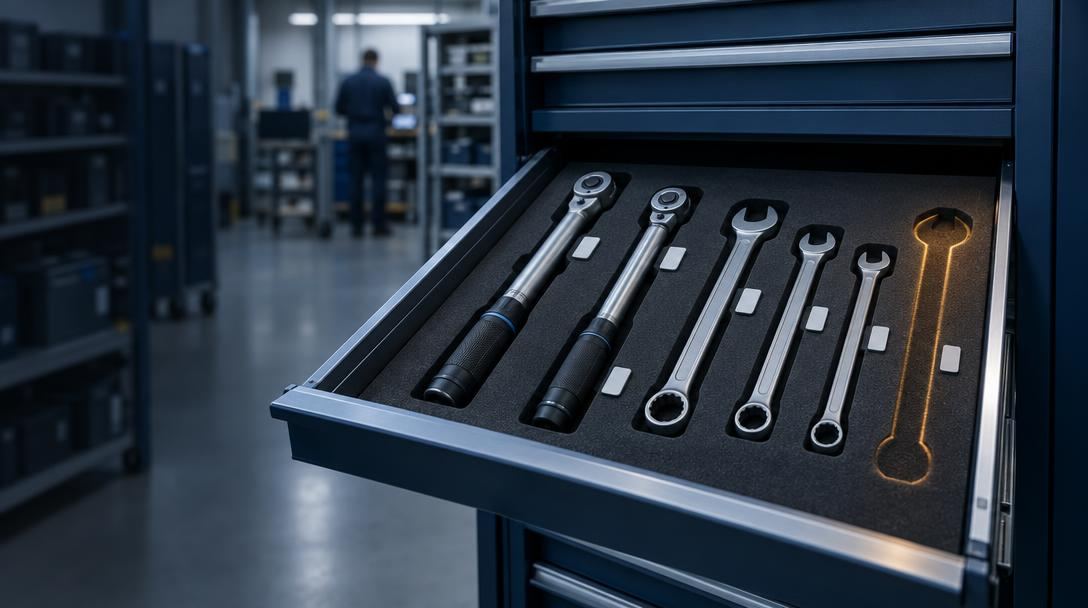
Automated tool control (RFID cabinets, portals, mobile cribs) creates check-in/out records tied to work orders and technicians. UWB or BLE-AoA in hangars adds zone presence when tools leave controlled storage. Calibration due dates and out-of-tolerance impact assessments need to ride the same identity.
FOD walkdowns remain procedural. Technology reduces the 'missing tool after close-up' failure mode. Challenge any supplier who claims RFID eliminates FOD programmes. It strengthens accountability evidence inside an existing FOD plan.
MRO hangar patterns and audit readiness
Typical programmes tag torque tools and special tooling first, then expand to kits and high-value rotables. Integrate with MRO/ERP so assignment is not a parallel shadow system. Portal reads at hangar doors catch egress. Cabinet cycles catch crib discipline.
Audit packs should retrieve: who had tool X on airframe Y, calibration status at time of use, quarantine holds, and open discrepancies. If the locating database cannot answer that in minutes, it is inventory software, not AS9100 evidence.
Defence-adjacent sites add export-control and secure-zone overlays. Segment networks and access roles accordingly; do not dump hangar location feeds into a flat corporate IoT tenant.
Supplier claims to challenge
Ask for aerospace references (anonymised), on-metal tag survival data, cabinet false-negative rates under dense tooling, and API depth into your QMS. Lab read-rate demos on empty benches do not predict hangar performance.
Confirm the system records negative evidence (tool expected but not returned) with alerting SLAs. FOD risk lives in the absences, not only in successful scans.
Calibration, quarantine and configuration links
Out-of-tolerance tools must be blocked from issue automatically. Quarantine locations should be physical and digital. Configuration-controlled tooling needs identity continuity when handles are replaced or tags re-affixed, orphaned histories are an audit gap.
For serialized flight parts, align locating events with shipping/receiving and MRB processes so custody stories match the quality record.
How we approach aerospace tool and FOD programmes
We baseline missing-tool and search-time metrics, design crib/portal coverage for the actual hangar flow, and integrate with MRO/ERP before hardware is ordered. Success is audit-ready custody plus fewer FOD near-misses, measured, not anecdotal.
FOD programme integration details
Technology without a FOD board ritual fails. Define who owns missing-tool escalation before aircraft close-up, what scan failures mean, and how rented or calibrated loaner tools enter the identity system.
Shadow boards and RFID can coexist: optical checks for shape, RFID for identity and custody. Auditors like both when procedures say how they reinforce each other.
Measure: open discrepancies ageing, time-to-account before release, and repeat offenders by work centre, then coach, do not only dashboard.
Supplier and customer audit posture
Prime contractors increasingly ask suppliers to demonstrate digital tool control. Be ready to show sample custody trails, calibration linkage and quarantine evidence in minutes. If your locating data lives only in a supplier cloud your security team rejects, resolve tenancy before the audit window.
Stage gates for aerospace locating
Gate 1: critical tool list, FOD procedure alignment, hangar RF risks, MRO/ERP interface map. Gate 2: pilot crib/portal with acceptance on missed-return detection. Gate 3: scale with calibration interlocks and audit-pack rehearsal. Skip gates and you buy cabinets that operations route around.
Frequently asked questions
Is AS9100 alignment enough, or do we need certification?
Aerospace primes typically require certification, not just alignment. We deliver systems that survive certification audit, working alongside your quality team for the formal certification process.
How does this affect choice between RFID and RTLS?
Passive RFID is the dominant technology for tool-cabinet check-in/check-out and FOD-gate verification. UWB or BLE-AoA RTLS adds zone-level real-time location for tools issued to the floor. Most aerospace deployments use both. See our tool-control solution.
Can we retrofit AS9100 compliance to an existing tool-control system?
Often yes, with explicit gap-analysis and remediation. We do this as part of programme rescue engagements.
How does this integrate with our existing calibration management?
Through API integration with calibration management systems (often Beamex CMX, Compliance Wire, or bespoke). Tools' calibration status Flows into the tool-control system so out-of-calibration tools cannot be issued from the cabinet.
Last updated: