
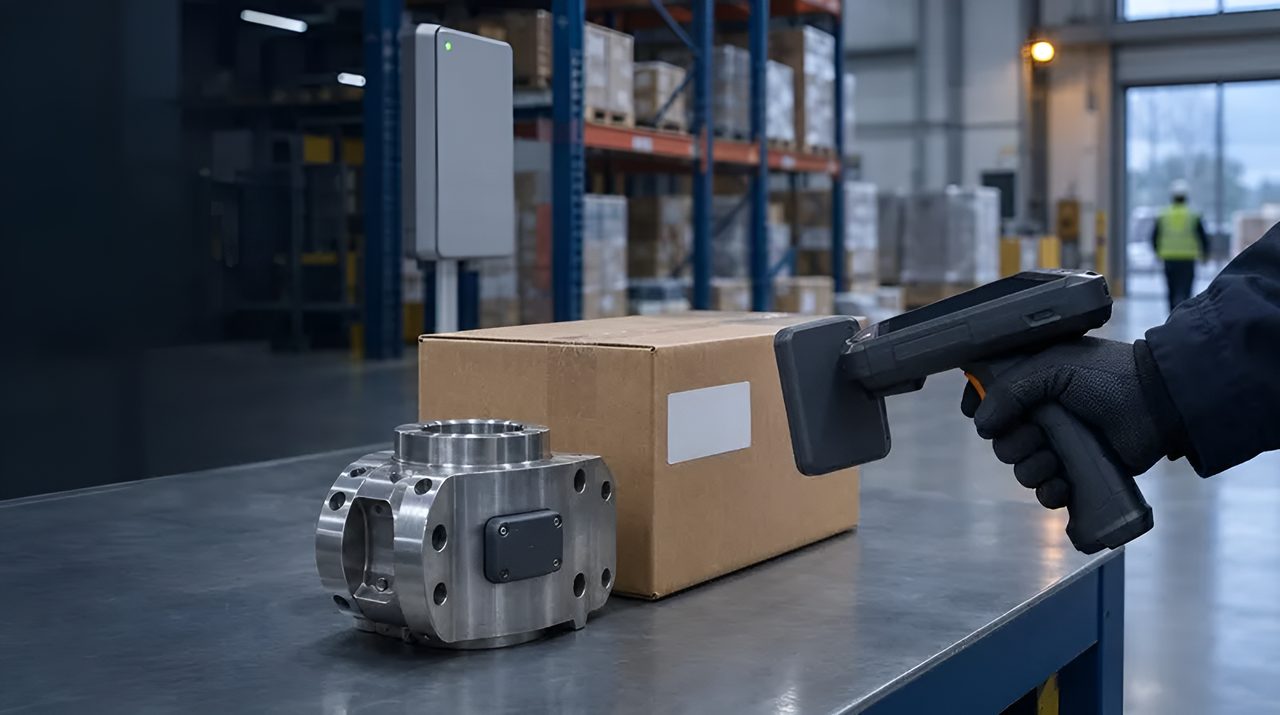
RFID vs barcode: when each wins.
RFID and barcode are not rivals in mature programmes. Use each where it wins: choke-point identity and speed versus dirt-cheap line-of-sight scans.
Reviewed September 2026. No universal winner. How we assess suppliers.
Barcode is cheap, ubiquitous and human-readable. RFID is bulk-readable, no-line-of-sight and machine-friendly. This is the operator-level comparison that helps procurement decide which to use where, and, more often, where to use both.
The technology difference
Barcode (1D EAN/UPC, 2D QR/DataMatrix/GS1 DataMatrix) is an optical encoding read by a camera or laser scanner, one item at a time, requiring line-of-sight. Cost per item is essentially free (printed in-line on packaging).
RFID (Passive UHF Gen 2 dominant in enterprise) uses radio backscatter from passive tags, bulk-readable, no line-of-sight required, item cost 3 cents to several Euros depending on form factor.
Read speed: RFID wins decisively in bulk
Barcode: one item at a time, typically 1-3 seconds per scan. RFID: thousands of tags read in a single second when bulk-reading a pallet, dock-door or shelf.
For high-volume receiving, sortation, dispatch and cycle counting, RFID's bulk-read advantage is the entire business case. For unit-by-unit verification at point of sale or in a clinical workflow, barcode's targeted-scan model is preferred.
Line-of-sight and orientation
Barcode requires the symbol to be visible to the camera or laser, in the right orientation, and unobstructed. Tilted, hidden, damaged or smudged barcodes fail.
RFID tags don't care about orientation, can read through packaging and around obstructions (with caveats around metal and liquid), and have built-in retry through the anti-collision protocol.
In any environment where items are stacked, packed inside boxes, or moving rapidly, RFID's no-line-of-sight property is decisive.
Cost and error patterns
Barcode cost per item: nearly zero (printed during normal packaging). RFID cost per item: 3 cents to several Euros.
Combined: barcode for unit confirmation, RFID for bulk aggregate.
Regulatory fit
Pharma DSCSA: every prescription unit in the US carries a 2D GS1 DataMatrix barcode (serialised GTIN + lot + expiry); RFID is supplementary for high-throughput aggregation. Aerospace AS9100: parts traceability uses both, with RFID for tool/FOD control.
Automotive IATF 16949: 2D barcode for unit traceability, RFID for inbound logistics. Retail apparel: RFID dominant at item-level globally; barcode for checkout. Healthcare: barcode for medication verification (BCMA), RFID for consignment stock and tool control.
Where each one wins decisively
Barcode: low-volume unit verification, regulated unit-level traceability (DSCSA, FDA UDI), point-of-sale, consumer scan-and-pay, prescription dispensing, blood-bank crossmatch.
RFID: high-volume receiving and dispatch, cycle counting, smart cabinets, returnable-asset tracking, retail inventory accuracy at scale, tool control, FOD prevention.
Both together: modern serialisation programmes carry both encoded on the same item (barcode for unit confirmation, RFID for aggregate). We design the right mix during stage 1 of the TRACIO programme method.
Decision criteria
Barcode is optical identity verification: cheap labels, line-of-sight, human- or scanner-paced. RAIN RFID is bulk RF identity: no line-of-sight, portal or handheld reads of many tags per second, higher label and infrastructure cost. Mature operations usually run both: RFID for inventory velocity, barcode for exception handling and regulated unit verification.
Decision axes: labour cost of counting, packaging that blocks optics, tag unit economics at your volume, portal RF feasibility, printer/encoder estate, and regulatory controls that still demand a human-confirmed optical read.
When RFID wins
- Cycle counting and receiving need orders-of-magnitude faster throughput than scan-all barcode.
- Items are stacked, boxed or hung where optics fail.
- Retail item-level, pharma serialisation custody or returnable transport items justify tag cost at volume.
- Automated dock portals can encode custody events into WMS without touching every unit.
When barcode wins
- Low SKU velocity, tight budgets, or processes that already meet accuracy SLAs with scan discipline.
- Regulated unit verification where a human-confirmed optical read is the control point.
- Environments hostile to RF (extreme metal or liquids) where tag engineering cost exceeds benefit.
- Short programmes where RFID CapEx cannot amortise before process change.
TCO traps
Trap: comparing RFID tag unit cost to barcode label cost without labour savings in counting. Trap: underestimating printer/encoder, portal RF design and exception handling. Trap: 100% RFID aspiration when a hybrid (RFID bulk + barcode verify) hits ROI faster. Trap: poor tag placement killing read rates and blaming the reader brand. Trap: forgetting change management for associates who still need a barcode fallback.
Implementation pattern that usually wins
Start with the process control points that destroy labour today (receiving, cycle count, shipping verification) and instrument those with RFID portals or handhelds. Keep barcode on exceptions, returns and any regulatory step that still requires optical confirmation. Encode inlays that passed your packaging tests; do not buy tags from a catalogue photo.
Reader brand (Impinj, Zebra, Honeywell, Alien) matters less than antenna design, power settings and tag placement. Printers and encoders must be in the BOM from day one or you will create unreadable labels at scale. Train associates on when to trust the portal and when to fall back to scan.
TRACIO stays independent across AIDC suppliers. We help you write the RF acceptance tests and the hybrid SOP so the technology choice survives first peak season.
Decision summary
Choose RFID when labour and bulk-read velocity dominate; choose barcode when optical unit verification and minimal CapEx dominate; choose both when peak seasons punish pure barcode counting but regulators or exceptions still need a scan. Put tag tests, portal design and printer encoding in phase one. TRACIO will not sell you a reader brand. We will help you fail the wrong architecture early.
Evidence to demand in quotes
Require portal read-rate tests on your actual packaging, handheld exception timings, printer/encoder models, inlay part numbers that passed, and a five-year consumables model. If a bidder cannot show those artefacts, the unit price is fiction. TRACIO reviews RF designs independently of Impinj, Zebra, Honeywell or Alien commercial pressure.
Frequently asked questions
Should we replace barcode with RFID entirely?
Almost never. Barcode is essentially free and works for unit verification. RFID adds bulk-read at scale. The right strategy is to add RFID alongside barcode where bulk-read or no-line-of-sight reading adds operational value, not to remove barcode.
What's the breakeven volume where RFID overtakes barcode?
Depends on the business outcome more than volume. For inventory accuracy in apparel retail, the breakeven happens at thousands of SKUs per store. For dock-door reconciliation, the breakeven is throughput-driven (>500 cases/hour). We model this in stage 1.
Can a single label carry both?
Yes, RFID inlay + printed 2D DataMatrix on the same label is now standard in retail apparel and increasingly in pharma. Encoding station programs the RFID and prints the barcode simultaneously.
Which is better for traceability audits?
Both, layered. Barcode-encoded serialisation (SGTIN, UDI) is the regulatory record. RFID aggregate-read events provide high-throughput evidence at process steps. Most modern serialisation platforms (Tracelink, rfxcel, SAP ATTP) ingest both.
What about NFC and HF RFID instead of UHF?
Different categories. NFC (13.56 MHz HF) is short-range device-to-tag interaction (smartphones, access control, payment). UHF RAIN is the enterprise bulk-read category.
We use NFC for specific use cases (asset authentication, work-instruction triggering) but UHF dominates supply chain and inventory.
More head-to-heads in the independent technology comparisons. Not sure which family fits yet? Start with choosing a locating technology, then independent RTLS consulting for the advisory view.
Last updated: