
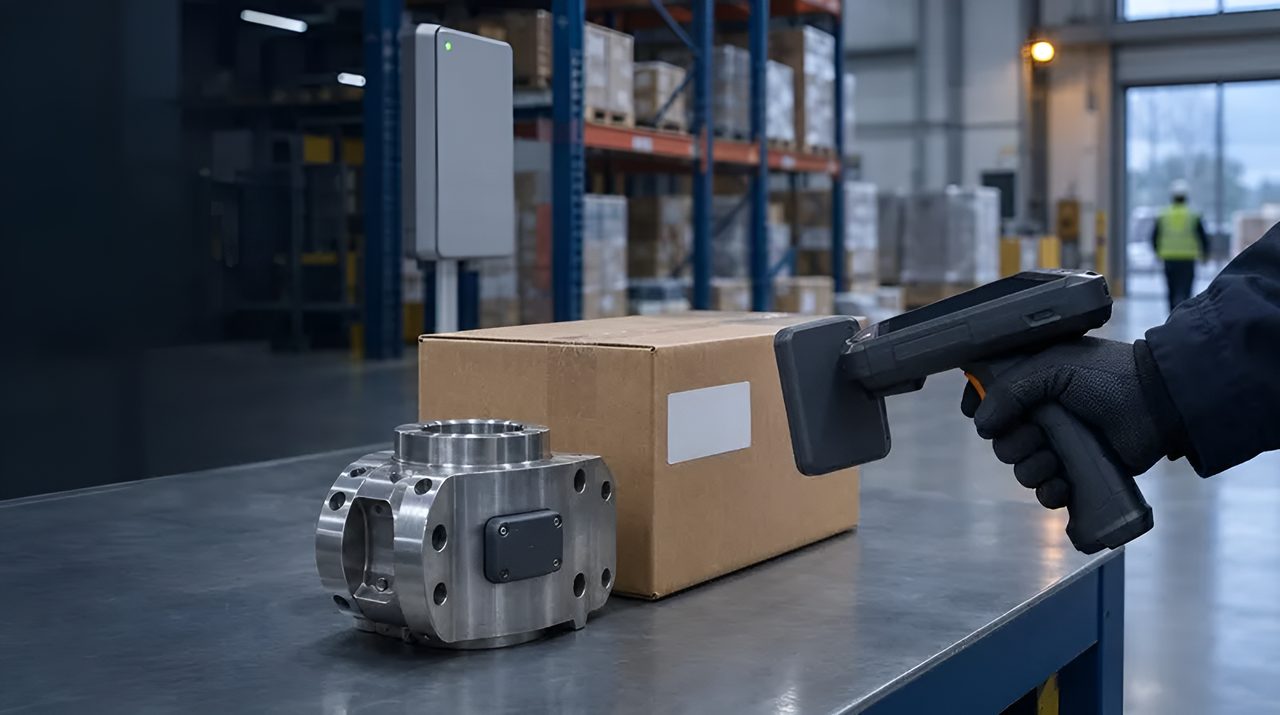
RFID versus barcode: wanneer elk wint.
RFID en barcode worden vaak als concurrenten neergezet, maar in volwassen implementaties zijn ze complementair, elk speelt in op een kracht die de ander niet heeft.
Barcode is goedkoop, alomtegenwoordig en leesbaar voor mensen; RFID is bulkleesbaar, zonder zichtlijn en machinevriendelijk. Dit is de operator-niveau vergelijking die inkoop helpt beslissen welke waar gebruikt moet worden en vaker waar beide worden gebruikt.
Het technologische verschil
Barcode (1D EAN/UPC, 2D QR/DataMatrix/GS1 DataMatrix) is een optische codering die door een camera of laserscanner wordt gelezen, één item tegelijk, en die line-of-sight vereist. De kosten per item zijn in feite gratis (direct op de verpakking gedrukt).
RFID (Passive UHF Gen 2 dominant in bedrijven) gebruikt radio-backscatter van passieve tags, bulkleesbaar, geen zichtlijn vereist, item kost 3 cent tot enkele euro's afhankelijk van de vormfactor.
Leessnelheid: RFID wint overtuigend in bulk
Barcode: één item tegelijk, meestal 1-3 seconden per scan. RFID: duizenden tags worden in één seconde gelezen bij het bulklezen van een pallet, dokdeur of plank.
Voor grootvolumeontvangst, sorteer, dispatch en cyclustelling is het bulkleesvoordeel van RFID de volledige businesscase. Voor unit-voor-eenheid-verificatie bij het verkooppunt of in een klinische workflow heeft barcode de voorkeur voor het targeted-scan-model.
Zichtlijn en oriëntatie
Barcode vereist dat het symbool zichtbaar is voor de camera of laser, in de juiste oriëntatie en onbelemmerd. Scheef, verborgen, beschadigde of uitgeveegde barcodes falen.
RFID-tags geven niets om oriëntatie, kunnen door de verpakking heen lezen en om obstakels heen (met kanttekeningen rond metaal en vloeistof), en hebben ingebouwde herkansing via het anti-botsingsprotocol.
In elke omgeving waar spullen gestapeld, verpakt in dozen of snel bewegen, is de geen-zichtlijn van RFID doorslaggevend.
Kosten- en foutpatronen
Barcodekosten per artikel: bijna nul (gedrukt tijdens normale verpakking). RFID kosten per artikel: 3 cent tot enkele euro's.
Gecombineerd: barcode voor unitbevestiging, RFID voor bulkaggregate.
Regelgevende fit
Pharma DSCSA: elke receptunit in de VS draagt een 2D GS1 DataMatrix-barcode (geserialiseerd GTIN + lot + vervaldatum); RFID is een aanvulling voor high-throughput aggregatie.
Lucht- en ruimtevaart AS9100: onderdelentraceerbaarheid gebruikt beide, met RFID voor gereedschap/FOD-controle.
Automotive IATF 16949: 2D-barcode voor traceerbaarheid van eenheden, RFID voor inkomende logistiek. Detailhandel: RFID dominant op itemniveau wereldwijd; Barcode voor afrekenen.
Gezondheidszorg: barcode voor medicatieverificatie (BCMA), RFID voor consignatievoorraad en gereedschapscontrole.
Waar ieder beslissend wint
Barcode: verificatie van apparaten met laag volume, gereguleerde traceerbaarheid op eenheidsniveau (DSCSA, FDA UDI), verkooppunt, consumentenscan-en-betalen, receptafgifte, kruisvergelijking van bloedbanken.
RFID: ontvangst en verzending met een hoog volume, cyclustelling, slimme kasten, tracking van retourbezittingen, detailhandelsvoorraadnauwkeurigheid op grote schaal, gereedschapsbeheer, FOD-preventie.
Beide samen: moderne serialisatieprogramma's bevatten beide gecodeerd op hetzelfde item (barcode voor eenheidsbevestiging, RFID voor aggregate). We ontwerpen de juiste mix tijdens fase 1 van de TRACIO-programmamethode.
Beslissingscriteria
Barcode is optical identity verification: cheap labels, line-of-sight, human- or scanner-paced. RAIN RFID is bulk RF identity: no line-of-sight, portal or handheld reads of many tags per second, higher label and infrastructure cost. Mature operations usually run both: RFID for inventory velocity, barcode for exception handling and regulated unit verification.
Decision axes: labour cost of counting, packaging that blocks optics, tag unit economics at your volume, portal RF feasibility, printer/encoder estate, and regulatory controls that still demand a human-confirmed optical read.
Wanneer RFID wint
- Cycle counting and receiving need orders-of-magnitude faster throughput than scan-all barcode.
- Artikelen liggen gestapeld, in dozen of hangend, waar optisch scannen faalt.
- Retail item-level, pharma serialisation custody or returnable transport items justify tag cost at volume.
- Automated dock portals can encode custody events into WMS without touching every unit.
When barcode wins
- Low SKU velocity, tight budgets, or processes that already meet accuracy SLAs with scan discipline.
- Gereguleerde verificatie per eenheid, waarbij een optische scan die een mens bevestigt het controlepunt is.
- Omgevingen die vijandig zijn voor RF (veel metaal of vloeistoffen), waar de kosten van tag-engineering hoger zijn dan de baten.
- Short programmes where RFID CapEx cannot amortise before process change.
TCO-valkuilen
Trap: comparing RFID tag unit cost to barcode label cost without labour savings in counting. Trap: underestimating printer/encoder, portal RF design and exception handling. Trap: 100% RFID aspiration when a hybrid (RFID bulk + barcode verify) hits ROI faster. Trap: poor tag placement killing read rates and blaming the reader brand. Trap: forgetting change management for associates who still need a barcode fallback.
Implementatiepatroon dat meestal wint
Start with the process control points that destroy labour today (receiving, cycle count, shipping verification) and instrument those with RFID portals or handhelds. Keep barcode on exceptions, returns and any regulatory step that still requires optical confirmation. Encode inlays that passed your packaging tests; do not buy tags from a catalogue photo.
Reader brand (Impinj, Zebra, Honeywell, Alien) matters less than antenna design, power settings and tag placement. Printers and encoders must be in the BOM from day one or you will create unreadable labels at scale. Train associates on when to trust the portal and when to fall back to scan.
TRACIO stays independent across AIDC suppliers. We help you write the RF acceptance tests and the hybrid SOP so the technology choice survives first peak season.
Beslissingssamenvatting
Choose RFID when labour and bulk-read velocity dominate; choose barcode when optical unit verification and minimal CapEx dominate; choose both when peak seasons punish pure barcode counting but regulators or exceptions still need a scan. Put tag tests, portal design and printer encoding in phase one. TRACIO will not sell you a reader brand. We will help you fail the wrong architecture early.
Evidence to demand in quotes
Require portal read-rate tests on your actual packaging, handheld exception timings, printer/encoder models, inlay part numbers that passed, and a five-year consumables model. If a bidder cannot show those artefacts, the unit price is fiction. TRACIO reviews RF designs independently of Impinj, Zebra, Honeywell or Alien commercial pressure.
Veelgestelde vragen
Moeten we de barcode volledig vervangen door RFID?
Bijna nooit. Barcode is in wezen gratis en werkt voor eenheidsverificatie; RFID voegt bulk-read op schaal toe. De juiste strategie is om RFID naast de barcode toe te voegen, waarbij bulk-read of no-line-of-sight operationele waarde oplevert, niet om barcode te verwijderen.
Wat is het break-evenvolume waarbij RFID de barcode overhaalt?
Het hangt meer af van het bedrijfsresultaat dan van het volume. Voor voorraadnauwkeurigheid in de kledingwinkel gebeurt de break-even bij duizenden SKU's per winkel. Voor dockdeur-afstemming is de break-even doorvoergedreven (>500 gevallen/uur). We modelleren dit in fase 1.
Kan één label beide aanbieden?
Ja, RFID inlay + geprinte 2D DataMatrix op hetzelfde etiket is nu standaard in detailhandel en steeds meer in de farmaceutische industrie. Het coderingsstation programmeert de RFID en print de barcode gelijktijdig.
Welke is beter voor traceerbaarheidsaudits?
Beide, gelaagd. Barcode-gecodeerde serialisatie (SGTIN, UDI) is het regelgevende record; RFID aggregate-read events leveren hoogdoorvoerbewijs bij processtappen. De meeste moderne serialisatieplatforms (Tracelink, rfxcel, SAP ATTP) nemen beide in.
Wat dacht je van NFC en HF RFID in plaats van UHF?
Verschillende categorieën. NFC (13,56 MHz HF) is een kortafstandsinteractie tussen apparaat en tag (smartphones, toegangscontrole, betaling). UHF RAIN is de categorie voor grootschalige leesopdrachten voor bedrijven.
We gebruiken NFC voor specifieke gebruikssituaties (assetauthenticatie, werkinstructie-triggering), maar UHF domineert de supply chain en voorraad.
Laatst bijgewerkt: