
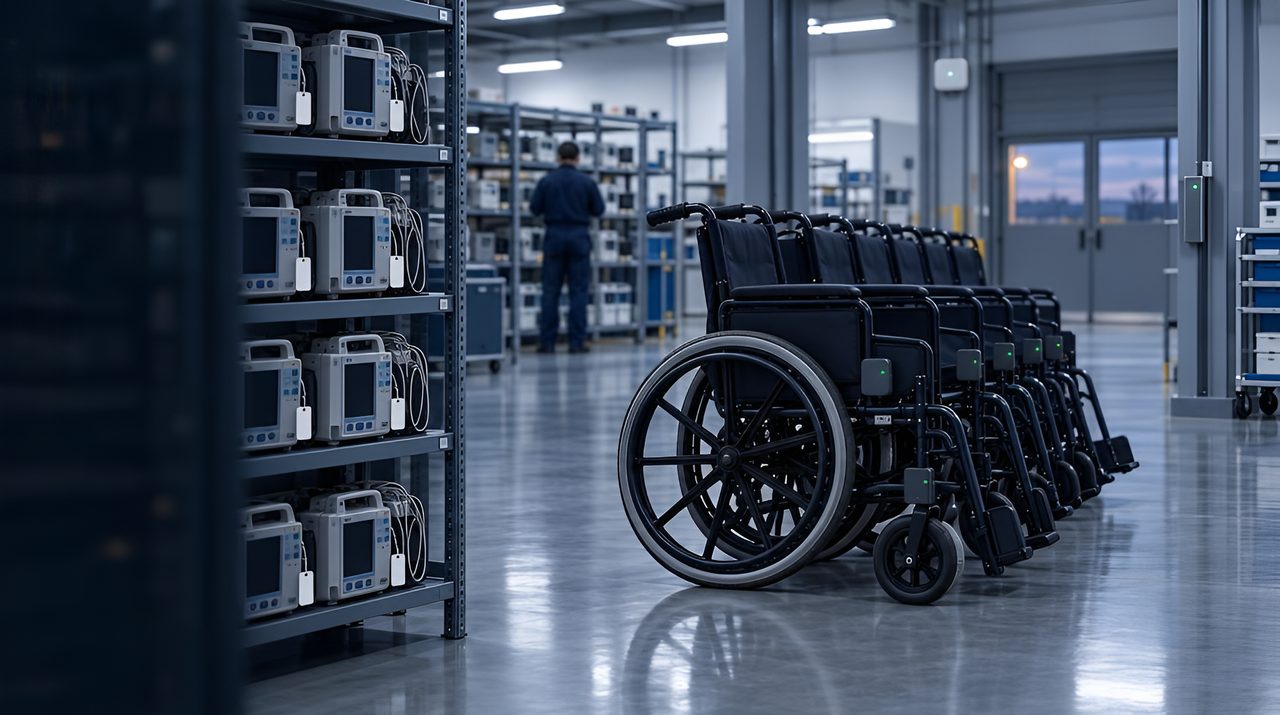
HIPAA & RTLS in healthcare.
Hospital RTLS routinely touches PHI, sometimes obviously, sometimes through room and workflow context. Design minimum necessary into the architecture, not as a policy afterthought.
What counts as PHI in an RTLS context
PHI engages whenever location data can be linked to an identifiable patient. Tagging an medical equipment is not PHI. Tagging a patient wristband is.
Tagging staff badges that happen to be assignable to a specific patient at a given time can be PHI by combination. The right architecture choice is: separate the location infrastructure from the patient-identification layer, with controlled joins.
Business Associate Agreements (BAAs)
Any RTLS supplier whose platform stores, processes or transmits PHI on your behalf is a Business Associate and requires a BAA. This includes cloud-hosted RTLS platforms (the majority), managed-service operators, and SI partners with platform access.
Suppliers who decline to sign a BAA cannot host PHI-linked deployments. That disqualifies a meaningful number of otherwise-strong RTLS suppliers. Verify BAA willingness early.
Minimum necessary and role-based access
HIPAA's minimum-necessary rule means clinical staff should see only the location data they need for their role. Nurses see patient flow on their unit; biomed sees equipment location; security sees zone access; nobody routinely sees everything.
This requires role-based access at the platform layer with audit logging. Default supplier configurations rarely implement this well. It's a stage 1 design decision.
Encryption, audit and breach response
PHI in RTLS systems must be encrypted in transit (TLS 1.2+) and at rest (AES-256). Audit logs must capture every PHI access and be retained per state law (typically 6 years).
Breach response (including the 60-day notification window) must be SOP'd. We design the security and breach-response SOPs as part of stage 1 / stage 3 deliverables, jointly with your privacy office.
Locating architecture that keeps PHI out of the RTLS plane
The cleanest HIPAA posture for hospital RTLS is a tag-centric design: the locating platform stores tag IDs and coordinates, while patient or staff identity lives in the EMR, badge directory or asset master. Association and dissociation happen in the subscriber system (often via FHIR Location / DeviceAssociation style joins), not as a permanent PHI payload inside the RTLS cloud.
That split is not academic. It shrinks Business Associate scope, reduces breach blast radius, and lets biomed run equipment-only programmes without waiting on privacy counsel for every dashboard. When patient flow or staff-duress use cases require identity joins, document the join as a controlled, audited interface with minimum-necessary fields, not as a bulk export of census lists into the supplier SaaS.
Challenge supplier claims that 'HIPAA compliant' means the platform is automatically safe for wristband tracking. Ask for: written BAA willingness, encryption at rest and in transit specifics, role templates mapped to clinical vs biomed vs security personas, retention and deletion APIs, and evidence that admin actions are audited alongside clinical queries.
Obligations that actually bite programmes
Covered entities must limit uses and disclosures to the minimum necessary, execute BAAs before PHI flows, complete a risk analysis under the Security Rule, and be ready for breach notification within the statutory window. For RTLS that means access reviews, MFA on admin consoles, network controls between clinical VLANs and locating infrastructure, and SOPs that name who can run a patient-location query and why.
Hand-hygiene, nurse call and workflow analytics are frequent grey zones. Aggregate unit-level compliance scores are usually easier to defend than individual clinician trails used for performance management. If individual trails are required, treat them as workforce monitoring with explicit notice, purpose limitation and short retention, and keep them out of the supplier's marketing analytics product.
State privacy overlays and hospital accreditation expectations often exceed the HIPAA floor. Design retention (commonly six years for access logs, sometimes longer for clinical records) into stage 1, not as a go-live afterthought.
Procurement challenges for healthcare RTLS suppliers
Require early confirmation that the supplier will sign your BAA, not a marketing BAA with one-sided liability caps that your counsel will reject six weeks into the RFP. Confirm subprocessors (cloud regions, support desks, SI partners) are flowed down.
Insist on a deployment audit pack: risk assessment inputs, encryption evidence, RBAC matrices, backup/restore tests, and a tabletop breach scenario. If the supplier cannot produce this for a pilot, they will not produce it for OCR scrutiny.
Prefer architectures that allow equipment-only go-live first, then optional PHI-linked modules behind a second gate. That sequencing de-risks clinical adoption and keeps the privacy office aligned with the programme plan.
Operational controls after go-live
HIPAA programmes fail quietly after the pilot when temporary 'break-glass' admin accounts linger, supplier support still uses shared passwords, or new wards inherit the default role that sees the whole campus. Schedule quarterly access reviews jointly with the privacy office, and treat locating admin rights like EMR admin rights.
Define retention for raw coordinates versus derived events. Raw trails used for temporary workflow debugging should expire faster than equipment utilisation aggregates. Document how a patient requests an accounting of disclosures if location queries are logged as PHI accesses.
Train helpdesk and biomed separately: equipment find workflows should not require opening patient-context screens. If they do, your minimum-necessary design leaked into operations.
How TRACIO scopes HIPAA-aware locating
Stage 1 produces a PHI touch-map: which use cases create identifiable joins, which stay equipment-only, which supplier components need BAAs, and which interfaces carry minimum-necessary fields. Stage 2 validates encryption, RBAC and audit in the chosen stack. Stage 3 locks SOPs and breach tabletop evidence before scale-out.
We stay independent: the goal is a defensible architecture and procurement pack, not a pre-selected hospital RTLS brand.
Frequently asked questions
Can we deploy an RTLS system that doesn't touch PHI at all?
Yes, for equipment-only deployments. Tag medical equipment, beds and wheelchairs, not patients or staff badges, and the system is out of HIPAA scope. This is the easiest path for biomed/equipment-utilisation programmes.
Which RTLS suppliers will sign a BAA?
Most enterprise healthcare-RTLS suppliers will (Stanley Healthcare, CenTrak, Sonitor, Kontakt.io, Aruba, Cisco). Some industrial suppliers won't. They're not in this market. We verify BAA-willingness during supplier shortlisting in stage 1.
How is hand-hygiene compliance reporting handled under HIPAA?
Carefully. Aggregate compliance reporting at unit or shift level is generally outside HIPAA.
Individual staff compliance, attributable to a named clinician treating a named patient, can engage HIPAA depending on context. Most programmes report at unit level for both HIPAA and labour-relations reasons.
Do we need an OCR-style audit pack?
Recommended. We assemble a deployment audit pack covering risk assessment, technical controls, training records, BAA inventory, breach-response SOP and ongoing-monitoring evidence. Updated annually or on material change.
Last updated: