
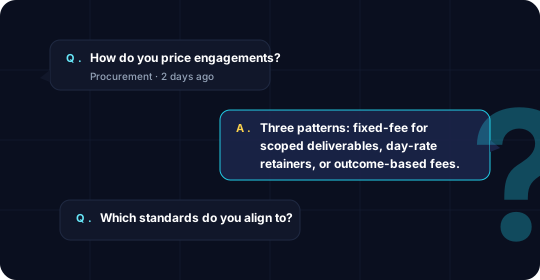
Engagement & procurement
What kind of engagements do you take on?
Discovery and strategy work, technology selection, RFP support, PoC / pilot delivery, full programme delivery, location-analytics builds, AGV/AMR fleet management, programme recovery, expert review, and vendor go-to-market. Engagement size ranges from a single two-day discovery workshop (typical fee €12k–€18k) through to multi-year, multi-site programmes spanning 40+ facilities and budgets in the low eight figures. We have led RAIN RFID rollouts across 200+ retail stores, UWB tool-control across aerospace MROs, and clinical-RTLS standardisation across hospital groups in three regions. If your problem doesn't fit one of the named shapes, we'll tell you on the first call rather than reshape it to sell more days.
Are you really vendor-neutral?
Yes. TRACIO does not resell hardware, does not take vendor margin or rebates, and is not enrolled in any partner programme that affects recommendations. The only thing we sell is independent advisory time, billed by the day or by the deliverable. We routinely recommend the option that does not maximise our future scope — including telling clients that an existing system can be rescued rather than replaced, or that a problem is operational rather than technical. Our reference list and the breadth of vendors named on our Ecosystem page is the simplest proof.
How do you price engagements?
Three common patterns. First, fixed-fee for scoped deliverables — e.g. a discovery workshop (€12k–€18k), a technology selection report (€28k–€55k), or an independent ROI model (€15k–€25k). Second, day-rate advisory retainers, typically priced €1.8k–€2.6k per consultant-day depending on seniority and committed volume. Third, outcome-based fees on full programme delivery, where a portion of fees is tied to acceptance criteria such as tag-read accuracy, go-live date, or first-pass user adoption. We invoice in EUR by default and can quote in GBP, USD, CHF, AED, or SGD where the client entity requires it.
Can you sign our standard MSA / vendor agreement?
Yes, with reasonable redlines — we have signed onto procurement frameworks from Fortune 500 manufacturers, top-10 European retailers, NHS trusts, and Gulf sovereign entities. We also have our own template MSA, SOW, and DPA which most mid-market clients adopt unchanged, plus a standing supplier-onboarding pack (insurance certificates, code of conduct, ISO alignment statements, sanctions screening). Typical contract turnaround is 5–10 working days from term-sheet agreement. See our Company Information page for the procurement pack and certificate downloads.
What about NDAs?
Mutual NDA available on request — we typically counter-sign within 24 hours and accept most client paper unchanged. Confidential information shared during pre-contract conversations is treated confidentially whether or not an NDA is signed, and we have a long-standing internal policy of never using a client's name, vendor stack, or commercial terms as a reference without explicit written approval. This is one reason the publicly named clients on our site represent a small fraction of the work we do. We also sign multi-party NDAs for tripartite engagements involving a system integrator or hardware vendor.
Will you sub-contract or use offshore resources?
Core advisory work is delivered by named TRACIO personnel and we do not bait-and-switch from senior partners to junior associates between proposal and delivery. Where specialist sub-contractors are used — hands-on RF site survey, MES or EMR integration, ATEX-rated installation supervision, regional language support — they are named in the SOW, bound by the same NDA and data-protection terms, and subject to client approval. We maintain a vetted bench of roughly 30 long-standing associates across EMEA, APAC, and the Americas for surge capacity. No offshore back-office is used for confidential client material without explicit written consent.
Technology & delivery
Which technologies do you cover?
UWB (FiRa, IEEE 802.15.4z) for 10–30 cm accuracy, BLE 5.x with AoA for 1–3 m room/zone work, RAIN RFID (EPC Gen2v2 / ISO 18000-63) for item-level visibility, active RFID and sensor tags for harsh environments, GPS / GNSS / RTK for outdoor and cm-grade survey, LoRaWAN, Sigfox, NB-IoT, LTE-M for wide-area sensors, Wi-Fi 6E RTT and FTM for opportunistic indoor positioning, plus ultrasound, vision, and SLAM for infrastructure-free use cases. We pick the technology to fit the use case — not the other way around — and a single programme will routinely mix three or four of these layers. Where the right answer is no RTLS at all (e.g. a process or labelling fix), we'll say so.
Do you build software?
We design and architect the location-analytics and integration layer, define the canonical data model, specify the event schema, and oversee the build. Implementation can be delivered three ways: by a small TRACIO build squad (typically 3–6 engineers on a fixed-price increment), by your in-house team operating under our technical leadership and acceptance gates, or by a system integrator we help you select and govern. Common stacks include Kafka or Kinesis for event transport, MQTT at the edge, TimescaleDB or ClickHouse for the location time-series store, and a thin React or Power BI layer for operator views. We're explicitly not trying to become a product company — the IP we hand over is yours, with full source and documentation.
Which enterprise systems do you integrate with?
On the ERP and supply-chain side: SAP S/4HANA + EWM, SAP MII, Oracle Fusion, Manhattan Active, Blue Yonder, Körber, Infor LN/CSI. On the shop floor: Rockwell FactoryTalk, Siemens Opcenter, GE Proficy, AVEVA, plus PLC / SCADA layers via OPC UA. On the clinical side: Epic, Cerner / Oracle Health, Meditech, InterSystems, with HL7 v2 and FHIR R4 messaging. For service management and assets: ServiceNow IRM / HAM, IBM Maximo, Infor EAM. Everything else — bespoke MES, EMR, CMMS, WMS, TMS, YMS — we connect through OPC UA, HL7 / FHIR, REST, GraphQL, or MQTT depending on what the system speaks natively.
Do you have a recommended cloud / IoT platform?
No default — the platform decision should follow the data-residency, integration, and TCO requirements, not the other way round. We are hands-on across Azure IoT Hub + IoT Edge + Digital Twins, AWS IoT Core + Greengrass + SiteWise, Google Cloud IoT successors, Eclipse ThingsBoard and Hono, Software AG Cumulocity, PTC ThingWorx, Siemens MindSphere / Insights Hub, and Balena for fleet device management. For European clients with sovereignty concerns we have delivered on OVHcloud, T-Systems Open Telekom Cloud, and on-premise Kubernetes. Over a 5-year horizon the platform choice typically swings 15–30% of total TCO — we model this explicitly in the selection report.
What's a typical timeline?
Discovery and use-case framing: 2–4 weeks. Independent technology selection report with vendor scoring and ROI: 4–6 weeks. Proof-of-Concept in a controlled bay or zone: 4–8 weeks. Single-site pilot with operator adoption: 8–16 weeks. Full multi-site rollout: typically 6–18 months depending on facility count, change-management complexity, and integration scope. Programme-recovery diagnostics with a written go/no-go recommendation: under 14 days. We publish a milestone-by-milestone Gantt at SOW signature and report variance weekly — no monthly "everything is green" status theatre.
Compliance, security, regions
Which compliance frameworks do you align to?
For data protection: GDPR / UK DPA 2018, HIPAA, plus DPIA / TIA preparation for cross-border transfers. For life sciences and clinical: 21 CFR Part 11, EU Annex 11, GxP, DSCSA, EU FMD, GDP. For industrial: IEC 62443 for OT cybersecurity, ISA-95 / Purdue Model for OT/IT layering, AS9100D for aerospace, IATF 16949 for automotive. For hazardous areas: ATEX and IECEx zone-rated hardware specification. For cyber and resilience: NIST CSF, ISO 27001 alignment, SOC 2 alignment, NIS2, DORA. We help our clients design systems that pass audits — we are not an auditor or certification body. See the Standards page for the full list.
What about security clearance for defence / public sector work?
Discussed case by case under NDA. We have delivered programmes in air-gapped sovereign-cloud environments, on-premise classified networks, and IL-rated estates — including aerospace MRO tool-control and defence depot inventory. Cleared personnel can be assigned on request through long-standing associate relationships, with vetting at NATO Secret, UK SC / DV, US Secret-equivalent, and EU national clearances depending on the contract. We will not bid for work that requires clearance we cannot credibly supply, nor will we run a programme remotely where the operational reality demands on-site presence. References available under separate cover for vetted procurement contacts.
Which regions do you cover?
EMEA, APAC, NALA, LATAM, and MENA — with active references in the UK, DACH, Benelux, the Nordics, France, Iberia, Italy, the Gulf, Singapore, Australia, and across North America. Delivery is remote-first with on-site presence at the moments that actually need it — site survey, anchor commissioning, pilot go-live, executive workshops — rather than billable-hour tourism. We adjust to regional regulatory specifics including ETSI vs FCC RF power tables, regional UWB channels (e.g. UWB channel restrictions in Japan and Korea), and EU vs US healthcare integration norms. Our website is available in 14 languages and engagement deliverables can be produced in English, German, French, Spanish, Italian, Dutch, and Arabic as standard.
Where is data hosted?
Our public website and corporate systems operate inside the EU on EU-headquartered providers. Client-engagement data — documents, meeting notes, deliverables, and any operational data we touch — is hosted in the region appropriate for your data-residency requirements: EU, UK, US, Switzerland, UAE, Singapore, or directly inside your own tenant. Each engagement DPA documents the exact processing locations, sub-processors, retention periods, and deletion procedures. Where required by NIS2, DORA, or sector-specific rules (e.g. Schrems II safeguards for transfers outside the EU/EEA), we will not move data without a documented transfer impact assessment.
Have a question that isn't covered here?
Email hello@tracio.com or book a strategy call through the contact page. We come back to all qualified enquiries within one business day, and a first 30-minute exploratory call is always free of charge and free of obligation. If we are not the right firm for your problem — wrong region, wrong scale, conflict of interest — we will tell you on that first call and, where we can, point you toward someone who is.