
Temperature, location, and chain-of-custody — proven to regulators.
For pharma, biologics, vaccines, and high-value clinical-trial materials. TRACIO designs the sensor fleet, the data flow, and the audit trail that satisfies DSCSA (US), EU FMD, GDP, FSMA, and 21 CFR Part 11. Vendor-neutral across BLE cold-chain loggers, cellular IoT trackers, and active RFID with sensor payloads — selected against your route, your SKU mix, and your regulator.
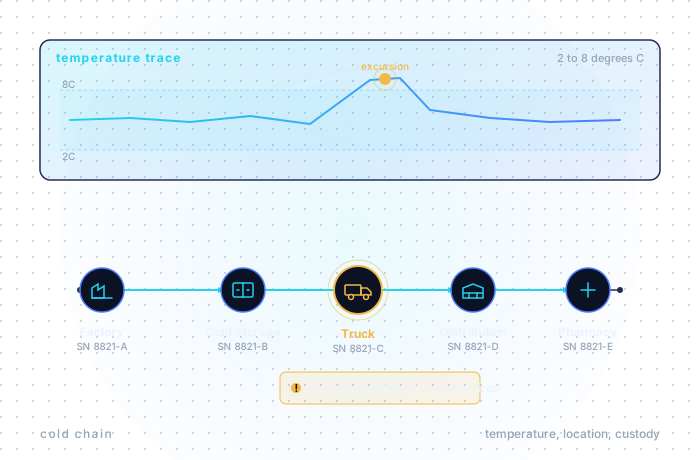
Watch a shipment trace its temperature.
A simulated cold-chain logger, live in your browser. Default state holds inside the 2–8°C pharma band. Trigger an excursion and watch the alarm path fire — the breached portion of the trace turns red, an audit entry is created, and ServiceNow gets the ticket. This is the loop we wire for real.
Logger feed — live
Real-time monitoring
Every reading is in your control plane the moment the sensor speaks. No more downloading the logger at the dock, no more discovering the breach at receipt. A live stream, with the latency budget written into the SLA.
Excursion alarms → action
Threshold breach fires within seconds: PagerDuty, ServiceNow, Veeva Vault QMS, or your incident channel of choice. Escalation paths and on-call rotations defined as part of the SOP, not bolted on after go-live.
Audit trail by design
Every reading, every alarm, every operator acknowledgement is an immutable, time-stamped event with a CSR identifier. 21 CFR Part 11 electronic records are a by-product of the architecture — not a quarterly clean-up.
Three failure modes the regulator finds first.
The auditor is not interested in your dashboard. The auditor wants the evidence trail. These are the gaps we find before they do.
Excursion alerts arrive too late
The temperature breach is detected when the logger is downloaded at the receiving dock — hours or days after the excursion. By then the product is quarantined, the batch is at risk, and the root-cause window has closed.
Serialization data lives in three silos
DSCSA EPCIS events sit in one system. EU FMD aggregations in another. The shipment’s temperature history in a third. The audit trail exists, but reconstructing a single SKU’s journey takes a team a week.
Audit-readiness is a quarterly fire-drill
Validation packs are reassembled by hand before each inspection. Deviations and CAPAs are tracked in spreadsheets. The quality team is busy proving compliance — not improving it.
Six workstreams from sensor to signed CSV pack.
We design and deliver against GxP from day one. The evidence the regulator wants is a by-product of the architecture, not a quarterly project.
BLE · cellular · active RFID
Logger selection against the SKU, route, lane temperature profile, and replenishment model. We size accuracy, battery life, and recovery economics across multi-use, single-use, and re-deployable fleets — in EUR per shipment.
Real-time excursion response
Alarm thresholds, escalation paths, and on-call rotations that catch excursions in the lane, not at the dock. SOPs aligned with WHO PQS and the stability-budget model of the product.
DSCSA & EU FMD on one event spine
EPCIS event capture, aggregation, and exchange wired into the same event bus that feeds cold-chain monitoring. One serialized record per unit, from packaging line through dispensing — with temperature history bound to it.
Validated by design
Electronic records, e-signatures, access control, and time-stamped audit trails specified at architecture — not retrofitted at validation. User-requirement specs, FRS, and DS produced under GAMP 5.
SAP · Veeva · MES · LIMS
Master data, batch genealogy, deviation events, and quality holds wired across SAP S/4 (EWM, ATTP), Veeva Vault, the MES, and the LIMS. One serialized truth across the regulated stack.
The folder the inspector wants
IQ, OQ, PQ protocols, traceability matrices, test evidence, and a continuously-maintained validation pack. Audit-readiness becomes a state, not an annual project.
Three ways to bring us in.
Sized to where you are in the compliance and technology lifecycle.
Compliance gap audit · 3 weeks
Mapped against DSCSA, EU FMD, GDP, FSMA, and 21 CFR Part 11. Sensor-fleet review, data-flow review, validation-pack review. Output is a remediation roadmap with prioritised findings.
Sensor-fleet design · 6–10 weeks
Technology selection, lane-by-lane sizing, alarming SOP, integration architecture, and a procurement pack. Vendor-neutral — we tender, you sign.
Validated rollout · 4–9 months
Full GxP-grade delivery: URS through PQ, sensor deployment, IT-system integration, SOP rollout, and handover to QA. Gated milestones, fixed evidence deliverables at each gate.