Tick everything you need to track.
Most operations need 2–4 of these. The recommendation updates live below.
Which radio for which use case — and why.
Every recommendation below comes with the physics, economics, and integration logic behind it. No vendor agenda.
Volume kills any battery-powered option. Passive RFID tags cost 3–30 cents — the only economics that work for tagging every pallet. Reads happen at known choke-points (dock doors, conveyor takeaway, dispatch lanes) so you don't need full-room positioning.
Add BLE 5.x only if you also need to track where the forklift moving the pallet is, not just where the pallet was last seen. Most teams don't — the pallet's last reader event is enough.
BLE 5.x AoA delivers 1–3 m accuracy at one-quarter the infrastructure cost of UWB. For "which ward is the pump in?", that's enough. Tag battery life is 2–3 years on a coin cell.
UWB earns its premium only where you need sub-metre precision — sterile processing rooms, the pharmacy clean-utility room, the OR. Layer it in at those zones only. The rest of the hospital stays on BLE.
This is what UWB exists for. Time-of-flight, multi-path resilient, sub-metre even in metal-rich environments. Anchor density 1 per 50–120 m². Tag battery 2–5 years.
Combine with passive RFID at the cell-entry portal so you have item-level identity confirmation when a batch enters the cell — UWB tracks where it is, RFID confirms what it is.
GPS is unbeatable outdoors. Cellular backhaul gives you live tracking with 5–10 m accuracy. Add RTK for cm-level when it matters — precision agriculture, construction stake-out, automated yard moves.
The thing GPS doesn't solve: indoor handoff. Use BLE or UWB inside the building, GPS outside, and a shared event bus that resolves the asset's location regardless of which radio reported it.
LPWAN is built for "send a 12-byte payload every 5 minutes for 7 years on AA batteries." Perfect for cold-chain temperature loggers, pallet humidity sensors, water-meter readings.
The trade-off: not real-time, and downlink bandwidth is severely limited. If you need to actuate something from the cloud quickly, LoRa is the wrong layer. Pair with BLE for short-range commissioning and a cellular gateway for backhaul.
For routine presence and mustering, BLE wearables (wristband, hard-hat tag) at €5–25 per unit cover the operation. Battery life is the buying criterion — 2–3 years on a CR2032 is the minimum.
For high-stakes zones (blast exclusion in mining, robot safety perimeters in manufacturing) layer in UWB for sub-metre accuracy. For outdoor sites add GPS-cellular trackers for the same workforce.
You don't need sub-metre for occupancy. You need "is the room being used, and by whom". BLE detects credentialed badges entering and leaving. Tag cost per person is irrelevant because the IT estate already provisions wearables.
Add anonymous occupancy sensors (PIR, CO₂, vision-based people-count) for staff who don't carry tags. The two streams reconcile in the analytics layer.
SLAM means the robot builds and references its own map — no facility-wide anchor infrastructure required. For a 10-AMR fleet, that's a transformative cost saver vs UWB. Modern AMRs ship with embedded SLAM.
Layer UWB in specifically at high-precision hand-off points — conveyor pickups, charging docks, fixture interfaces. SLAM gets the robot there; UWB confirms it's in tolerance before the docking move.
The logger needs to phone home from anywhere — truck, plane, distribution centre. Cellular IoT (NB-IoT or LTE-M) does that. BLE temperature pucks inside the shipment talk to the logger via short-range BLE.
GPS gives you the location breadcrumb. The logger consolidates all three into a single event stream: position + temperature + timestamp + audit trail. That stream is what 21 CFR Part 11 demands.
Tag cost at scale wins. 3–15 cents per source-tagged item means you can tag every SKU and still hit a sub-1-year payback through inventory accuracy alone. Mature retail ecosystems (Zara, Decathlon, Macy's) prove the model.
Overhead readers do periodic store-wide cycle counts. Handheld readers handle returns and BOPIS pick. There's almost no reason to add a second radio on top — this is the rare use case where one radio does almost everything.
Heavy plant (excavators, dozers, loaders) wants GPS-cellular. You need to know which site it's on, not which square metre. Hand tools wear BLE tags at a few euros each so you can find them in a 200×200 m site without the cost of UWB.
Add UWB or BLE-based geofence only at safety-critical zones — trench edges, swing radius of a crane, blast-exclusion boundaries. Worker tags trigger the same geofence stream.
GPS doesn't work underground. Active RFID or LoRa over a mesh network reaches every drift and refuge chamber with sub-second location updates. ICMM-aligned proximity-detection wants higher precision at vehicle intersections — that's where UWB earns its keep.
BLE wristbands at refuge chambers confirm headcount instantly during evacuation. Cellular doesn't propagate, so this is purpose-built infrastructure either way — design once for the whole site.
What the combination looks like in practice.
Stories anonymised — the numbers and the architecture are real.
BLE 5.x AoA + UWB + RAIN RFID — three radios, one event stream
Eight floors. 480 infusion pumps, 120 telemetry monitors, 350 wheelchairs, 60 ventilators. Sterile processing, pharmacy, ED, and 4 wards.
- BLE 5.x AoA across all eight floors (room-level, 1 locator per 280 m²) — covers the 90% case: "what ward is the pump in?"
- UWB only in sterile processing (2 anchors) and the pharmacy clean utility (3 anchors) — where sub-metre matters for compliance.
- RAIN RFID at the laundry-cart wash bay and the pharmacy dispense window — cents-per-tag identity confirmation at choke-points.
All three feed a vendor-neutral event bus (MQTT). The Epic EHR sees one normalised location event regardless of which radio sourced it. Result: 22 min/nurse/shift hunt-time dropped to 7 min. Payback under 10 months on hard dollars alone.
UWB + RAIN RFID + GPS — radio per workflow, single MES
Body-in-white, paint, assembly, outbound logistics. Tooling, WIP, finished vehicles, outbound truck yard.
- UWB in body-in-white for high-value torque-tool tracking (3,200 tools, every torque event geolocated for traceability).
- RAIN RFID at every production-cell entry (12,400 in-process sub-assemblies tagged) — OEE up 4 points, perfect-order rate up 6 points.
- GPS + RTK in the outbound truck yard (210 trailers, 8 yard tractors) — cm-level dock assignment without human dispatchers.
- LoRa for environmental sensors across the campus — not real-time, but enough for the ESG team.
SAP MII consumes the unified event stream. Procurement bought the UWB once, the RAIN readers from a different vendor, the GPS-RTK from a third. None of the three vendors had to know about the others.
RAIN RFID + BLE + SLAM — three radios, near-zero anchor estate
E-commerce fulfilment. Inbound from 4 origin DCs, outbound to 14 retail stores and consumer addresses.
- RAIN RFID at every dock door and conveyor takeaway — pallet and tote identity, no battery cost across 60,000 active tags.
- BLE 5.x on every forklift and roll-cage (320 mobile assets) — mean dwell, utilisation per fleet, charge-cycle analytics.
- SLAM on the 28-AMR pick fleet — no facility-wide UWB infrastructure required; the AMRs navigate themselves and report position to the WMS.
Anchors required: zero (RFID is portal-based, BLE locators are pole-mounted, SLAM is on-robot). Total infrastructure cost: 38% of an equivalent UWB-everywhere deployment.
Three radios. One event stream.
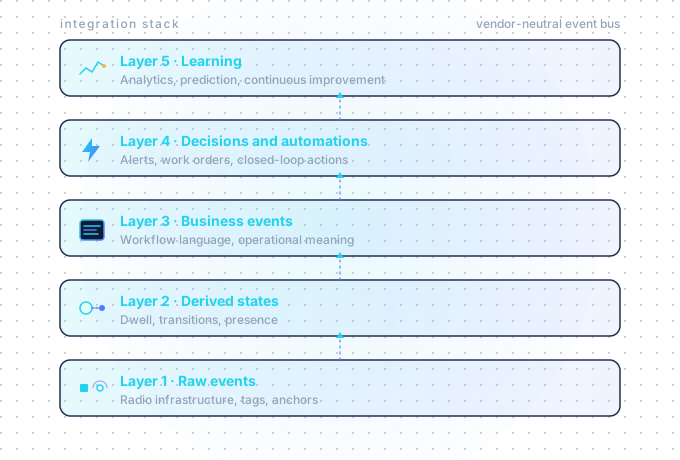
The architecture pattern is the same regardless of how many radios you mix. Each vendor produces raw events. A vendor-neutral normalisation layer rewrites them into a common schema. Downstream systems consume that — not the vendor-specific feeds.
This is the difference between a hybrid stack that ages well and one you have to re-platform every five years. Your WMS, EMR, or MES never needs to know which radio reported the location — they all look the same after Layer 2 of the architecture stack.
- Vendor-neutral event schema (MQTT or Kafka)
- Per-radio adapters that translate proprietary feeds into the schema
- Derived-state engine that produces dwell, transition, co-location regardless of source radio
- Business-event layer that the workflow systems consume
- Replay capability so analytics can re-run history with new logic