
Robots from any vendor. Advice from one team.
TRACIO does not sell a fleet management product. We are independent consultants. We work directly with your AMR and AGV suppliers — MiR, Otto, Locus, Geek+, Seegrid, Fetch, 6 River Systems — and directly with the fleet management software providers who orchestrate them (the FMS / robot fleet manager layer above the robots). We sit between you and both sides of that supply chain, vendor-neutral, so the architecture, the contracts, and the operating numbers all land in your name.
Multi-vendor robotics without an orchestration layer is a stranded asset.
You bought MiR for transport, Locus for picking, and a Geek+ shuttle for storage. They don't talk to each other. They don't share a map. Your WMS sees three separate fleets. Without orchestration, you have three expensive island deployments instead of one connected system.
No common language
Proprietary APIs from each vendor mean every WMS, MES, or paging integration has to be done three times — and rebuilt every time a vendor updates firmware.
No traffic management
Without a shared orchestrator, vendors' robots can't coordinate aisles, intersections, or charging infrastructure. The result is dead-locks, near-misses, and lost productivity.
No utilisation visibility
You can't compare ROI across vendors if each fleet only reports its own KPIs. Procurement decisions get made on demo-floor performance instead of production data.
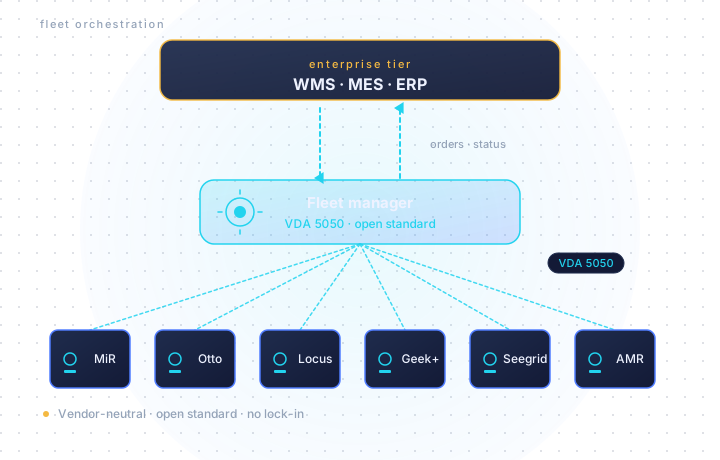
VDA 5050 ends vendor lock-in for AGV/AMR fleets.
The VDA 5050 standard, originally published by the German Association of the Automotive Industry, defines a universal MQTT-based interface between an AGV/AMR and a master control system. Most major vendors — MiR, Otto Motors, Locus Robotics, Geek+, Seegrid, Fetch / Zebra, 6 River Systems — now support it.
We help you architect a VDA 5050-compliant programme so the master fleet management system you choose — or already own — becomes the control plane, the robots are interchangeable, and the WMS / MES integration is built once. We design it. Your preferred orchestration vendor builds and licenses it. You own the contract.
- Master-control architecture review against VDA 5050 v2.x
- Vendor mapping — what each AGV/AMR supports today, with gap analysis
- Traffic-management, lane-priority, and charging-station orchestration strategy
- Map federation across SLAM, magnetic-tape, and natural-feature navigation
- WMS / MES integration design (Manhattan, Blue Yonder, SAP EWM, Körber)
- Procurement support: spec, RFP, scoring, contract review
Infrastructure-free positioning for the modern AMR fleet.
Simultaneous Localisation and Mapping (SLAM) removes the need for floor-magnets, reflectors, or QR-code fiducials. The robot builds and references its own map from LiDAR, vision, or sensor-fusion inputs — with sub-decimetre accuracy where it matters.
Slamcore-class platforms
Embedded SLAM software for AMR vendors and in-house robotics teams — Slamcore, Sevensense (ABB), Slambox-class systems. Architecture review, vendor selection, and integration design.
Sensor fusion
LiDAR + camera + IMU + UWB-assist sensor fusion for challenging environments — dynamic manufacturing floors, mixed-traffic warehouses, outdoor / indoor transitions.
Map federation
Federated maps across multiple vendors and modalities so SLAM-based AMRs and magnetic-tape AGVs share a single ground truth of the facility.
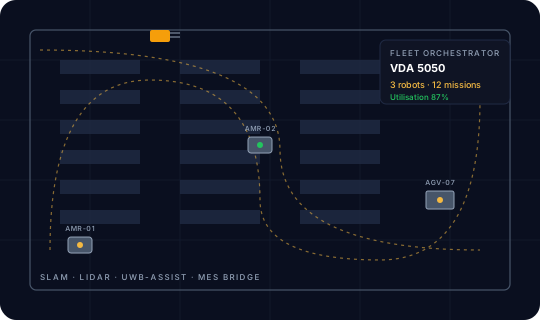
One orchestrator, three robot vendors, zero collisions.
A live look at what VDA 5050 actually does on the floor — a single fleet manager dispatching MiR, Otto, and Locus robots over MQTT, resolving aisle conflicts, and sequencing charging without taking units offline. No vendor lock-in. No bespoke middleware.
Orchestrator — live
The Fleet Manager dispatches orders over MQTT and the robots stream state back at ~5 Hz.
Watch the bus above — when paths converge, the orchestrator holds one robot to avoid a collision. When Otto 100 dips below threshold, it gets routed to the charger.
Standard messages, any robot
One MQTT contract — order, state,
visualization, connection — consumed
identically by MiR, Otto, and Locus. New vendors plug in
without rewriting your WMS interface.
Traffic management at junctions
The fleet manager owns the floor graph. When two robots contend for the same node, the orchestrator pre-empts one with a brief hold — no near-misses, no manual operator intervention.
Charging strategy without downtime
Opportunity charging is a fleet decision, not a robot decision. The orchestrator sequences units to chargers based on state-of-charge, queue depth, and the next task window — so utilisation stays high.
Independent across the full AGV/AMR market.
MiR (Teradyne)
Mobile Industrial Robots — MiR250, MiR600, MiR1350. Industry workhorse for materials transport in production and warehouse settings.
Otto Motors (Rockwell)
Heavy-duty AMRs for industrial materials handling with the Otto Fleet orchestration platform.
Locus Robotics
Goods-to-person AMRs optimised for e-commerce fulfilment with LocusOne fleet orchestration.
Geek+
Goods-to-person and shuttle solutions with the GeekHive orchestration platform — popular for 3PL and apparel.
Seegrid · Fetch (Zebra) · 6RS
Vision-guided AMRs (Seegrid), warehouse AMRs (Fetch / Zebra), and collaborative picking robots (6 River Systems / Shopify).
Slamcore · Sevensense · Slambox-class
Embedded SLAM platforms for vendors and in-house builders. Architecture and integration support across vision, LiDAR, and fused sensing.
We work directly with the orchestration platforms too.
The fleet management software sits above the robots and coordinates them. We have working relationships with the providers below — vendor-direct, not through a reseller chain. You sign the licence in your name. We negotiate, design, and integrate.
SafeLog · ek robotics · idealworks AnyFleet
VDA 5050-native fleet managers built to orchestrate heterogeneous AGV/AMR fleets from multiple OEMs. Strongest when your robot mix spans 3+ vendors.
MiR Fleet · Otto Fleet · LocusOne
Vendor-native FMS extended to manage third-party robots over VDA 5050. Good when you have one anchor vendor and want to layer others on top.
SAP DMC · Siemens Opcenter · Körber
MES- and WMS-integrated orchestration where the fleet decisions sit inside the production or fulfilment control tower, not in a separate stack.
FlexSim · AnyLogic · Visual Components
Discrete-event simulation tools we use to model throughput, deadlock risk, and charging strategy before the first robot lands on the floor.
We are not a reseller of any of these platforms and we do not earn referral commission. Selection is driven entirely by the fit between your environment, your robot mix, and your existing WMS / MES stack.
What you get when you hire TRACIO.
Six workstreams, scoped individually or as a programme. All deliverables are documents, decisions, and trained internal owners — not software you have to renew with us.
AGV/AMR feasibility
Workflow analysis, throughput modelling, payload profiling, and the business case — with your numbers — before the first robot purchase order is raised.
Deliverable: Feasibility report & ROI model
Vendor selection
RFP authoring, multi-vendor evaluation scorecard, reference checks, and contract-readiness review. You decide; we make the decision defensible.
Deliverable: Scored shortlist & recommendation
Orchestration architecture
VDA 5050 master-control design, traffic management, charging strategy, map federation, and WMS / MES integration architecture — vendor-neutral.
Deliverable: Architecture design document
SLAM integration
Slamcore / Sevensense / Slambox-class platform selection, sensor-fusion design, and map management guidance for SLAM-driven AMR fleets.
Deliverable: Navigation architecture & vendor pack
Pilot & rollout
Pilot scoping with measurable KPIs, programme management for the full deployment, UAT scripting, operational hand-over to your team.
Deliverable: Programme plan & UAT pack
Fleet analytics
Define the KPIs — utilisation, MTBF, throughput-per-robot, energy-per-mission — and spec the dashboards in your existing BI tooling.
Deliverable: KPI dictionary & dashboard spec
Three ways to bring us in.
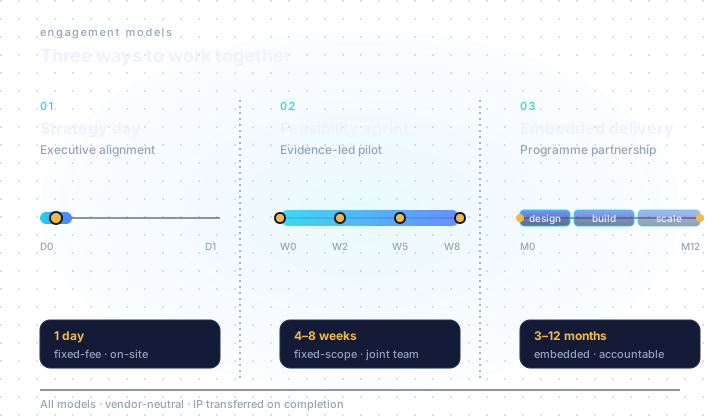
Strategy day
One day on-site or remote with your operations and IT leads. Walk the floor, review the use case, sketch the architecture, and price the next step. Fixed-fee.
Feasibility sprint
Four to eight weeks. Full feasibility, vendor evaluation, business case, and a board-ready recommendation. Fixed-fee, fixed-scope, no surprises.
Embedded delivery
Multi-month programme leadership: we sit alongside your team through procurement, integration, pilot and rollout — until your people own it.