
RTLS for manufacturing
On the factory floor, location data closes the gap between the MES plan and what is actually happening — WIP, tools, forklifts and people — so you can lift OEE and inventory accuracy.
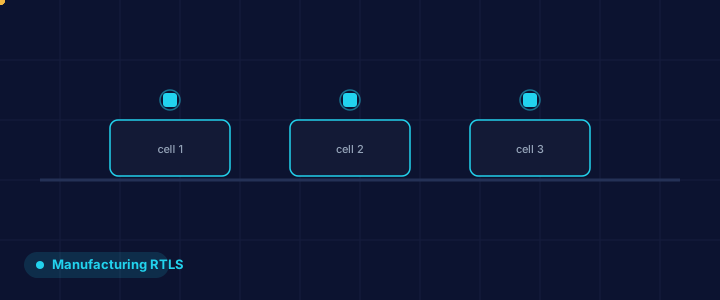
Highest-ROI use cases
- WIP / work-in-progress tracking — close the 60–70% accuracy gap to 99%+
- Tool control and calibration — cut search time and prevent FOD
- Forklift safety and utilisation — fewer near-misses, right-sized fleet
- Just-in-sequence traceability into MES (e.g. Opcenter, SAP)
Choosing the technology
Metal-dense plants often need UWB for precision at workstations, RAIN RFID for item identity at gates, and BLE for broad zone visibility — frequently a hybrid. The right mix is set by the accuracy each use case truly needs, not by a single vendor’s catalogue.
What good looks like
A gate-governed rollout: validate the use case, pilot in the real RF environment, prove the KPI, then scale across lines and sites. That sequence is why some manufacturers reach payback in a year and others stall in pilot.
Frequently asked questions
What RTLS accuracy does manufacturing need?
It varies by use case: workstation-level WIP may need sub-metre UWB; zone visibility is fine on BLE; gate identity suits RAIN RFID.
What ROI is realistic?
Common drivers are WIP accuracy, tool search time, FOD reduction and forklift utilisation. Our ROI calculator models payback from your numbers.
Will it integrate with our MES/ERP?
Yes — clean integration into MES/ERP/WMS is core to the work; we design for it from the start.
Where should we start?
A discovery sprint on one line, then a pilot, then scale. See the manufacturing deep-dive and book a review.