
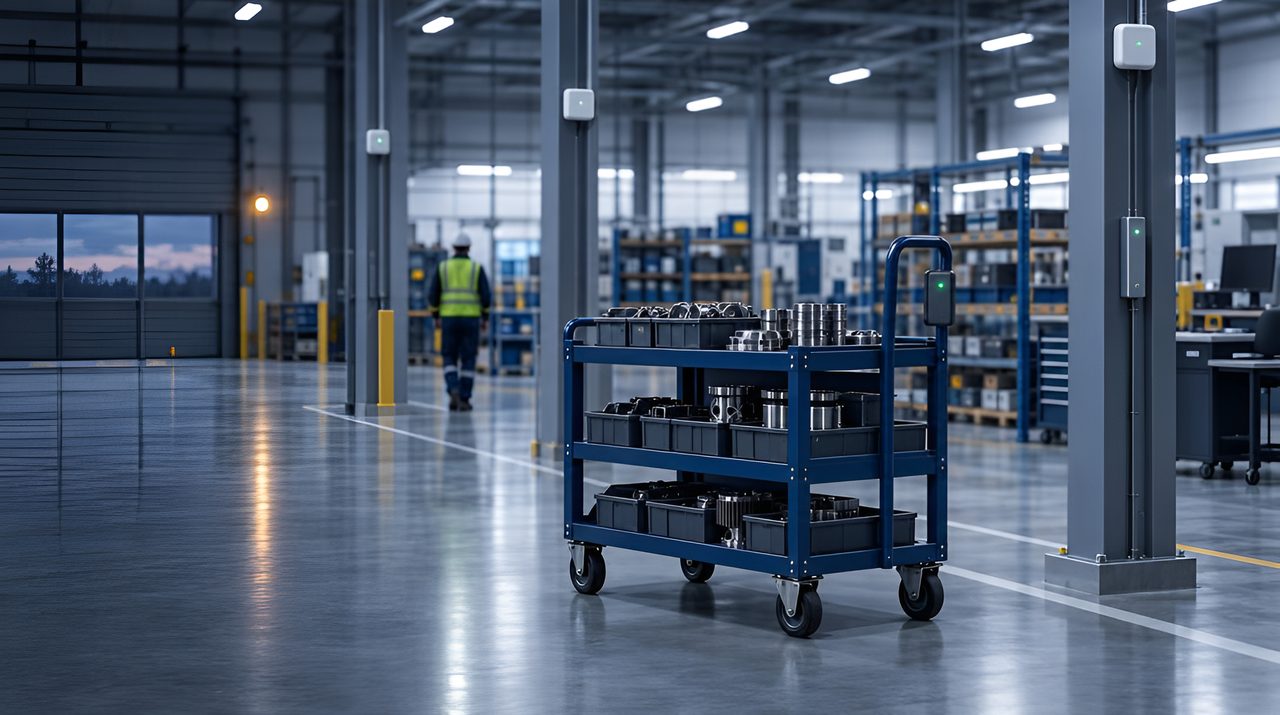
UWB vs RFID : quand chacun gagne.
UWB et RFID sont mis en concurrence lors des achats, mais la réponse réaliste est qu’ils sont conçus pour des missions différentes.
Pistes UWB Position en temps réel pour une flotte relativement petite de plaques actives ; RFID confirme Présence aux points de lecture pour des milliers de tags passifs.
C’est la comparaison au niveau opérateur qui vous aide à choisir, ou, plus souvent, à définir où chacun appartient dans une pile hybride.
La différence de catégorie
L’UWB est généralement l’option la plus précise. La précision obtenue dépend de votre site, et nous la confirmons lors de l’audit sur site.
RFID (PLUIE UHF Gen 2) utilise des étiquettes passives qui diffusent leur ID lors de la transmission d’un lecteur, confirmant la présence dans le champ du lecteur.
UWB vous indique où une chose est En ce moment, à quelques centimètres. RFID vous le dit une chose était là Quand le lecteur tirait. La plupart des entreprises qui les comparent en approvisionnement ont besoin des deux pour différentes parties de l’opération.
Vous envisagez l’UWB ? Obtenez un conseil UWB indépendant. Vous penchez pour la RFID ? Voir le conseil RFID indépendant.
Précision : d’un ordre de grandeur
L’UWB est généralement l’option la plus précise. La précision obtenue dépend de votre site, et nous la confirmons lors de l’audit sur site. RFID: confirmation de présence dans la zone de lecture du lecteur (quelques mètres pour les portatifs et portails fixes), ou 1-3 m pour les RFID de grade RTLS plus récent (Zebra ATR7000, contrôles RF CISC).
UWB est environ 10 × plus précis que le RFID de qualité RTLS, et 100 × plus précis que le portail RFID basique.
Si la précision en dessous d’un mètre compte pour votre cas d’utilisation (évitement collision, assemblage du kit, entraînement tactique), UWB. Si la présence est suffisante (comptage de cycles, réconciliation porte-dock), RFID.
Étiquette économie : le facteur décisif de l’échelle
Tags RFID: 3 à 10 cents pour les incrustations de détail, 50 cents à quelques euros pour les industriels, sans batteries, durée de vie de plusieurs années. Tags UWB: 30-150 euros chacun, avec une charge de gestion de la batterie.
Si vous devez suivre 100 000 vêtements, articles ou biens retournables, la différence de coût des plaques est la décision d’achat globale : RFID l’emporte de loin. Si vous suivez 200 travaux en cours de grande valeur en temps réel, le coût du tag UWB est à peine perceptible.
Coût et densité des infrastructures
Ancrages UWB: plusieurs centaines d’euros chacun, déployés à un espacement de ~10 m en 3D, câblé pour la synchronisation. Une zone de production typique de 5 000 m² nécessite entre 30 et 60 ancres.
Lecteurs fixes RFID: coût similaire par lecteur mais déployés uniquement aux points d’étranglement (portes d’amarrage, armoires intelligentes, stations d’encodage). Un site comparable peut nécessiter 5 à 15 lecteurs.
Mobile RFID: aucune infrastructure fixe, juste des appareils portables. L’écart de coût en infrastructure compte le plus pour les sites où les lectures de goulottage fonctionnent ; UWB ne gagne que lorsque vous avez vraiment besoin d’une couverture spatiale continue.
Taux de mise à jour et latence
UWB: débits de mise à jour de plusieurs Hz à 50 Hz, position en temps réel. RFID: événements de présence lorsque les éléments entrent dans le champ du lecteur, sans suivi continu.
Pour les processus dynamiques (évitement des collisions de chariot élévateur, performance sportive, interactions autonomes-actifs), UWB est la seule option.
Pour les processus pilotés par les événements (réception, picking, expédition), le modèle d’événements de RFID s’intègre parfaitement.
Les stacks hybrides sont la norme
La plupart des grandes entreprises gèrent les deux. Exemples : une usine automobile utilise le UWB pour le suivi en cours sur la ligne (submètre nécessaire) et le RFID pour les kits de pièces à la réception (lectures en gros bon marché) ;
une installation MRO aérospatiale utilise le UWB pour le placement des outils pendant le travail et le RFID dans les armoires intelligentes pour l’enregistrement/sortie ;
un hôpital utilise BLE-AoA pour le flux de travail du personnel et des équipements, et RFID pour l’inventaire des consommables.
L’hybride est le résultat par défaut à grande échelle, la question des achats ne l’est pas qui, c’est où chacun s’insère.
Quand TRACIO choisit UWB vs RFID
UWB: évitement des collisions, entraînement tactique, performance sportive, WIP en sous-mètre, suivi en temps réel des outils, vérification de l’assemblage du kit, entraînement force sur force.
RFID: article au niveau de détail, rapprochement entre les portes d’entrepôt et les docks, sérialisation pharmaceutique, armoires intelligentes, contrôle des outils, suivi des actifs retournables (RTI), inventaire à grande valeur ajoutée.
Nous évaluons le mix à l’étape 1 de la méthode du programme TRACIO en fonction des cas d’usage, pas des préférences technologiques. Voir Ultra-Wideband (UWB) et RFID : Mobile, fixe et RTLS - Explication pour les traitements individuels plus approfondis.
Questions fréquemment posées
UWB et RFID peuvent-ils coexister sur la même infrastructure ?
Oui, ils fonctionnent sur différentes fréquences (UWB sub-GHz à 10 GHz large bande ; Passive RFID à 860-960 MHz) et ne gênent pas.
De nombreux déploiements partagent le réseau de câblage, les contrôleurs réseau et les plateformes d’intégration. Nous concevons des stacks hybrides comme une sortie normale de l’étape 1.
Lequel est globalement le moins cher à déployer ?
RFID à grande échelle, de loin, quand la présence est suffisante. UWB a des coûts d’indexation, d’ancrage et d’intégration plus élevés mais offre une position en temps réel que RFID ne peut pas.
La bonne mesure est le coût par résultat commercial, pas le coût par étiquette. Nous modélisons les deux lors de l’étape 1.
Le RTLS -grade RFID (ATR7000, RF Controls) est-il un substitut au UWB?
Parfois. Pour une position en temps réel de 1 à 3 m sur les balises passives, le RFID de qualité RTLS est une alternative solide à UWB, surtout à grande échelle où l’économie des tags domine.
Pour la précision en dessous du mètre, UWB l’emporte toujours. Voir RFID : Mobile, fixe et RTLS - Explication pour le détail RTLS de qualité RFID.
Peut-on commencer par RFID et ajouter UWB plus tard ?
Oui, et c’est souvent la bonne séquence. RFID offre un retour sur investissement plus rapide sur la précision des stocks et la conciliation des points d’étranglement ;
UWB est ajouté plus tard pour les quelques processus à forte valeur ajoutée qui nécessitent une position en temps réel.
Les déploiements par phases sont des sorties de porte 1 de /méthode.
Comment l’histoire de l’intégration se compare-t-elle ?
Les deux exposent les événements aux systèmes d’entreprise via des API standard (MQTT, REST, OPC UA). RFID en WMS / ERP / EPCIS ; UWB vers MES / systèmes de plancher d’atelier / plateformes de sécurité contre les collisions. Voir Intégrations RTLS & IoT pour nos modèles d’entreprise.
Dernière mise à jour: