
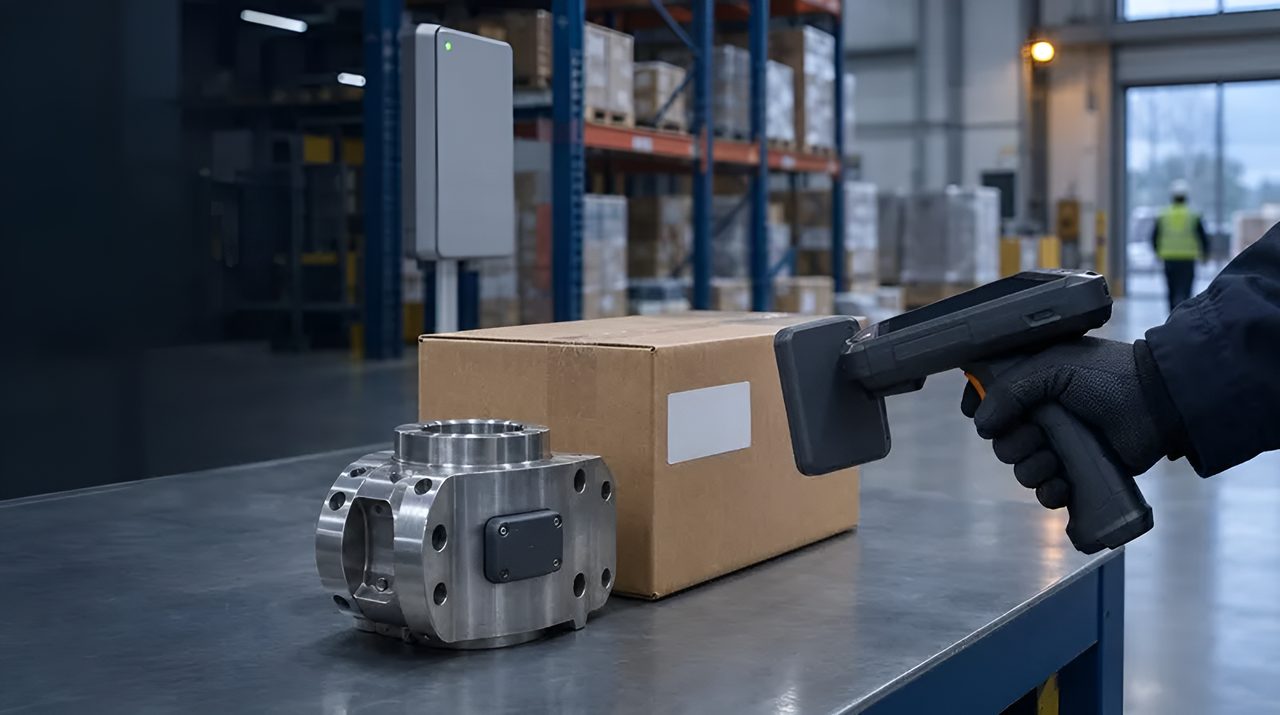
RFID : Mobile, fixe et RTLS - Explication.
RFID est la technologie derrière chaque déploiement moderne au niveau des articles de détail, la plupart des systèmes d’auto-identification à l’échelle des entrepôts, et une classe croissante de déploiements complets RTLS qui localisent les étiquettes passives en temps réel.
Les tags sont bon marché, passifs et lisibles par mille à l’heure, mais la manière dont vous déployez les lecteurs (mobile, portail fixe ou RTLS - grade) détermine le résultat commercial que vous obtenez réellement.
Voici l’explication au niveau opérateur de la façon dont RFID fonctionne dans les trois modes de déploiement, quand chacun l’emporte, et où les alternatives actives s’intègrent encore mieux.
La définition en 30 secondes
Le RFID d’entreprise moderne est dominé par RFID passif : le nom commercial pour le UHF passif RFID fonctionnant dans la bande 860-960 MHz, régi par la norme EPC Classe 1 Gen 2 (ISO 18000-63).
Rain signifie RAdio frequency IdentificatioN. La propriété définissante : les balises n’ont pas de batterie ; ils récoltent l’énergie de la RF transmise par le lecteur et l’utilisent pour alimenter leur réponse.
Ça fait des balises RAIN Pas cher (centimes pour euro selon le format), Fin et flexible (la plupart sont à base d’incrustations, intégrables dans les étiquettes et les emballages), et Essentiellement sans entretien sur des durées de déploiement sur plusieurs années.
HF RFID (13,56 MHz, NFC) et LF RFID (125 kHz) sont toujours utilisés dans le contrôle d’accès et le marquage animal, mais la conversation sur l’identification automatique des entreprises porte majoritairement sur l’UHF UHF.
Comment fonctionne réellement RFID
Un lecteur émet un signal RF dans la bande UHF.
À portée (généralement 1 à 10 m pour les appareils portables et fixes, plus longs avec des antennes directionnelles), les balises proches récupèrent l’énergie,
réveillent leur minuscule puce et diffusent en rétrodiffusion une réponse contenant leur EPC (Code de produit électronique) unique.
Le lecteur capte la rétrodiffusion, décode l’EPC et la transmet à la couche application.
Les lecteurs modernes peuvent exécuter des protocoles anti-collision qui lisent des milliers de balises en quelques secondes (lectures en masse),
et les puces de balises prennent en charge des fonctionnalités de sécurité (verrouillages mémoire, commandes d’arrêt, authentification cryptographique sur les puces plus récentes).
Le modèle de données est régi par les normes GS1 : SGTIN pour les articles sérialisés individuels, SSCC pour les unités d’expédition.
La même incrustation d’étiquette fonctionne sur les lectures mobiles, fixes et RTLS. La différence de déploiement repose entièrement sur le côté lecteur.
Mobile RFID : piloté par l’opérateur, point de travail
Mobile RFID met le lecteur entre les mains de l’opérateur. Terminaux portatifs (Zebra MC3300xR, MC9400, RFD90 ; Honeywell IH40 ; TSL 1128/2128 ; CAEN qIDmini) combinent un lecteur UHF avec un imageur de codes-barres et un ordinateur Android.
L’opérateur parcourt la zone ; Les balises à quelques mètres de l’antenne sont lues sur la détente.
Les cas d’utilisation sont profondément orientés par l’opérateur : comptages cycliques dans le magasin de détail, l’inventaire en magasin par les employés,
la réception de la vérification par rapport à un ASN au quai de chargement, les vérifications des outils avant et après un service, la rapprochement des retours.
Mobile RFID est le point d’entrée le moins cher vers RFID. Vous n’avez pas besoin de câbler d’infrastructure, vous achetez simplement des portables.
Le compromis est que rien ne se passe sans opérateur. La précision des stocks reste élevée uniquement si des comptages cycliques sont effectués ; La fraîcheur des données dépend du moment donné.
RFID fixe : toujours allumé aux points d’étranglement
Le RFID fixe les lecteurs à Points d’étranglement : des endroits où les objets balisés doivent passer pour faire leur travail.
Portails de portes de port (Impinj R700 / R420, Zebra FX9600, Alien ALR-F800) lisent les palettes et valises entrant ou sortant d’un entrepôt, déclenchées par des rideaux lumineux ou des capteurs de mouvement.
Étagère intelligente et meuble intelligent Les lecteurs maintiennent un inventaire continu d’articles de grande valeur ou contrôlés (outils calibrés, produits pharmaceutiques, stock de consignation hospitalière).
Convoyeurs et lecteurs de tunnel Vérifiez les cartons dans les lignes de tri. Stations d’encodage dans les lignes d’impression et d’application, les tags du programme sont à la source.
Le RFID fixe assure une réconciliation automatisée sans opérateur dans la boucle : réception contre ASN, expédition contre listes de retraite, retour d’actifs à la porte, prévention du FOD lors de l’entrée en salle blanche.
Le coût de déploiement est plus élevé que pour le mobile (câblage, antennes, montage) mais les données sont continues et non contestées.
RTLS -grade RFID : localisation en temps réel avec balises passives
RTLS -grade RFID est le mode de déploiement le plus récent et celui que la plupart des entreprises ignorent l’existence.
Au lieu de confirmer Présence à un point de lecture, il suit le Poste de plaques passives de pluie en temps réel sur des milliers de mètres carrés, en utilisant les mêmes incrustations bon marché.
Deux technologies dominent la catégorie. Zebra ATR7000 est un lecteur à réseau phasé monté au plafond avec une antenne de guidage de faisceau 30×30 ;
il balaie électroniquement la zone de lecture et indique le relèvement de l’étiquette ainsi que l’identification, de sorte qu’une grille clairsemée d’ATR7000 triangule la position à 1-3 m.
Commandes RF Les séries CS-445 / CS-9000 implémentent le suivi intelligent continu en intérieur (CISC) avec une direction 3D à travers des plafonds très larges,
offrant une précision inférieure à 2 m dans les entrepôts, hôpitaux et cours extérieures grâce à des balises passives de pluie.
Le scénario économique est spectaculaire : le RTLS de qualité RFID offre une position sans batteries à gérer, à une économie de tag 100× moins chère que la UWB. La précision dépend de votre site, et nous la confirmons lors de l’audit sur site.
Où chaque mode de déploiement l’emporte
Mobile RFID: comptage cyclique de la vente au détail, inventaire sur le magasin, réception de vérification, vérifications d’outils, retours, audits au point de travail.
Ça gagne lorsque les flux de travail des opérateurs sont déjà en place et que l’objectif est d’améliorer massivement leur débit.
Fixé RFID: réconciliation des portes d’avoi, armoires intelligentes, tri, encodage par impression et application, vérification automatisée de l’expédition, prévention de la FOD lors des entrées en zone contrôlée, agrégation de sérialisation pharmaceutique.
Les victoires lors du placement dans le point d’étranglement couvre les événements qui comptent.
RTLS -grade RFID: visibilité en cours d’entrepôt sur les balises passives, suivi des envois hospitaliers à travers les services, gestion extérieure des cours pour des milliers d’actifs retournables, inventaire militaire et aérospatial dans les hangars et magasins.
Gagne quand on a besoin d’un vrai poste en temps réel, mais l’économie du tag UWB ne correspond pas. La plupart des grandes entreprises gèrent les trois à différents endroits de l’exploitation.
RFID versus les alternatives
RFID vs UWB: différentes catégories au niveau présence vs position, mais le grade RTLS réduit significativement l’écart. L’UWB est généralement l’option la plus précise. La précision obtenue dépend de votre site, et nous la confirmons lors de l’audit sur site.
La plupart des entreprises utilisent les deux. RFID vs RFID actif (433 MHz): le RFID actif a une plus grande autonomie et une transmission alimentée par batterie, mais les balises coûtent 100 × plus cher et la gestion de la batterie est un vrai surchargement.
Active RFID a perdu la majeure partie de la part d’entreprise au profit de RAIN + UWB au cours de la dernière décennie. Suivi des actifs RFID vs BLE: BLE est aussi actif, cas d’usage différents.
RFID vs code-barres 2D: Le code-barres est en ligne de vue, un à la fois. RFID est en lecture en bloc, sans ligne de vue. De nombreux déploiements utilisent les deux (code-barres pour la vérification des unités, RFID pour les comptages agrégés).
Limitations réalistes
La physique RF impose de réelles contraintes à travers les trois modes. Métal et liquide: Les balises non traitées peinent sur des contenants métalliques ou remplis de liquide.
Des incrustations spécialisées sur métal existent mais coûtent plus cher et nécessitent un placement soigneusement.
pour une vérification critique, vous complétez des étapes de confirmation (re-scanner à main portée, code-barres 2D).
La portée n’est pas illimitée: la portée de lecture pratique est de 1 à 10 m ; Les distances plus longues nécessitent des antennes directionnelles et ne sont pas polyvalentes. La précision de grade RTLS est bornée: 1-3 m, pas centimètres.
Si vous avez besoin de sous-mètres, UWB ou BLE-AoA.
La vie privée dans les contextes commerciaux: les consommateurs qui sortent avec des produits tagués peuvent théoriquement être lus ; La pratique moderne utilise des ordres d’arrêt ou la désactivation des balises au point de vente pour traiter ce problème.
Paysage des fournisseurs et des écosystèmes
Quatre couches. Silicium: Impinj (puces de la série M) et NXP (puces UCODE) sont les principaux fournisseurs de silicium RAIN ; De nombreux nouveaux entrants existent.
Incrustations et tags: Avery Dennison Smartrac est de loin le plus grand fabricant d’incrustations, avec de nombreux autres fabricants de marques propres à Confidex, Beontag, HID et OEM en marque de distributeur.
Lecteurs mobiles et fixes: Impinj, Zebra, Honeywell, Alien Technology et CAEN RFID dominent, avec une intégration de l’informatique mobile via Zebra et Honeywell.
RTLS -grade RFID: Zebra ATR7000 réseau phasé ; Contrôles RF CS-445 / CS-9000 avec direction par faisceau CISC ; des acteurs plus petits comme Mojix dans la catégorie plus large RTLS -from-rain.
Quais: Mojix, Avery’s atma.io, Impinj Authenticity, Zebra MotionWorks, ainsi que l’intégration dans WMS / MES via des partenaires SI. Gouvernance des normes : GS1, EPCglobal et l’Alliance Passive RFID.
Où TRACIO recommande RFID et quel mode
Des cas d’utilisation nécessitant une présence et un nombre d’agrégats à grande échelle, où les tags individuels doivent être peu coûteux et sans entretien.
Par défaut, nous Mobile RFID pour le comptage cyclique et les flux de travail opérateurs, Fixé RFID Pour la réconciliation des points d’étranglement, les portes d’accueil, les armoires intelligentes et la sérialisation pharmaceutique,
et RTLS -grade RFID (ATR7000, commandes RF) lorsque la position en temps réel est requise mais que l’économie des balises UWB ne correspond pas : visibilité en cours à l’échelle de l’entrepôt, stock de consignation hospitalière, dépôts d’actifs retournables.
Nous ne recommandons pas le RFID pour le suivi de position en temps réel en submètre (UWB ou BLE-AoA convient mieux),
pour le suivi extérieur longue portée de véhicules en mouvement (GNSS), ni pour les cas d’utilisation où la détection active alimentée par batterie apporte de la valeur (RFID ou BLE actif).
Lectures associées.
Questions fréquemment posées
Mobile, fixe ou RTLS de qualité RFID : comment choisissons-nous ?
Mobile si le flux de travail est piloté par l’opérateur et intermittent (comptages cycliques, réception, retours). Corrigé si les éléments passent des points d’étranglement naturels (portes de quai, tri, armoires, stations d’encodage).
RTLS -grade (ATR7000, RF Controls) si vous avez besoin d’une position en temps réel continue sur des tags passifs sur une zone plus large. Nous dimensionnons le mélange des modes à l’étape 1 : la plupart des entreprises finissent avec deux ou trois modes superposés.
Combien coûte une étiquette RFID?
Les incrustations standard pour les vêtements ou les magasins coûtent généralement 3 à 10 cents à l’échelle de l’échelle. Les plaques industrielles sur métal et robustes coûtent 50 cents contre quelques euros.
Les formats industriels durcis ou scellés (palettes, contenants retournables) peuvent atteindre 5 à 20 euros. L’économie des tags, que ce soit au niveau de l’article, du cas ou du niveau palette, est la bonne granularité.
Quelle est la précision du RTLS de qualité RFID : ATR7000, contrôles RF ?
Typiquement de 1 à 3 m au 95e percentile avec le ATR7000 réseau phasé ; Le CISC des contrôles RF rapporte des plafonds très larges en dessous de 2 m.
La précision dépend fortement du site : hauteur du plafond, densité, teneur en métal. La validation pilote à charge de production est la porte 2 de la méthode du programme TRACIO pour tout déploiement RTLS.
RFID ou code-barres 2D pour la traçabilité ?
Souvent les deux. Code-barres pour la vérification unité par unité au niveau de l’opérateur ; RFID pour des lectures agrégées à haut débit.
La plupart des programmes de sérialisation modernes (DSCSA pharma, IATF 16949 automobile, AS9100 aérospatiale) portent les deux encodés sur le même article.
Les balises RFID peuvent-elles être reprogrammées sur le terrain ?
Oui, la Gen 2 prend en charge les opérations d’écriture sur la mémoire utilisateur et les champs EPC.
La plupart des déploiements dans la vente au détail et la chaîne d’approvisionnement programment l’EPC à la source et le verrouillent ; Certains cas d’usage industriels réécrivent la mémoire des tags aux étapes du processus.
Le RFID a-t-il besoin d’une connectivité cellulaire ou Wi-Fi ?
Les lecteurs ont besoin d’une connectivité réseau pour transférer les lectures vers la couche application, généralement Ethernet (PoE pour les appareils fixes et de qualité RTLS) ou Wi-Fi (pour les portables mobiles).
Les tags eux-mêmes ne sont liés à rien ; Ils ne répondent qu’aux lecteurs. C’est l’avantage structurel par rapport aux RFID et BLE actifs.
Comment RFID s’intègre-t-il à notre plateforme WMS / ERP / sérialisation ?
Via le middleware du lecteur (Impinj ItemSense, Zebra MotionWorks, Honeywell ITC, RF Controls CISC platform, ainsi que des plateformes partenaires) dans votre WMS / ERP via des API standard.
Pour la sérialisation pharmaceutique, dans les dépôts EPCIS. Nous concevons une architecture d’intégration durant la première étape, voir Intégrations RTLS & IoT.
Dernière mise à jour: