
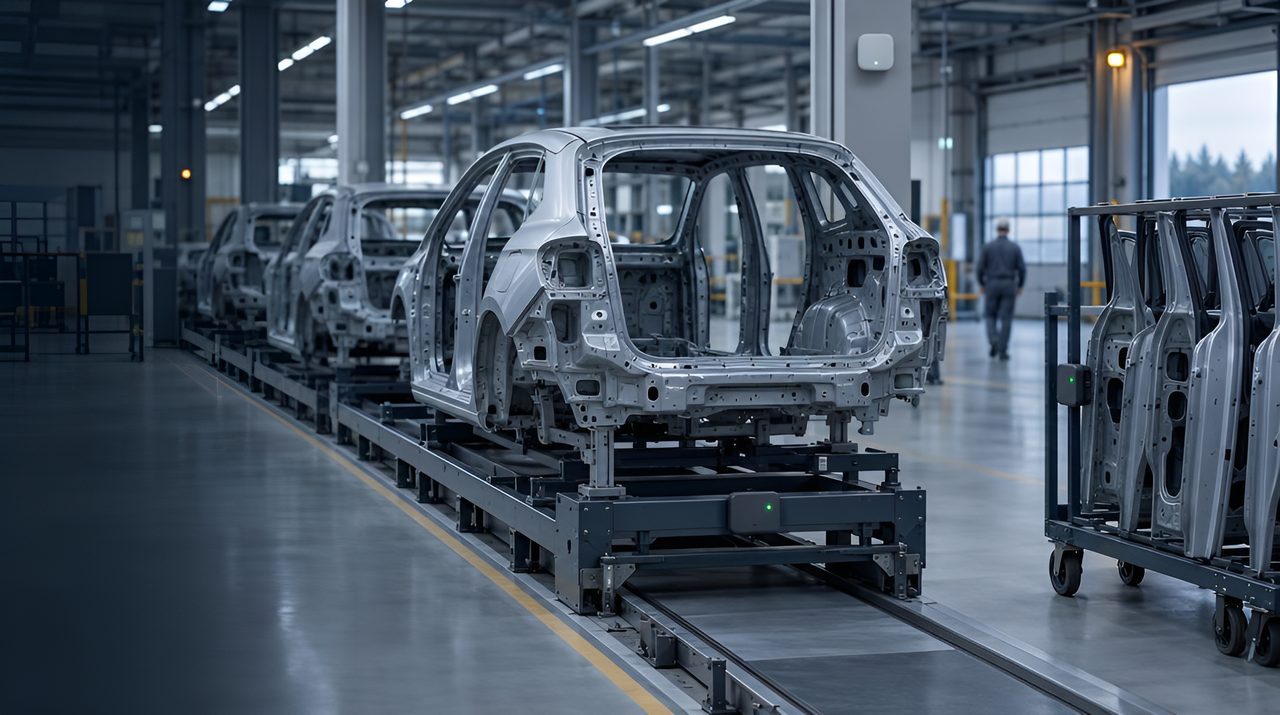
Automotive WIP tracking: what production-grade actually looks like.Automotive WIP tracking that fails at line speed?
Automotive WIP tracking is where UWB earns its premium and where the install economics decide whether the programme pays back.
80 anchors over a 5,000 m² body-shop is the supplier reference design. 40-50 is what holds the KPI when properly audited. Hardware prices come from supplier quotes in the survey.
Free 30-minute call with an adviser · written proposal with the price after · fixed-scope engagements from £3k.
Why automotive WIP is the hardest UWB design problem.
Body shops generate the worst multipath conditions in industrial RTLS.
Large flat metal surfaces (vehicle bodies, press tooling, stillage), stainless production guarding, concrete-aggregate floors, overhead conveyor and dynamic metal movement through the cycle: every one of them creates RF reflections.
The supplier reference design absorbs this by adding anchors. Independent design absorbs it by geometric offset.
UWB is usually the most precise of these options. The accuracy you get depends on your site, and we confirm it in the survey. The design that gets there is anchor-count-disciplined, height-verified, multipath-aware and acceptance-tested at the press cycle peak.
The KPI stack that decides ROI.
Below 95% WIP location accuracy, the OEE uplift evaporates.
Sequence integrity: for JIS lines, every torque event, every fitment, every off-line repair tagged to VIN. IATF 16949 audit-grade.
Mis-build rate: measure your own baseline first; RTLS-tied traceability is there to drive it down.
OEE points captured: measured against your own baseline at six months after go-live.
The technology stack we recommend most often.
UWB is usually the most precise of these options. The accuracy you get depends on your site, and we confirm it in the survey.
Passive RFID at portals for cross-line, stillage and dock-door reads (Impinj, Zebra fixed readers).
BLE-AoA in support zones (paint, sub-assembly) where UWB density would be excessive.
Integration: SAP MII, Rockwell FactoryTalk, Siemens Opcenter, or your in-house MES, the event stream feeds existing andon, downtime tracking and quality genealogy.
Where the cost actually lives.
Hardware prices come from supplier quotes in the survey.
Hardware prices come from supplier quotes in the survey.
Integration into MES: often one of the largest cost lines. The line item that decides whether adoption actually sticks.
An independent audit of the supplier's design (part of our install service) often cuts the install bill on each site, and the saving repeats across a multi-site rollout.
Who sells automotive WIP tracking and what body-shop programmes get wrong.
UWB RTLS suppliers (Sewio, Ubisense, Litum, Pozyx and peers), Passive RFID SI packages, and MES analytics overlays all compete for WIP visibility budgets. Body and paint shops are hostile RF environments (metal, movers, pits), so glossy warehouse demos transfer poorly. Hybrid designs win: Passive RFID at docks and line gates for cheap presence events; UWB where continuous in-flight position drives andon, sequencing or buffer control.
What programmes get wrong: UWB-blanket coverage when portals would have paid back faster; ignoring vehicle/carrier identity that must survive paint and weld; measuring localisation centimetres instead of dwell, starve and rework loops; and letting an AMR supplier redefine WIP tracking as robot fleet monitoring.
We remain independent and sell no radios or robots. Design centres on the KPI stack (dwell, buffer health, sequence integrity), RF survey under live production, and MES event contracts. See JIS when sequence is the dominant job.
What body and paint WIP locating must survive on a live line.
Automotive WIP is a hostile RF and process environment: moving metal, pits, carriers through paint, and shift patterns that change sightlines hourly. Designs copied from tidy warehouses fail. Start from the KPI stack (dwell by station, buffer health, rework loops, starve risk), then place Passive RFID at gates and UWB only where continuous position changes a decision.
Carrier and body identity must persist through processes that destroy ordinary tags. Mounting, shielding and process-tolerant encoding are engineering problems, not purchasing afterthoughts. MES integration should drive andon and sequencing logic from validated events. A parallel RTLS dashboard operators ignore is waste. Live-shift RF surveys across paint, body and assembly catch multipath the empty-bay survey never sees.
AMR and AGV programmes should consume the same WIP truth layer. Buying robots to compensate for missing inventory truth usually produces expensive choreography on bad data. We advise and integrate. We don't sell hardware, so our advice stays independent. Change control when lines rebalance is mandatory: yesterday’s anchor map is today’s accuracy regression.
Acceptance: KPI movement on dwell and starve measures, sustained identity continuity through the worst process step in scope, and a re-validation ritual after every major layout change.
WIP tracking in high-volume automotive plants.
High-volume OEM and Tier-1 plants (BMW, Volkswagen, Toyota, Jaguar Land Rover, Stellantis and peers) commonly combine portal RFID with selective UWB for WIP and tugger flow. The guidance below is how those market programmes are usually scoped, not a client list.
Frequently asked questions
Why is UWB the standard for automotive WIP?
The accuracy depends on your site, and we confirm it in the survey. Passive RFID gives presence not position.
Can we mix UWB and Passive RFID in the same line?
Yes, this is the recommended hybrid stack. UWB for live WIP position, Passive RFID at portals for cross-line reads and stillage tracking. Integration handles the event-stream merge into MES.
Which UWB supplier is best for automotive WIP?
Sewio, Ubisense, Pozyx all deliver production-grade UWB at the required accuracy. The choice is decided by integration architecture, supplier support model in your region, and commercial fairness of the SLA, not RF chipset.
What does an independent design audit save on a typical automotive WIP programme?
It depends on the supplier’s design. An independent audit often cuts the anchor count and the install bill on each site, and saves programme time by catching design problems before installer mobilisation. The saving repeats across a multi-site rollout.
Last updated: