
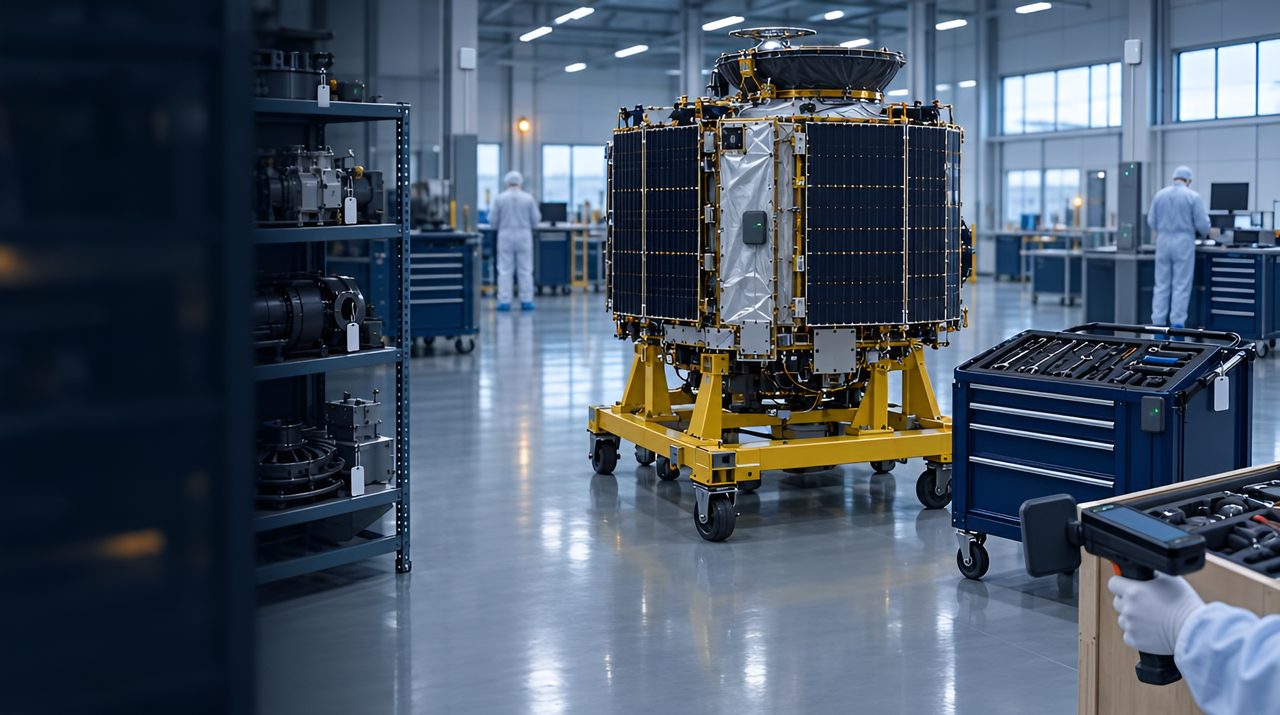
Space and satellite: tool control, traceability and tracking for satellite builders and AIT sites.Tool control and traceability gaps in satellite AIT?
Independent advice for the people who build and test spacecraft: every tool accounted for before a panel is closed, every serialised part traceable from goods-in to the as-built record, and GSE you can find without walking the building. We choose the technology for each job, check it against your cleanroom and ESD rules, and specify how it connects to the systems you already run. We don't sell hardware, so our advice stays independent.
Free 30-minute call with an adviser · written proposal with the price after · fixed-scope engagements from £3k.
Independent.
How are RFID and RTLS used in satellite production and AIT?
Most of the value sits in four jobs. Proving every tool is back on its board before a close-out. Carrying the identity and history of serialised parts so the build record matches the hardware. Knowing where GSE, test equipment and transport containers are, and whether they are in date. And moving kits and parts to the line without someone walking them there. Passive RFID handles most of the counting. Real-time locating (RTLS) earns its place where live position matters, such as GSE across a large hall. In a cleanroom, though, the technology question comes second. First you need to know what your contamination control plan, your ESD programme and your test rules allow in the room.
This page covers satellite and smallsat builders, constellation production lines, subsystem and component suppliers, and AIT sites and test houses.
Why an integration hall is its own problem
A missing tool stops the job. On a factory floor, a lost spanner is a nuisance. Next to flight hardware, an unaccounted tool means the panel stays open until someone can show it is not inside the spacecraft. That can mean an inspection, a non-conformance and a test slot that moves. A loose item that would sit still on a bench can move under launch vibration, and nobody can fetch it once the spacecraft is in orbit.
The room has rules. Cleanrooms limit what materials come in, how things are cleaned and what sheds particles. ESD protected areas limit insulators near sensitive hardware. Some sites limit radio devices near powered hardware during test. A tracking system has to fit inside all three.
Production is changing. Constellation and smallsat programmes build many units rather than one, so habits that worked for a single spacecraft built by a small team (a clipboard, a shadow board and a good memory) get stretched across shifts, lines and sites.
Custody crosses company lines. Parts and assemblies move between suppliers, your stores, test houses and launch sites. Each handover is a point where the record and the hardware can drift apart.
Space use cases and the technology that fits each
| Use case | What good looks like | Usual technology | Integrate with |
|---|---|---|---|
| Tool control and FOD prevention | Each tool issued to a person and a task; the board or kit is complete before close-out; a missing item is flagged while the panel is still open | Passive RFID at the tool board, crib or kit; 2D codes where radio is not allowed; RTLS only where live location is needed | Work instructions, FOD process, QMS |
| Serialised parts and chain of custody | Every serialised part read at goods-in, kitting, integration and dispatch, with parent and child links kept | Passive RFID or 2D codes on parts, bags or carriers, read at fixed points and by handheld | ERP, MES, QMS, PLM |
| GSE and test equipment | Dollies, rotation stands, lifting gear, EGSE racks and test adapters found without a search, with inspection and calibration dates enforced | Passive RFID for check-in and check-out; BLE or UWB RTLS for large items across halls | EAM or CMMS, calibration records |
| Transport containers and shipments | Containers and their contents accounted for between your site, test houses and launch sites | Passive RFID or 2D codes at dispatch and receipt; GNSS trackers on containers where the route needs it | ERP, WMS, logistics records |
| Protective covers and remove-before-flight items | Every cover and temporary item recorded on and recorded off | Passive RFID or 2D codes, read at fit and removal | Build record, close-out checklist |
| Kit and part flow to the line | Kits arrive at the airlock when the build step needs them | AMR or AGV between stores and airlock; RFID confirms the delivery | WMS or SAP EWM, MES |
Five use cases in satellite assembly, integration and test
Tools counted before close-out
Every tool issue in the FOD controlled area recorded, with open issues listed before a panel is closed. Supports your close-out inspection. Tool control
Serialised parts and the as-built record
Each serialised part identified at goods in and linked to the unit it goes into, so the as-built record is built as the work happens. Serialisation and custody
Covers and protective items on and off
Dust covers, caps and remove-before-flight items recorded when fitted and removed, with the list still fitted ready before each step. Tool control
GSE and test equipment in known configuration
Shared carts, fixtures and test sets found, in date, and flagged for a check if another team used them since the last one. Asset tracking
Shelf-life materials in date
Adhesives, tapes and other limited-life materials flagged before issue, with re-certification and disposal recorded. Inventory accuracy
Tool control and FOD prevention in cleanrooms and integration halls
A shadow board tells you a slot is empty. It does not tell you who took the tool, when, for which task, or whether it came back before the panel was closed. That is the gap a tool-control system should close.
What a good set-up records:
- who took each tool, against which task or work order, and when it came back;
- that the board, kit or crib is complete before a close-out, not just at the end of the shift;
- calibration status, so an out-of-date torque tool cannot be issued;
- consumables and small items (wipes, tape, caps, fasteners) that your FOD process says must be counted;
- what happens when a read fails, so the system shows "unknown" rather than "present" when it cannot see a tool.
A sensible starting point is often passive RFID at the board, cabinet or kit, because it counts many items at once with no battery on the tool. Live location (RTLS) is worth adding where tools leave the board for long periods in a large hall. Where radio is not welcome near powered hardware, 2D codes and a scan at issue and return can do the job. We test the choice on your tools, your board and your close-out process, not in a demo room.
Read next: Tool control · Aerospace FOD prevention
Serialised parts traceability and chain of custody for AS9100
AS9100 quality systems expect identification and traceability where they are required, control of production tooling and the prevention of foreign objects. Your customers and programme requirements usually add their own. A tag or a code only helps if each read becomes a record your quality team can stand behind at audit.
What we design for:
- every serialised part read at goods-in, bonded or quarantine stores, kitting, integration and dispatch;
- parent and child links kept, so the unit, its sub-assemblies and its harnesses stay tied together;
- non-conforming and quarantined items blocked from issue until they are released;
- custody handovers between suppliers, your stores, test houses and the launch site, with who, what, where and when on each one;
- an as-built record and data pack that match what is physically on the spacecraft;
- exception handling for damaged tags, unreadable codes and re-labelled parts, with an owner for each.
We map this against your QMS and ERP before anyone picks a tag. On controlled programmes, we work within your export-control process.
Read next: Serialisation and chain of custody · AS9100 locating and RFID · Quality traceability
Tracking tools, GSE and assets through AIT
AIT is where expensive equipment moves the most: from the integration hall to vibration, thermal vacuum and EMC test, then into a container for the launch site. Things go missing in the gaps between those steps.
What is worth tracking:
- MGSE such as dollies, rotation stands, lifting gear and slings, with inspection dates enforced;
- EGSE racks, test adapters and harnesses that travel with the hardware between test facilities;
- calibrated tools and instruments, linked to their calibration records;
- transport containers and what is packed in them;
- protective covers and remove-before-flight items, from fit to removal.
Passive RFID at doors, airlocks and stores often covers most of this. BLE or UWB RTLS adds live location for large items in big halls. GNSS trackers can follow containers on the road. We size each by area and by process, not one choice for the whole site.
Read next: Asset tracking · Choosing a locating technology
RFID and RTLS in a cleanroom: what to check before you trial
This is where space differs most from other sites. Before a system is trialled near flight hardware, these questions need answers from your own contamination control, ESD and test owners. We help you ask them and test the answers; we do not overrule your specialists.
Materials and outgassing. Tags are made of an inlay, face stock, adhesive and sometimes a potting or housing. If a tag will go on flight hardware or GSE that enters a thermal vacuum chamber, ask for outgassing screening data to the test method your programme uses, and check it against your approved materials list. If there is no data, treat it as not approved until your materials engineer says otherwise. Often the simplest answer is to keep tags off the spacecraft altogether: on the tool, the case, the bag or the GSE instead.
Particles and cleaning. Tags and holders should survive your wipe-down routine and cleaning agents without shedding, cracking or lifting at the edges. Test them with your wipes, your solvent and your gloves.
ESD. Most tags and reader housings are plastic, which counts as an insulator in an ESD protected area. Your ESD control plan decides how process-required insulators are handled near sensitive hardware. Ask whether a tag is static dissipative or insulating, how it behaves when peeled or wiped, and whether it can be kept away from unprotected hardware. Your ESD coordinator signs this off, not the tag supplier.
Radio near powered hardware. Some sites set keep-out distances for radio devices, RFID readers included, around powered sensitive hardware. Find out your site's rule before designing read points. Fixed readers should be easy to switch off, schedule or move for sensitive tests, and the system should cope with that.
Batteries. RTLS tags carry batteries. Check your site rules on batteries and charging in the cleanroom, and how tags are cleaned when they are swapped.
Fallback. Where radio is not allowed, 2D codes read by a scanner at issue and return can still give you a reliable record.
| Choice | Where it tends to fit in space work | What to check in a cleanroom |
|---|---|---|
| Passive UHF RFID | Tool boards, cribs, kits, stores, airlocks, containers | Tag materials, outgassing data, cleaning, reader placement and keep-out rules |
| HF or NFC RFID | Close reads at a bench or issue point | Same materials checks; short range helps where radio is restricted |
| BLE or UWB RTLS | Live location of GSE and large assets in halls and stores | Batteries, infrastructure on walls and ceilings, keep-out rules during test |
| 2D codes | Parts, bags and tools where radio is not allowed | Label and ink materials, mark durability, scan discipline |
Read next: RFID tag types · UWB vs RFID · RF site survey checklist
AMRs and AGVs for production intralogistics
As build rates rise, people spend more time walking kits, parts and consumables between stores, kitting areas and the cleanroom airlock. Mobile robots can take some of that work. The questions in a space plant are a little different from a warehouse:
- where the robot stops: handing over at the airlock keeps the robot out of the cleanroom altogether;
- if a robot does go inside, what it sheds, how it is cleaned and charged, and how it fits your ESD rules;
- whether fixed routes (AGV) or free navigation (AMR) suit your layout and how often it changes;
- safety in shared aisles, against ISO 3691-4 and your own risk assessment;
- how robot tasks connect to your WMS, MES or SAP EWM, so a delivery is booked when it happens;
- whether you might run more than one robot brand later, which is where VDA 5050 comes in.
We help you decide whether robots fit at all, then specify, select and test them against your flows.
Read next: AMR and AGV advisory · AGV vs AMR · VDA 5050 consulting
SAP EWM and WMS integration
Tracking data only pays off when it lands in the systems people already use. For space manufacturing that usually means serial numbers, batches, handling units, stock types such as quarantine or blocked stock, and storage bins in SAP EWM or another WMS, plus the ERP, MES and QMS around it.
What we specify:
- which reads become transactions (a part entering quarantine, a kit leaving stores, a tool returned) and which stay as raw location data;
- filtering at the edge, so the WMS gets state changes, not a flood of position updates;
- master data: how tag IDs map to material, serial and batch numbers, and who owns that mapping;
- reconciliation, so orphan reads and missing scans are found and fixed rather than ignored;
- acceptance tests for the interface, agreed before the pilot starts.
We design the integration and test it in the pilot. Your SAP partner or WMS team usually builds it.
Read next: SAP EWM integration · MES integration · All integrations
Standards and requirements we design to
| Standard or requirement | What it means for your programme |
|---|---|
| AS9100D | Quality system expectations for identification and traceability, control of tooling and prevention of foreign objects. The tracking record becomes audit evidence, so retention and exception handling are designed in. |
| AS9146 | FOD prevention programme requirements for aviation, space and defence organisations, where your customer invokes it. Tool, consumable and personal-item accountability are part of it. |
| ISO 14644-1 | Cleanroom classification by airborne particles. Your room class and procedures set what tracking hardware is allowed in and how it is cleaned. |
| ECSS-Q-ST-70-01 | Cleanliness and contamination control for space products, including ground equipment that touches flight hardware. Relevant where your programme follows ECSS. |
| ECSS-Q-ST-70-02 and ASTM E595 | Outgassing screening tests for materials. Relevant to any tag, label or adhesive that may go near a thermal vacuum chamber. |
| ANSI/ESD S20.20 and IEC 61340-5-1 | ESD control programme requirements, including how insulators near sensitive hardware are handled. Relevant to tags, labels and reader housings. |
| ISO 3691-4 | Safety requirements for driverless industrial trucks. Relevant to AGV and AMR projects. |
| Your customer and programme requirements | These usually add to or tighten all of the above. We read them first. |
How we run a space programme
Every stage has a gate where you can stop and keep what we have produced.
- Discovery and scoping. Walk the stores, kitting areas, cleanroom and test areas with your team. Agree the problem worth solving and how you will measure it.
- Site rules and materials review. Collect your contamination control, ESD and radio rules before choosing technology, so nothing is trialled that the room cannot accept.
- Supplier selection. An independent shortlist with scripted demonstrations on your tools, your parts and your systems.
- Pilot on rented equipment. One board, one kit or one store, run on rented equipment against written pass/fail criteria agreed before it starts.
- Rollout support. Integration testing, training and a data-quality check after go-live.
Fees are scoped per project, £3k to £30k per project, and confirmed in writing before work starts. We work worldwide.
Read next: Pricing · Supplier selection · Pilot success criteria
What we don't do
- We don't sell hardware or take commissions from vendors.
- We don't approve materials, ESD controls or cleanroom procedures. Your specialists do. We give them the evidence to decide.
- We don't act as the integrator of record. We specify, check and accept that work on your behalf.
Frequently asked questions
Can RFID tags be used in a spacecraft cleanroom?
Often, yes, but your contamination control, ESD and test owners decide. Check the tag materials and any outgassing data, how tags stand up to cleaning, whether they are insulating or dissipative, and your site's rules on radio near powered hardware. We test those points on your materials before anything is bought.
Do we need RTLS, or is RFID enough for tool control?
For tool boards, cribs and kits, passive RFID at issue and return is usually enough to show every tool came back. RTLS adds live location, which helps when tools or GSE spend long periods away from their home in a large hall. We decide area by area, not for the whole site.
Can this work with SAP EWM or the WMS we already run?
Yes, that is normally the aim. We define which reads become transactions, how tag IDs map to serial and batch numbers, and how the interface is tested. Your SAP partner or WMS team usually builds it.
Do you sell tags, readers, tool boards or robots?
No. We write the requirements, run the selection and the pilot, and hold suppliers to the pass/fail criteria.
What does an engagement cost?
Fees agreed in writing after scoping of £3k to £30k per project, depending on scope. Start with a free 30-minute call. If there is a fit, you get a written proposal with the price.
Also covered in space
Last updated: